
- Catalogs
- ZWICK GMBH & CO. KG
- roboTest P

roboTest P

roboTest P
Overview
The 'roboTest P' is a robotic testing system designed for fully automatic tensile testing of metallic specimens, compliant with standards such as DIN EN 10002-1, ISO 6892, ASTM E8, and JIS Z2201. It can also perform additional tests like hardness and roughness measurements.
System Configuration
- Materials testing machine with capacities ranging from 5 kN to 2000 kN, featuring pneumatic or hydraulic grips and optional extensometer.
- Specimen magazine with a capacity of up to 400 specimens, depending on dimensions.
- Robotic feeding system 'roboTest P'.
- Optional barcode scanner and cross-section measuring device.
- Industry Controller with test software testXpert® and automation software autoEdition2.
Advantages
- High reproducibility of test results by eliminating operator influence.
- Increased utilization during idle times, leading to quicker results.
- Modular system allows economical adaptation to customer needs.
- Reduces testing costs per specimen, with a typical payback period of one to two years.
- State-of-the-art web technologies enable constant process control and remote diagnostics.
- Automatic data logging ensures secure documentation and statistical monitoring.
- Maintenance-free components designed for three-shift operation.
Technical Data
- Electrical connection: 230/400 V, up to 80 kVA.
- Mains frequency: 50/60 Hz.
- Compressed air: 6 bar, from 10 lpm.
Specimen Specifications
- Types: dumbbells, stripes, round specimens.
- Max weight: 30 kg; Max length: 500 mm.
- Max shoulder width (flat): 50 mm; Max diameter (round): 20 mm; Max thickness: 80 mm.
Options
- Specimen identification via barcode.
- Cross-section, coat thickness, roughness, and hardness measuring.
- Spectrum analysis and scale.
- Specimen removal and good/bad sorting.
- Data exchange with superior systems via ASCII-files or ODBC.
- Optical status indicator with a threefold traffic light system.
Test Sequence
The user fills the specimen magazine either directly on the system or externally, even during operation. Specimen data can be entered on a PC, or omitted if using barcode operation. The system automatically handles specimen feeding, testing, and removal, with the order of testing controlled by the operator. Good/bad sorting is possible with appropriate inputs.
Catalog excerpts

Zwick Materials Testing Product Information Robotic Testing System ‘roboTest Application The robotic testing system is used for the fully automatic performance of tensile tests on metallic specimens (e.g. according to DIN EN 10002-1, ISO 6892, ASTM E8, JIS Z2201). Additional tests like hardness or roughness measuring can be carried out, too. System Configuration • Materials testing machine 5 kN up to 2000 kN with symmetrically closing, pneumatic or hydraulic specimen grips and an optional extensometer • Specimen magazine for up to 400 specimens (depends on specimen dimensions) • Robotic feeding system ‘roboTest P' • Barcode scanner (optional) • Cross-section measuring device (optional) • Other devices (see options) • Industry Controller with test software testXpert ® and automation software autoEdition2 P' (Portal) for Metals Advantages of the Robotic Testing System ‘roboTest P’ • A high reproducibility of the test results is obtained because operator influences are excluded (hand temperature, moist hands, eccentric or inclined insertion of specimens etc.). • Qualified laboratory staff is relieved of routine jobs and is thus available for more complex activities. • The machine can be used during idle times (break, night shift) and thus increases the rate of utilization and allows „quicker“ results. • For increasing the specimen throughput several materials testing machines can be integrated. • The modular system makes an economical adaptation to specific customer requirements possible. • The system reduces the testing costs per specimen and usually pays off within one to two years. • For manual tests the specimen gripper can be moved to the side, allowing operator free access to materials testing machine. • Due to the precise centering of the specimen in the cross-section measuring device and the automation of the measuring sensors, the specimen dimensions can be exactly measured. • The usage of state-of-the-art web-technologies ensures a constant process control and remote diagnostics of the robotic testing system. Results as well as status messages can be sent directly per email or SMS. • The automatic data logging system ensures secure documentation and enables statistical long-term monitoring (Statistical Process Control). • The components of the robotic testing system are not subject to wear; they are maintenance-free and designed for three-shift operation.
Open the catalog to page 1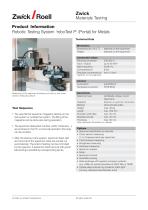
Zwick Materials Testing Zw/ck / RoellProduct Information Robotic Testing System ‘roboTest P’ (Portal) for Metals Measuring of the specimen thickness and with by the crosssection measuring device Test Sequence • The user fills the specimen magazine directly on the test system or outside the system. The filling of the magazine can be done also during operation. • The specimen data (ident number, width, thickness,...) are entered on the PC. In barcode operation this step can be omitted. • After the startup of the system, specimen feed, test and removal of the specimen rests are carried out automatically....
Open the catalog to page 2All ZWICK GMBH & CO. KG catalogs and technical brochures
 HC Series
2 Pages
 HB series
3 Pages
 Vibrophore 1000
3 Pages
 Vibrophore 250
3 Pages
 Vibrophore 100
3 Pages
 Vibrophore 50
3 Pages
 Vibrophore 25
3 Pages
 LTM
LTM5 Pages
 roboTest A
2 Pages
 roboTest B
2 Pages
 roboTest I
2 Pages
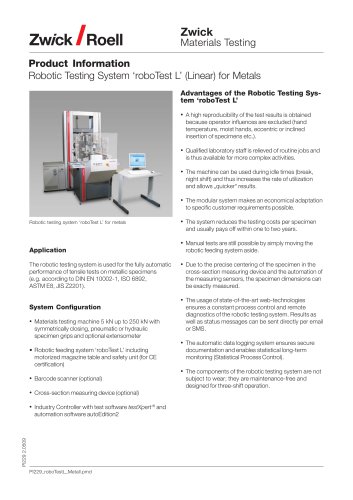 roboTest L FOR METALS
2 Pages
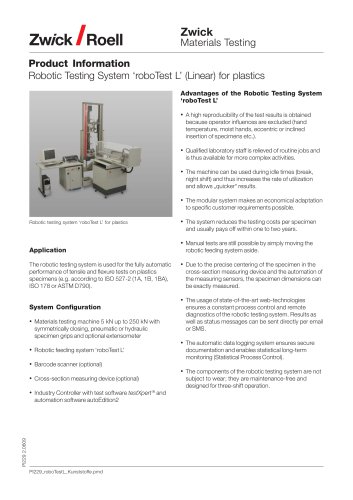 roboTest L FOR PLASTICS
2 Pages
 roboTest L FOR ELASTOMERS
2 Pages
 H-series
2 Pages
 Z330E
Z330E3 Pages
 Materials testing
2 Pages
 HDT/Vicat Standard
4 Pages
 Testing of Plastics and Rubber
56 Pages
 Vicat Dry
2 Pages




- Aeronautical testing machine
- Material testing machine
- Automatic testing machine
- Vertical testing machine
- Fatigue testing machine
- Hydraulic testing machine
- Compression testing machine
- Tensile strength testing machine
- Horizontal testing machine
- Temperature testing machine
- Electric testing machine
- Pneumatic testing machine
- Bending testing machine
- Tension testing machine
- Manual testing machine
- Mechanical testing machine
- Electronic material testing machine
- Avionic system testing machine
- Gear testing machine