
- Catalogs
- WESTERN SUPERCONDUCTING TECHNOLOGIES CO LTD
- Ti-6Al-2Sn-4Zr-2Mo

Ti-6Al-2Sn-4Zr-2Mo

1 / 2 PagesView full catalog
Ti-6Al-2Sn-4Zr-2Mo
Product catalog summary
Chemical Composition
Table 1 outlines the chemical composition of the Ti-6Al-2Sn-4Zr-2Mo alloy. The primary elements include Titanium (balance), Aluminum (5.50-6.50%), Tin (1.80-2.20%), Zirconium (3.60-4.40%), and Molybdenum (1.80-2.20%). Other elements such as Silicon, Iron, Oxygen, Nitrogen, Carbon, Hydrogen, and Yttrium are present in minimal amounts, with specific limits for each.
Table 1 outlines the chemical composition of the Ti-6Al-2Sn-4Zr-2Mo alloy. The primary elements include Titanium (balance), Aluminum (5.50-6.50%), Tin (1.80-2.20%), Zirconium (3.60-4.40%), and Molybdenum (1.80-2.20%). Other elements such as Silicon, Iron, Oxygen, Nitrogen, Carbon, Hydrogen, and Yttrium are present in minimal amounts, with specific limits for each.
Mechanical Properties
Table 2 provides the mechanical properties of the alloy according to AMS 4976H-2012 standards. At room temperature, the tensile strength (σb) is ≥896 MPa, yield strength (σ0.2) is ≥827 MPa, elongation (A) is ≥10%, and reduction of area (Z) is ≥25%. At 482℃, these values are ≥621 MPa, ≥483 MPa, ≥15%, and ≥30% respectively. The alloy exhibits high creep resistance at 510℃ for 35 hours under 241 MPa with a deformation of ≤0.10%.
Table 2 provides the mechanical properties of the alloy according to AMS 4976H-2012 standards. At room temperature, the tensile strength (σb) is ≥896 MPa, yield strength (σ0.2) is ≥827 MPa, elongation (A) is ≥10%, and reduction of area (Z) is ≥25%. At 482℃, these values are ≥621 MPa, ≥483 MPa, ≥15%, and ≥30% respectively. The alloy exhibits high creep resistance at 510℃ for 35 hours under 241 MPa with a deformation of ≤0.10%.
Application and Development
Ti-6Al-2Sn-4Zr-2Mo is a near α titanium alloy known for its high creep resistance, suitable for operating temperatures between 470℃ and 550℃. It is primarily used in the manufacture of discs and blades for high-pressure compressors in aero-engines. Developed in 1974, it has been extensively researched and is used in aircraft engines like F414, F119, and TRENT800.
Ti-6Al-2Sn-4Zr-2Mo is a near α titanium alloy known for its high creep resistance, suitable for operating temperatures between 470℃ and 550℃. It is primarily used in the manufacture of discs and blades for high-pressure compressors in aero-engines. Developed in 1974, it has been extensively researched and is used in aircraft engines like F414, F119, and TRENT800.
Ultrasonic Testing
Table 3 describes the ultrasonic testing parameters as per AMS 2628. The classification includes near-surface hole depth, billet diameter, calibration FBH diameter, and acceptable amplitude levels. The signal-to-noise ratio is maintained at 2.5, with specific calibration and acceptable amplitude values depending on the billet diameter and depth.
Table 3 describes the ultrasonic testing parameters as per AMS 2628. The classification includes near-surface hole depth, billet diameter, calibration FBH diameter, and acceptable amplitude levels. The signal-to-noise ratio is maintained at 2.5, with specific calibration and acceptable amplitude values depending on the billet diameter and depth.
Micrograph
Figure 1 presents a micrograph at 100X magnification, although specific details are not provided in the text.
Figure 1 presents a micrograph at 100X magnification, although specific details are not provided in the text.
See more
Catalog excerpts

Ti-6Al-2Sn-4Zr-2Mo is near α titanium alloy with high creeping resistance, which is working at 470℃-550℃ and mainly used for manufacture of discs and blades of high pressure compressor of aero-engine. This alloy was successfully developed in 1974 by foreign and was done a lot of basic and applied research and development. At present, Ti-6242 alloy has been successfully used for aero-engine of F414, F119 and TRENT800 aircrafts. Residual Each Total ≤0.1 ≤0.30 Mechanical Properties Room temperature
Open the catalog to page 1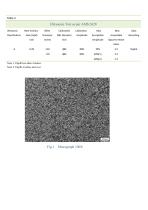
Ultrasonic Test as per AMS 2628 Ultrasonic Hole Depth Data Recording Signal-to-Noise Ratio Note 1: Depth less than 4 inches Note 2: Depth 4 inches and over
Open the catalog to page 2All WESTERN SUPERCONDUCTING TECHNOLOGIES CO LTD catalogs and technical brochures
 Ti-10V-2Fe-3Al
1 Page
 Ti-8Al-1Mo-1V
2 Pages
 Ti-4.5Al-3V-2Fe-2Mo
2 Pages
 Ti-6Al-4V
2 Pages
*Prices are pre-tax. They exclude delivery charges and customs duties and do not include additional charges for installation or activation options. Prices are indicative only and may vary by country, with changes to the cost of raw materials and exchange rates.
About AeroExpo
AeroExpo is a marketplace that offers B2B players a complete experience, from product sourcing to purchase. AeroExpo is an entity of VirtualExpo Group.
Are you a buyer?
Are you a supplier?