
- Catalogs
- Waygate Technologies
- Everest Mentor Visual iQ+ : Real3DTM Measurement Handbook


Everest Mentor Visual iQ+ : Real3DTM Measurement Handbook

Everest Mentor Visual iQ+ : Real3DTM Measurement Handbook
The document discusses advancements in 3D measurement technologies, particularly in video borescopes, and focuses on the Mentor Visual iQ. It highlights the importance of training to fully utilize these technologies for remote visual inspection (RVI).
Accurate measurements are essential in RVI to ensure asset serviceability, reduce costs, and mitigate safety risks. Real3D technologies provide a 3D point cloud for enhanced data quality and measurement accuracy.
- 3D Phase Measurement: Uses structured-light technology for precise, on-demand measurements.
- 3D Stereo Measurement: Creates a full 3D point cloud for improved analysis.
- Stereo Measurement: Traditional method using stereo images, limited by the absence of a 3D point cloud.
- Comparison Measurement: A 2D method using a physical reference target.
Optimal accuracy requires clean, calibrated equipment, proper camera positioning, and suitable surface conditions. Real3D technologies can resolve feature depths to ~0.125mm with errors within +/- 0.05mm under ideal conditions.
Different measurement types are suited for various applications, such as length, depth, and area. Each type has specific conditions for accurate measurement.
Accuracy depends on application-specific factors. A Gauge R&R study is recommended to ensure requirements are met.
Details on measurement tips, including diameters, working channels, and specifications for forward and side view tips, are provided.
- Selecting the right tip involves considering defect view direction and distance.
- Inspectors should be qualified and follow in-house procedures.
- Maintain clean optics and secure tip attachment.
- Orient tips correctly for optimal results.
- Verify system accuracy with NIST traceable blocks.
- Position tips close to measurement areas to avoid inaccuracies.
- Length: Measures straight-line distances.
- Point to Line: Measures perpendicular distances from a line to a point.
- Depth: Measures distance from a reference plane to a point.
- Area: Measures planar areas on surfaces.
- Multi-Segment: Measures total length along curved paths.
- Depth Profile: Maps perpendicular distances from a reference plane.
- Use 3D Surface Mask and point cloud views for accuracy.
- Apply image transforms for better analysis.
- Utilize the 3X Zoom window for precise cursor placement.
Position measurement tips close to indications and adjust cursors for maximum green pixel coverage. Use depth map mode for better visualization.
Useful for corrosion and erosion analysis by identifying highest or lowest points.
Determines clearance using 3DPM or 3D Stereo technology.
Measures angles between reference and angle planes.
Measures area and edge lengths of missing blade corners.
Creates a 3D circle for visual comparison against surface shapes.
Extends measurement capabilities into areas with no 3D data.
- Area Depth Profile: Measures height or depth using reference lines.
- Angle Measurements: Projects cursors onto the Measurement Plane.
- Missing Corner and Radius Gauge: Requires prior placement of the Measurement Plane.
- Guide Lines: Assist in accurate measurement by extending from cursor locations.
- Best Practices: Adjust cursor positions for optimal Guide Line placement.
- Composite Image Creation: Combines images for a comprehensive view.
- Factors Affecting 3DS: Include distance, visual features, and material composition.
- Accuracy Curves: Provide insights into system capability.
- Depth and Profile Errors: Graphs illustrate average absolute errors.
Detailed specifications for measurement tips, including part numbers and fields of view, are provided.
Outlines procedures for using 3D Phase and 3D Stereo Measurement technologies.
A glossary defines key terms to aid user understanding.
Advisory messages for achieving accurate measurements are included.
Information on data export formats and processing functions is provided.
Discusses potential sources of error and mitigation strategies.
Waygate Technologies' contact details are provided for further assistance.
Catalog excerpts

QWaygate _ Technologies a Baker Hughes business Real3D™ Measurement Handbook A guide to advanced 3D measurement technologies, techniques and applications for video borescopes used in remote visual inspection applications.
Open the catalog to page 1
Measurement Technologies
Open the catalog to page 2
Advances in image based 3D measurement are making the video borescope an increasingly powerful tool in the inspector’s toolbox. While in the past, you could identify indications and capture images; today’s advanced video borescopes allow you to map, measure, and analyze indications in 3D. This guide is designed to help inspectors and asset owners understand measurement technologies available on the Mentor Visual iQ and how they can be properly applied to improve decision making in remote visual inspection applications. Many video borescope owners underutilize the advanced features of their inspection...
Open the catalog to page 3
Measurement Technologies (See Mentor Visual iQ VideoProbeTM Operating Manual – Advantages of Measurement Types) Using patented structured-light technology, 3D Phase Measurement enables inspectors to locate, measure, and analyze an indication using the same tip optic. The wide field of view and large depth of field allow for measuring with the same tips used for inspecting, thus eliminating the extra steps required to back out, change the tip, and then relocate the indication. 3D Phase Measurement provides accurate measurement “on-demand” while saving time and increasing overall inspection productivity....
Open the catalog to page 4
Two main things to consider when selecting a 3DPM tip are from what direction the defect is viewed and from how far away. To determine whether you need a forward view or side view tip, consider where your insertion point is in relation to the area you're inspecting. Measurement Depth of Field (DOF) values are provided as general guidelines to help select the most appropriate tip for a given application. The actual measurement DOF for a particular application depends on several factors including feature size, required accuracy, measurement types and surface finish.
Open the catalog to page 5
Side View Tip Specs Optical Measurement Blue, Green and Red side view tips comparison chart. Note: Green tip view is tilted up 10 degrees to improve turbine blade root visibility Color Measurement view size at max distance Part Number
Open the catalog to page 6
General Guidelines • nsure the inspector is qualified to perform measurement. E • Use in-house procedures and the selector tool on this page to choose the appropriate measurement technology and type for your application. • nsure that your measurement tip and probe optics are clean and that the tip is securely attached. If using a stereo tip, be sure to correctly E identify the tip serial number when first entering measurement. 3D Phase Measurement tips are automatically recognized by the system. • For best results when measuring on a narrow surface using 3DPM, orient the tip such that the long...
Open the catalog to page 7
Choose the Right Measurement Type For Your Application While multiple measurement types may be used for certain applications, this chart is intended to show the expert recommendation. Length • Simple measurement of features or components Point to Line • Turbine blade edge damage • Gap width • Weld width Depth • Pits or dents from corrosion, erosion, or FOD impact • Pipe inside diameter • Weld height • Gap width Area Depth Profile • Corrosion, erosion and pitting • Maximum weld height • Maximum wear groove depth Angle • Angle on flat surfaces Surface Angle • Blade tip curl • Angle between two...
Open the catalog to page 8
Measurement Types This section will detail each of the measurement types available on the Mentor Visual iQ VideoProbe, suggest applications where each technique can be most effective, and provide tips and suggestions for accurate measurement setup. Measures the straight-line distance between two selected cursor points. Example Applications: • Simple measurement of features or components When enabled in Settings, a blue mask will highlight surface points where planes perpendicular to the straight length 3D line between the cursor points intersect the viewed surface. • Indication length measurement...
Open the catalog to page 9
Example Applications: • Turbine blade edge damage • Estimate missing corner area using multiple point-to-line measurements • Gap or groove width • Weld width 3D Surface Mask: When enabled in Settings, a blue mask will highlight surface points where planes perpendicular to the straight 3D line between the third cursor point and the reference line intersect the viewed surface. Best Practices to Improve Measurement Accuracy: • Review the 3D point cloud to ensure your cursors are located correctly. • Space the first two cursors far apart along the reference edge. If possible, place them on opposite...
Open the catalog to page 10
Measures the distance from a reference plane (defined by three selected points) to a fourth selected point above or below the plane. Example Applications: Best Practices to Improve Measurement Accuracy: • Blade tip to shroud gaps • he measurement tip should be as close as possible to the T indication to increase the accuracy of measurement. • Pits or dents from corrosion, erosion, or FOD impact • Pipe inside diameter • Weld height • Stator vane rock • Gap width • osition the three reference-plane cursors to maximize the P coverage of 3D Surface Mask green pixels on the reference surface. If measuring...
Open the catalog to page 11
0 Multi-segment Measures a planar area on a surface by outlining an indication with multiple cursor points. Example Applications: • Missing blade corners using a Measurement Plane • Coating loss • Surface area of pitting or corrosion • FOD impact damage Best Practices to Improve Measurement Accuracy: • Check the point cloud to ensure accurate cursor placement. • When measuring a curved surface, reduce error by measuring multiple smaller areas and combining the results. • Use with a Measurement Plane to measure area and lengths of blade missing corners. See Measurement Plane section for details....
Open the catalog to page 12All Waygate Technologies catalogs and technical brochures
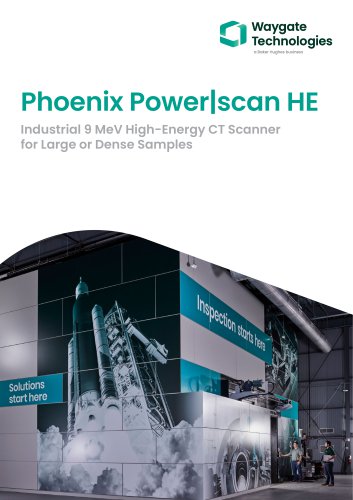 Phoenix Power|scan
3 Pages
 Ultrasonic Contact Probes
47 Pages
 Thickness Probes
47 Pages
 Special Applications
24 Pages
 RotoArray
4 Pages
 Lab Tank
8 Pages
 Immersion Probes
47 Pages
 Phased Array Probes
24 Pages
 Mentor UT
8 Pages
 USIP|xs CV
4 Pages
 HydraStar
3 Pages
 Detectors DXR series
8 Pages
 VideoProbe accessories
51 Pages
 Structurix X-ray films
4 Pages
 Phoenix CT Innovations
16 Pages
 Phoenix V|tome|x S240
8 Pages
 ERESCO MF4 Control
2 Pages
 ERESCO 200 MF4-R
2 Pages
 ERESCO 32 MF4-C
2 Pages
 ERESCO 42 MF4
2 Pages
 ERESCO 65 MF4
2 Pages
 ERESCO 52 MF4-CL
2 Pages
 ERESCO 300 MF4-R
2 Pages
 Seifert ERESCO MF4 series
5 Pages
 DXR250C-W
5 Pages
 (IW) Ecosystem
1 Page
 BIKE platform
10 Pages
 Rigid borescopes
9 Pages
 Fiberscopes
6 Pages
 PTZ HD 30
2 Pages
 X-Ray Tubes
4 Pages
 ISOVOLT Titan|neo series
5 Pages
 ISOVOLT Mobile 160
5 Pages
 DXR series
8 Pages
 V|tome|x C
8 Pages
 Phoenix X|aminer
8 Pages


- Waygate Technologies airport scanner
- Waygate Technologies X-ray scanner
- Inspection machine
- Inspection machine for the aeronautical industry
- Waygate Technologies inspection scanner
- Surface inspection machine
- Flaw detector
- Aeronautic flaw detector
- Endoscope
- Waygate Technologies scanner for the aeronautical industry
- Videoscope
- Ultrasonic inspection machine
- Videoscope for the aeronautical industry
- Flexible videoscope
- Portable videoscope
- CT scanner
- Portable flaw detector
- Ultrasonic flaw detector
- LCD display videoscope
- 2D scanner