


FD70
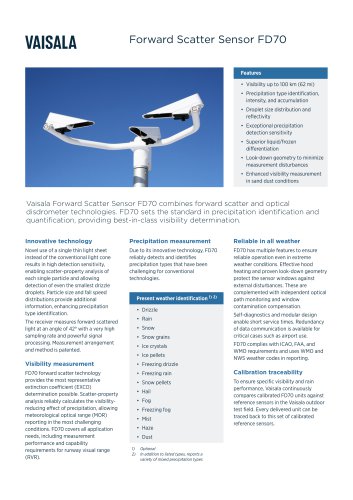
FD70
The Vaisala Forward Scatter Sensor FD70 is designed for advanced visibility and precipitation measurement, capable of identifying precipitation types and measuring visibility up to 100 km. It combines forward scatter and optical disdrometer technologies for superior performance in various weather conditions.
Key Features
- Visibility measurement up to 100 km with high accuracy.
- Identification of precipitation types, intensity, and accumulation.
- Detection of droplet size distribution and reflectivity.
- Enhanced performance in sand dust conditions and superior differentiation between liquid and frozen precipitation.
- Look-down geometry minimizes measurement disturbances.
Innovative Technology
The FD70 uses a single thin light sheet for high detection sensitivity, allowing detailed scatter-property analysis of particles. It measures forward scattered light at a 42° angle with a high sampling rate, providing accurate visibility and precipitation data.
Visibility Measurement
The sensor provides reliable extinction coefficient determination, crucial for meteorological optical range (MOR) reporting, and meets runway visual range (RVR) requirements.
Precipitation Measurement
The FD70 accurately detects challenging precipitation types, including drizzle, rain, snow, ice crystals, and mixed types. It reports using WMO and NWS weather codes.
Reliability and Compliance
Features like hood heating and look-down geometry ensure reliable operation in extreme conditions. The FD70 complies with ICAO, FAA, and WMO standards and includes self-diagnostics and modular design for easy maintenance.
Technical Specifications
- Visibility measurement range: 1 m to 100 km with ±10% uncertainty.
- Precipitation intensity sensitivity: Single droplet ≥ 0.1 mm.
- Operating temperature: -40 to +65 °C, with extended options available.
- Power consumption: 182 W with all options.
- Data communication: Ethernet, RS-232, RS-485, and radio modem options.
Compliance and Safety
The FD70 meets various EU directives and regulations, including EMC, LVD, and RoHS. It is classified as a Class 1M laser device for eye safety and complies with electrical safety standards.
Conclusion
The Vaisala FD70 sets a high standard in visibility and precipitation measurement, offering reliable and accurate data for meteorological applications, particularly in challenging weather conditions.
Catalog excerpts

Forward Scatter Sensor FD70 Features • Precipitation type identification, intensity, and accumulation • Droplet size distribution and reflectivity • Exceptional precipitation detection sensitivity • Superior liquid/frozen differentiation • Look-down geometry to minimize measurement disturbances • Enhanced visibility measurement in sand dust conditions Novel use of a single thin light sheet instead of the conventional light cone results in high detection sensitivity, enabling scatter-property analysis of each single particle and allowing detection of even the smallest drizzle droplets. Particle size and fall speed distributions provide additional information, enhancing precipitation type identification. The receiver measures forward scattered light at an angle of 42° with a very high sampling rate and powerful signal processing. Measurement arrangement and method is patented. FD70 forward scatter technology provides the most representative extinction coefficient (EXCO) determination possible. Scatter-property analysis reliably calculates the visibility-reducing effect of precipitation, allowing meteorological optical range (MOR) reporting in the most challenging conditions. FD70 covers all application needs, including measurement performance and capability requirements for runway visual range (RVR). Due to its innovative technology, FD70 reliably detects and identifies precipitation types that have been challenging for conventional technologies. Present weather identification 15 2) • Snow grains • Freezing drizzle • Freezing rain • Snow pellets 2) In addition to listed types, reports a variety of mixed precipitation types FD70 has multiple features to ensure reliable operation even in extreme weather conditions. Effective hood heating and proven look-down geometry protect the sensor windows against external disturbances. These are complemented with independent optical path monitoring and window contamination compensation. Self-diagnostics and modular design enable short service times. Redundancy of data communication is available for critical cases such as airport use. FD70 complies with ICAO, FAA, and WMO requirements and uses WMO and NWS weather codes in reporting. To ensure specific visibility and rain performance, Vaisala continuously compares calibrated FD70 units against reference sensors in the Vaisala outdoor test field. Every delivered unit can be traced back to this set of calibrated
Open the catalog to page 1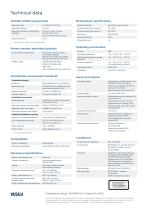
Reporting uncertainty in operational ±10 % or ±1 m at 1 m-10 km conditions (±3 ft at 3 ft-6.2 mi) ]) Operating principle Look-down forward scatter Scattering angle (main receiver) 42° ±0.25° Scattering angle (side receiver) 90° ±0.25° Light source Near-infrared 1) Fulfills ICAO Annex 3: ±50 m (164 ft) up to 600 m (1968 ft). Present weather identification Drizzle, rain, snow, snow grains, ice crystals, ice pellets, freezing rain / drizzle, snow pellets, hail, fog / freezing fog, mist, haze Weather codes SYNOP: WMO table 4680 METAR: WMO table 4678 NWS codes Light, moderate, and heavy intensities...
Open the catalog to page 2All VAISALA OYJ catalogs and technical brochures
 PWD series
5 Pages
 Insight
2 Pages
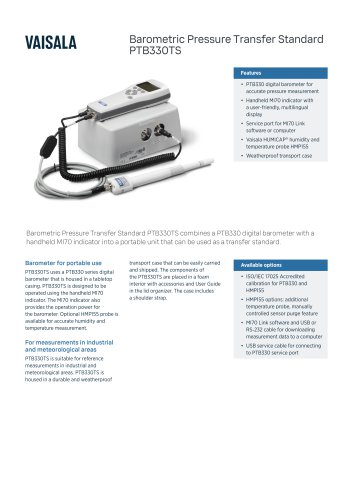 PTB330TS
3 Pages
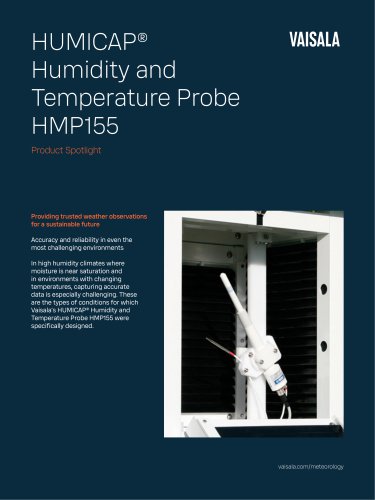 HMP155
2 Pages
Archived catalogs
 Vaisala Thermal Mapping
2 Pages
 Vaisala Lightning Integrator
2 Pages
 Vaisala Lightning Exporter
2 Pages
 Vaisala Thunderstorm Manager
2 Pages
 RFL100
4 Pages
 Vaisala BeaconTM Station
2 Pages
 RWS200
24 Pages
 PTU300
5 Pages
 Present Weather Sensor FS11P
2 Pages
 Visibility Sensor FS11
2 Pages
 Lightning Threat Zone API
2 Pages
 Thunderstorm Manager
2 Pages
 The Vaisala AUTOSONDE® AS41
5 Pages
 Vaisala AviMet® DSS
4 Pages
 HMP8
HMP82 Pages
 Vaisala: a sound decision
8 Pages
 A clearer approach to RVR
8 Pages


- Aeronautical software
- Real-time software
- Airport software
- Process software
- Cloud software
- Surveillance radar
- Measurement software
- Pressure sensor for the aerospace industry
- Tracking software
- Airport lamp
- Mapping software
- Web-based software
- Airport radar
- Data acquisition software
- Server software
- Meteorological software
- Digital pressure sensor
- Airport weather station
- Detection radar
- X-band radar