
- Catalogs
- UNITED PERFORMANCE METALS
- Stainless 17-4 PH


Stainless 17-4 PH

Stainless 17-4 PH
Catalog excerpts

Stainless 17-4 PH Type 17-4 PH stainless steel is the most widely used of all of the precipitation-hardening stainless steels. Its valuable combination of properties gives designers opportunities to add reliability to their products while simplifying fabrication and often reducing costs. Type 17-4 PH is a martensitic precipitation-hardening stainless steel that provides an outstanding combination of high strength, good corrosion resistance, and good mechanical properties at temperatures up to 600°F (316°C). Its unique combination of properties make this alloy an effective solution to many design and production problems. Chemical Composition, % Resistance to Corrosion: Type 17-4 PH stainless steel has excellent resistance. It withstands corrosive attack better than any of the standard hardenable stainless steels and is comparable to type 304 in most media. This has been tested in a wide variety of corrosive conditions in the petrochemical, petroleum, paper, dairy, and food processing industries, and in applications such as boat shafting. Features • Excellent resistance to corrosion • Provide toughness in both base metals and welds. • Well suited to applications that require ease of fabrication and then the addition of strength/hardness for improved reliability Aerospace applications Chemical processing equipment Oil and petroleum refining equipment Food processing equipment General metalworking
Open the catalog to page 1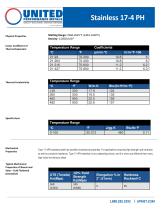
Physical Properties Stainless 17-4 PH Melting Range: 2560-2625°F (1404-1440°C) Density: 0.2820 lb/in3 Linear Coefficient of Thermal Expansion Temperature Range Thermal Conductivity Temperature Range Specific Heat Temperature Range Mechanical Properties Type 17-4PH stainless steel has excellent mechanical properties. For applications requiring high strength and hardness as well as corrosion resistance, Type 17-4PH stainless is an outstanding choice, and it is more cost effective than many high nickel non-ferrous alloys. Typical Mechanical Properties of Sheets and Strip - Cold Flattened (Annealed)...
Open the catalog to page 2All UNITED PERFORMANCE METALS catalogs and technical brochures
 6061 Aluminum
2 Pages
 Stainless 301
3 Pages
 Stainless 17-7 PH
3 Pages
 Mic6® Aluminum Cast Plate
2 Pages
 AEROSPACE GRADE MATERIALS
2 Pages
- Aeronautical stainless steel
- Titanium
- Aeronautical titanium
- Aluminum
- Aeronautical aluminum
- Aerospace titanium
- Plate stainless steel
- Stainless steel for the aerospace industry
- Titanium rod
- Aluminum for the aerospace industry
- Sheet stainless steel
- Rod stainless steel
- Plate aluminum
- Grade 2 titanium
- Plate titanium
- Sheet titanium
- Grade 3 titanium
- Grade 4 titanium
- ASTM B348 titanium