Overview: The Timken Engineering Manual for the Metals Industry offers comprehensive guidance on lubrication, sealing, application challenges,
bearing solutions, and related products and services. It emphasizes proper maintenance and installation techniques to enhance equipment performance and uptime.
Lubrication and Sealing: This section covers the fundamentals of lubrication, including selecting appropriate lubricants for different applications and various sealing systems and their uses.
Application Challenges and Enhanced Bearing Solutions: Timken provides high-performance bearings to address challenges like contact fatigue, debris, corrosion, and high acceleration, highlighting the benefits of precision rolling and advanced bearing solutions.
Related Products: Timken offers seals, lubricants, maintenance tools, and condition monitoring equipment, detailing features and benefits of Timken® Housed Units and Quick-Flex® Couplings.
Bearing Storage, Handling, and Installation: Proper packaging, storage, and handling are crucial for maintaining bearing performance, with guidelines for roll neck maintenance and techniques for mounting and dismounting roll neck bearings.
Services: Timken offers gearbox repair, bearing reconditioning, and upgrades for chock and roll systems, along with the MILLTEC™ Rolling Mill Program and service engineering support to enhance operational efficiency.
Popular Bearing Types in the Metal Industry: The manual outlines different bearings used in steelmaking, continuous casting, and rolling mills, providing insights into selection and application for auxiliary equipment.
Bearing Life Calculations and Related Analysis: This section explains symbols and equations for calculating bearing life, considering factors like fatigue life, applied loads, and internal clearance, with advanced analysis techniques discussed.
Innovation and Customer Support: Timken's global technology centers focus on developing innovative products and solutions, offering extensive customer support, including engineering expertise and a global distribution network.
Products and Services: Timken provides a wide range of friction-management products, including various bearings and housed units, with high-performance solutions like AquaSpexx® and DuraSpexx® for challenging environments, covering power transmission components and systems.
Seals and Couplings: Timken develops advanced seals and offers a comprehensive line of large-bore oil and grease seals, as well as metallic and non-metallic bearing isolators. Quick-Flex® couplings are durable, require minimal maintenance, and efficiently transmit torque without lubrication.
Chains: Timken manufactures precision roller chains tailored for demanding steel industry applications, ensuring strength and maximum wear life.
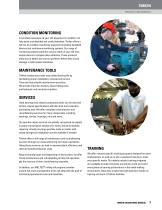
Condition Monitoring: Timken provides condition-monitoring equipment to prevent unscheduled downtime, ranging from simple alarms to complex data collection systems.
Maintenance Tools and Services: Timken offers tools to extend bearing life and simplify maintenance, including induction heaters and pullers, along with remanufacture and reconditioning services for bearings and gearboxes.
Training: Timken offers industry-specific training programs, including hands-on training and facility tours, to enhance plant professionals' skills.
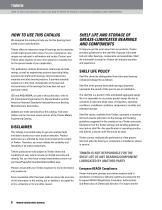
Catalog Usage: The catalog assists in selecting appropriate bearings, providing dimensions, tolerances, and load ratings, with guidelines for shelf life and storage of grease-lubricated bearings.
Storage Guidelines: Timken provides detailed storage guidelines to ensure product longevity, emphasizing maintaining appropriate temperature, humidity, and protection from contaminants.
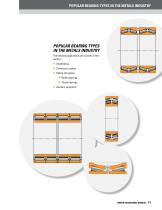
Popular Bearing Types: The document details various bearing types used in the metals industry, including spherical roller bearings and cylindrical roller types, designed for specific applications like steelmaking and continuous casting.
Continuous Casting: The continuous caster environment is challenging for bearings due to high loads, low speeds, and elevated temperatures. Timken's solution includes high-performance spherical roller bearings for fixed positions and ADAPT™ bearings for floating positions, with proper maintenance and handling being critical.
Rolling Mill Stands: Bearings in rolling mills encounter high radial loads and varying axial loads, with designs including two-, four-, or six-row tapered roller bearings and multi-row cylindrical bearings.
Auxiliary Equipment: Timken offers a range of bearings for auxiliary equipment like gear drives and table rolls, with popular types including spherical roller bearings and deep-groove radial ball bearings.
Application Considerations and Bearing Selection: This section covers processes such as steelmaking, continuous casting, and rolling mills, discussing bearing solutions for radial and axial positions, including work and intermediate rolls, backup rolls, and auxiliary equipment like main mill drives and gearboxes.
Steelmaking: The Basic Oxygen Furnace (BOF) is used for melting steel for alloy adjustment and purification, with spherical roller bearings preferred for main support positions due to their high radial capacity and misalignment capability.
Continuous Casting Process: The document describes the continuous casting process, focusing on the configuration and operation of slab casters, with bearings required to withstand high loads, temperatures, and environmental contamination.
Rolling Mill: The rolling mill section discusses the demands on bearings in hot and cold rolling processes, highlighting differences between hot and cold rolling, including mill speeds and product quality requirements.
Specifications: The document provides detailed technical specifications and considerations for rolling mill operations, focusing on annealing, temper rolling, and bearing selection, with mill speeds ranging from 1000 m/min to over 2000 m/min.
Temper Mill: Used for tempering strips with a small thickness reduction, enhancing dimensional trueness, surface finish, and flatness, with mill speed generally less than 1200 m/min.
Long Product Rolling: Includes a variety of products like bars, tubes, and structural sections, with processes involving roughing and finishing mills with hot and cold rolling.
Bearing Solutions: Work roll bearings are smaller and narrower due to lower loads, with flatness control techniques including roll bending and axial roll shifting.
Sealed Roll Neck Bearings: Reduce grease consumption and maintenance costs, with integrated seal design minimizing contamination and maximizing bearing life.
Optional Roll Neck Bearing Features: The TQOW assembly is a popular four-row assembly with variants like the TQOGW, which includes spiral bore grooves to retain and distribute lubricant.
Application Considerations and Bearing Selection: The document outlines various assemblies and practices for roll neck bearings, emphasizing lubrication, roll neck hardness, and chock drainage.
Work Rolls: Long Product Mills: Long product mills typically use a 2-Hi construction, with
radial bearings being either four-row cylindrical or tapered roller bearings.
Four-Row Cylindrical Roller Bearing: Timken offers a range of sizes with common designs like the RY or RYL type, emphasizing lubrication and fitting practices for optimal performance.
Specifications: Four-row cylindrical roller bearings are available with radial internal clearances according to DIN 620-4, typically using C4 or C3 values.
Lubrication Configuration: Timken bearings can be lubricated using grease, air-oil, oil-mist, or circulating-oil systems, with proper lubrication essential for optimal performance.
Bearing Selection Criteria: Initial selection is based on space availability dictated by roll and chock design, with key parameters including roll neck diameter to roll body size ratio and allowable roll neck stresses.
Design Considerations: Roll neck to roll body ratio is typically 60%, with backup chock section guidelines applying to various bearing types.
Roll Neck Design: Compound fillet radii are preferred over single radius fillets for strength and space efficiency, with maximum roll neck bending stress calculated using specific formulas.
Bearing Solutions: Four-row cylindrical roller bearings are used in both hot and cold mills for their high-speed and precision capabilities.
TQITS Configuration: The TQITS assembly is a tapered bore roll neck assembly designed for high-speed mills, providing high stability and excellent load sharing.
1. Cone Fitting Practice: There are two approaches to cone fitting: uniform bore and stepped bore, with the uniform bore ensuring equal fit across all cones.
2. Axial Clamping: The TQITS assembly cones must remain clamped after mounting to maintain proper fit and internal clearance.
3. Fixed and Float Positions: The cups are clamped on the fixed position of the mill, while the floating side allows axial movement to accommodate roll expansion and contraction.
4. Tapered Roll Neck Parameters: Roll necks should have a hardness of 27 to 37 HRC, a surface finish no greater than 0.80 μm, and must be clean and dry for optimal fit.
5. Tapered Roll Neck Measurement: Special tools are required for measuring roll neck taper and size to ensure proper assembly fit.
6. Tools for Mounting and Dismounting: A hydraulic ring jack is used for mounting, and high-pressure hydraulic fluid is used for dismounting.
7. Roll Interchangeability: Controlled dimensions allow for bearing interchangeability between roll necks.
8. Lubrication: The primary lubrication system for TQITS arrangements is air oil.
9. Fillet Ring Fit: The fillet ring should have a minimum interference fit ratio of 0.00050 x bearing bore.
10. Roughing Plate and Hot Finishing Mill: These mills require high separating forces and typically use four-row tapered roller bearings.
11. Optional Backup Roll Bearing Features: Features like radial holes for lubrication and increased neck diameter for high-load applications are discussed.
12. Increased Strip Accuracy: Control systems for strip profile and thickness are essential, with hydraulic systems preferred for roll gap adjustments.
13. Bearing Solutions for Axial Positions: Various bearing options are available for handling axial loads, including TDIK, 2TSR, and TTDWK assemblies.
14. Angular-Contact Ball Bearing Assembly: Used for high-speed applications, these bearings accommodate thrust loads and are used in pairs.
15. Backup Roll: Heavy-duty thrust bearings are required for backup rolls, especially in mills with roll shifting or crossing.
Keyway and Bearing Assembly: The document discusses the design of keyways in double cone bearings, allowing for reversibility to extend bearing life.
Locating Bearing for Float Chock: A thrust bearing is used to locate the float chock on the roll end, unless spreader bars are used.
Screwdown Systems: These systems adjust the gap in mills, using either electromechanical or hydraulic systems.
Bearing Solutions for Axial Positions: Various bearing assemblies like TTHDFLSV and TTHDFLSX are discussed, with design considerations for concave and convex profiles.
Main Mill Drive and Pinion Stand Gearboxes: Gearboxes in mills can be single or double reduction, designed for high reliability.
Application Considerations: Factors such as operating conditions, fitting practices, lubrication, and high-speed operations are crucial for bearing selection.
Pay-off and Rewind Reels: These reels are used in strip mills for coiling and uncoiling, with bearings handling changing loads and speeds.
Shears and Shear Drives: Shears in rolling mills and process lines can be stationary or flying, with bearings experiencing rapid speed and load changes.
Application Considerations for Shears: Bearings in shears experience rapid speed and load changes, leading to high-inertia and impact loads.
Table Rolls: Rolling mills use rolls to support, pinch, deflect, or tension material, with spherical and two-row tapered roller bearings being common.
Bearing Life Calculations and Related Analysis: Bearing life is influenced by factors like load, speed, lubrication, and environmental conditions.
Overview: The document provides detailed technical information on bearing ratings, life calculations, and related analyses, specifically focusing on Timken roller bearings.
1. Bearing Ratings: Timken has developed a specific rating method for roller bearings, considering material cleanliness and manufacturing technology improvements.
2. Dynamic Load Ratings: The document explains the formula for calculating the basic dynamic load rating (C90) for radial roller bearings.
3. Axial Load Ratings: The axial load-carrying capability of radial roller bearings is determined by the bearing type.
4. Static Load Ratings: For static applications, the maximum permissible load is defined by the maximum contact stress that does not alter the bearing's physical properties.
5. Applied Loads: The document discusses the traditional approach to bearing life calculation, which involves determining applied forces and calculating a bearing's dynamic equivalent load.
6. Gearing Types: Various gearing types are covered, including spur, single-helical, straight bevel, zerol, spiral bevel, and hypoid gearing.
7. Rolling Load Paths: In rolling-mill applications, the document explains the load paths for backup and work-roll positions.
8. Equivalent Dynamic Radial Loads: The dynamic equivalent radial load (Pr) is defined as a single radial load resulting in the same life as the combined radial and axial loading.
Specifications and Procedures: The document provides detailed specifications and procedures for calculating dynamic radial equivalent loads for single-row and
double-row bearings.
Norms and Recommendations: For
single-row bearings, the document advises determining the bearing arrangement and thrust load application before using the provided table to calculate loads.
Load Calculations: The document explains how to calculate bearing life for four- and six-row bearings, emphasizing the importance of load distribution among the rows.
Bearing Life Calculations: It details the equations for calculating bearing life (L10) based on dynamic load ratings and provides adjusted life equations that consider reliability, material, and operating conditions.
Reliability and Material Factors: The document discusses the reliability life factor (a1) and material life factor (a2), emphasizing the impact of steel quality on bearing life.
Load-Zone Life Factor: The document explains the load-zone life factor (a3k), which relates to the number of rollers supporting the load and the bearing's internal geometry.
Conclusion: The document concludes with a note on the importance of accurate information for Timken's technical reviews and the limitations of their warranty.
Lubrication Life Factor (a3l): Bearing life is significantly influenced by the lubricant film thickness, which depends on factors such as lubricant viscosity, operating temperature, load, speed, and surface finish.
Bearing Life Equations and Misalignment Life Factor (a3m): Misalignment between bearing rings affects bearing life, with permissible misalignment varying by bearing type.
Bearing Internal Clearance: Internal clearance in roller bearings affects performance aspects like fatigue life and vibration.
Influence of Fitting on Setting: Bearing fitting practices impact internal clearance and performance.
Specifications and Nomenclature: The document discusses the specifications of tapered roller bearings, focusing on the importance of precise spacer width adjustment for applications requiring accurate settings.
Bearing Internal Clearance and Temperature Influence: Operating bearing settings are affected by thermal expansion.
Advanced Analysis and Bearing Life Calculations: Timken's advanced analysis tools, including Syber and FEA, are used for accurate life calculations and stress analysis.
Lubrication and Sealing: Lubrication is crucial for bearing performance, with considerations for lubricant properties, quantity, and delivery method.
Film Thickness and Bearing Performance: The document explains the significance of elastohydrodynamic (EHD) film thickness in maintaining bearing performance.
Tables and Figures: Several tables and figures are included to illustrate concepts such as temperature gradients, rib speed, and pressure distribution.
Film Thickness and Lubrication: The document discusses the importance of film thickness in lubrication, particularly in rolling bearings.
Main Lubricant Characteristics: Viscosity is highlighted as the most crucial property of a lubricant, inversely related to temperature.
Lubricant Additives: Additives can enhance lubricant properties, such as oxidation and corrosion inhibitors, demulsifiers, and anti-wear agents.
Lubrication Selection: The choice between grease and oil lubrication depends on various factors like load, speed, and environmental conditions.
Grease Lubrication: Grease is a semi-solid lubricant with specific advantages and disadvantages.
Oil Lubrication Systems: Five types of oil lubrication systems are discussed, each with its advantages and disadvantages.
Compatibility and Maintenance: Mixing different greases can degrade lubrication properties, so thorough cleaning is recommended when switching types.
Oil Characteristics for Air-Oil Systems: The base oil is solvent-refined petroleum with a high viscosity index.
Oil-Mist Lubrication Systems: Used on roll necks when grease lubrication is unreliable due to high speeds.
Oil-Bath and Oil-Splash Lubrication Systems: These systems are simple but limited, suitable for low to moderate speeds.
Forced-Feed Oil Lubrication Systems: Used in high-heat applications like medium to high-speed gear drives.
Heat Generation and Dissipation: Excess lubricant churning is a major heat source.
Influence of Contaminants: Abrasive particles cause bearing damage, with case-hardened steel preferred for debris tolerance.
Sealing: Efficient sealing is crucial for bearing longevity, excluding contaminants and retaining lubricant.
Labyrinth Seals: Labyrinth seals are designed to reduce, but not eliminate, leakage by minimizing radial clearance.
Sealing Systems for Roll Necks: Robust sealing is crucial in roll neck applications, especially in contaminated environments.
Auxiliary Equipment Sealing: In cleaner environments, simpler sealing arrangements suffice.
High-Performance Bearings: Timken offers enhanced bearing solutions for demanding applications, addressing challenges like heavy loads, high speeds, and contamination.
Contact Fatigue Solutions: Contact fatigue, a common issue in bearings, can be mitigated through enhancements like cleaner steel and special profiling.
Debris Challenges and Solutions: Debris can cause significant bearing damage, particularly in harsh environments.
Debris-Resistance Technology: Debris-resistant bearings are designed to extend the life of bearings by resisting adhesive wear and self-repairing microcracks.
Lubrication Challenges and Solutions: Inadequate lubrication can lead to various types of bearing damage, including roller-end scoring and total bearing seizure.
Corrosion Challenges and Solutions: Water-based corrosion is a major issue for bearings, especially in roll neck applications.
Precision Rolling: Precision in roll neck bearings is critical for product quality in rolling operations.
High Acceleration Challenges and Solutions: Cages in roller bearings must withstand dynamic conditions like high accelerations and vibrations.
Related Products: This section includes information on seals, lubricants, maintenance tools, condition monitoring equipment, Timken® housed units, Quick-Flex® couplings, and precision chain products.
Specifications and Features: Timken Mill Grease is specifically developed for steel mill applications, offering improved resistance to water washout, rust, corrosion, high-temperature performance, and oxidation stability.
Lubrication Systems: The Timken lubrication line includes G-Power, M-Power, and C-Power lubricators, which distribute grease consistently into machine operations.
Seals: Timken offers a variety of industrial seals made from different materials to suit various applications.
Maintenance Tools: Timken provides a range of maintenance tools, including hydraulic pullers and induction heaters.
Condition Monitoring Equipment: Timken offers condition monitoring products to maximize uptime and safety in industrial operations.
Housed Units: Timken's housed units include split-block plummer blocks and spherical roller bearing solid-block housed units.
Overview: The document provides detailed information on Timken's range of housed units, bearings, couplings, and precision chain products, emphasizing their applications, specifications, and maintenance guidelines.
Specifications: Timken offers a variety of housed units, including spherical roller bearing solid-block housed units that can handle misaligned shafts up to ±1.5 degrees.
Locking Configurations: Two main locking solutions are provided: the EC Series with eccentric lock for heavy-duty applications and the V-Lock® Series with a double-taper lock for extreme heavy-duty applications.
Sealing Options: The document outlines three principal sealing options: Labyrinth Seals for high-speed applications, Triple-Lip Seals made of Nitrile for moist and dirty conditions, and Urethane seals for additional abrasion resistance.
Maintenance and Safety: Proper maintenance and handling practices are critical, with key guidelines including following installation instructions, maintaining proper lubrication, and avoiding excessive force during mounting.
Timken® Type E Tapered Roller Bearing Housed Units: These units offer enhanced performance with higher load ratings and reduced maintenance costs.
Quick-Flex® Couplings: Designed for metal manufacturing, these couplings handle high and low torque and speeds, require minimal maintenance, and do not need lubrication.
Precision Chain Products: Timken provides a range of ANSI standard roller chains designed for high temperatures and heavy loads.
Conclusion: Timken's products are engineered to provide robust performance in demanding environments, with a focus on reducing maintenance costs and increasing uptime.
Conveying Chain Specifications: For conveying applications, attachment roller chains are available in sizes 40 to 160 and C2040 to C2160H, made from standard carbon steel, stainless steel, Extended Life CHP® series, and Silver Shield CR® series.
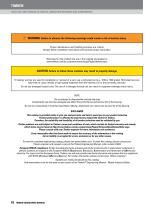
Warnings and Cautions: Use only subassemblies for assembling chain strands, and avoid using worn chains or installing new chains on worn sprockets to prevent property damage and personal injury.
Bearing Storage, Handling, and Installation: Bearings are packaged to protect them for five years if stored in a clean, dry area.
Bearing Marking and Identification: Timken bearings include markings for manufacturing source, country of origin, date code, and serial number for identification and traceability.
Roll Neck Maintenance Guidelines: Proper handling, mounting, and maintenance are crucial for bearing longevity, especially in harsh environments like the steel industry.
Bearing Removal and Handling: Use appropriate tools and methods for bearing removal to prevent damage.
Bearing Cleaning and Inspection: Use special cleaning tanks and solutions for cleaning bearings, inspecting for damage and wear.
Bearing Installation: Heating or cooling methods can facilitate bearing installation by expanding or contracting components for a tight fit.
Specifications and Procedures: The document provides detailed guidelines for the installation and maintenance of bearings, focusing on heating and cooling methods to achieve tight fits.
Heating and Cooling Guidelines: Table 12 outlines maximum temperature and time limits for heating and cooling bearing components.
Freezing Bearings: Methods for achieving low temperatures include using alcohol or dry ice mixtures and thermostatically controlled freezers.
Chock and Roll Neck Maintenance: The document emphasizes the importance of maintaining chock bores, roll neck seats, and shoulders to ensure optimal bearing performance.
Inspection and Rework Limits: Tables 13 and 14 provide permissible limits for chock bore rework and roll neck diameter wear.
Safety and Best Practices: Safety precautions are highlighted, especially regarding temperature control during heating and the use of appropriate safety equipment to prevent injuries.
Roll Neck Bearings Maintenance and Installation: The roll neck must be dimensionally checked and validated against the roll neck detail drawing for proper mounting, sealing, and lubrication.
Dimensional Checks and Grinding: If the inner ring is dismounted due to damage, the roll neck may need regrinding to ensure a tight fit for the new inner ring.
Gasket and Shim Selection: For chock end covers, select a compressible gasket or shim pack to prevent outer ring rotation.
Bolt Torque Specification: Follow mill builder's suggestions for bolt torque values, considering the number of bolts, their size, and steel grade.
Mounting and Dismounting Roll Neck Bearings: Bearings should be mounted and dismounted carefully to avoid damage.
Four-Row Tapered Roller Bearings: Available in TQOW and 2TDIW versions, these bearings require axial clamping in the chock.
Lubrication: Use grease or oil for lubrication during assembly.
Installation Procedures: Follow the correct sequence for stacking bearing assemblies.
Roll Neck Mounting Procedure: Clean and lubricate the roll neck before installation.
Dismounting Procedures: Support the roll assembly and use lifting devices to remove the chock and bearing assembly.
Four-Row TQITS Bearings: These bearings allow for axial float on the drive side to accommodate roll expansion and contraction.
Introduction: This document provides detailed procedures and specifications for mounting and dismounting cylindrical bearings used in backup and work rolls.
Specifications: The cylindrical bearings are mounted with tight fit inner rings on the roll neck.
Mounting and Dismounting Procedures: Clean and dry all components before installation, and use an induction heating device to remove inner rings safely.
Grinding and Inspection: For semi-finished inner rings, perform customer finish grinding to achieve the final radial internal clearance.
Axial Positioning and Thrust Bearings: In systems with high thrust loads, additional thrust bearings may be required.
Safety and Best Practices: Warnings are provided to prevent injury during the heating and handling of bearing components.
Conclusion: This document serves as a comprehensive guide for the installation and maintenance of roll neck bearings.
Adjustable Bearings: Single-row bearings have clearance adjusted during assembly, while multi-row assemblies use spacers or internal components for preset axial endplay or preload.
Non-Adjustable Bearings: These bearings, except certain cylindrical roller versions, have non-separable rings and come with factory-set internal clearance (RIC).
Bearing Setting Techniques: Multi-row tapered roller bearings are preset with spacers, with BEP (Bearing Endplay) determined by measurement and matching of components.
Fitting Practice Example: An example calculation for MEP range is provided, illustrating the impact of dimensions and tolerances on endplay.
Controlling Bearing Assembly Setting: Regular checks on multi-row tapered roller bearings are recommended to determine if BEP needs adjustment.
Services: Timken offers services such as gearbox repair, bearing reconditioning, chock and roll upgrades, MILLTEC® rolling mill program, service engineering, and training.
Upgrade Opportunities: Timken offers various methods to enhance gear life through metal hardening techniques such as nitriding and carburizing.
Scope of Work: Timken provides a comprehensive range of technical services for gearbox repair, including condition monitoring, diagnostics, drive exchange programs, engineered upgrades, and predictive maintenance.
Bearing Reconditioning and Reclamation Services: Timken emphasizes the importance of integrating mechanical components into a maintenance plan to lower costs and improve plant efficiency.
Advantages of Reconditioning and Reclamation: Reconditioning and reclamation provide cost reduction, improved product quality, reduced lead times, and increased application uptime.
Impact of Bearing Repair on Performance: Timken illustrates the potential life increase of bearings with repair, emphasizing the importance of timely maintenance to avoid catastrophic failures and maximize cost savings.
Indicators for Bearing Attention: Signs that a bearing may require service include exceeding operating temperatures, excessive vibration, and sudden changes in lubricant levels.
Timken Repair Expertise: Timken's repair services are backed by highly trained engineers, state-of-the-art equipment, and ISO-compliant operations.
Establishing an Integrated Repair Program: Timken advocates for an integrated maintenance and repair program for all mill-stand equipment to optimize performance and simplify maintenance schedules.
Chock and Roll Upgrades: Timken provides capabilities for producing new or remanufactured equipment for steel and aluminum mills.
Improving Existing Chocks: Timken offers repair services for chocks, providing mini- and full-rebuild options that can save up to 60% compared to purchasing new ones.
Roll Overlays and Repair: The Timken Services Group provides roll repair and overlay operations to extend the life of rolls, saving over 50% compared to buying new ones.
Chock and Roll Upgrades: Timken Gears and Services provides power transmission solutions and repairs for gearboxes.
MILLTEC® Service Engineering: Timken service engineers optimize bearings to maximize uptime and productivity in steel and aluminum mills.
Timken Online Monitoring Systems and Services: For critical plant assets, Timken offers wired and wireless online monitoring solutions to prevent unexpected failures.
MILLTEC® Rolling Mill Program: This program manages roll shop operations, offering services like bearing assembly, roll grinding, and condition monitoring to reduce costs and improve profits.
Training Programs: Timken provides various training programs, including Rolling Mill Training, Industrial Maintenance Training, and Bearing Certified Maintenance Program.







 TIMKEN® HOUSED UNIT CATALOG


