

TIMETAL 65A

1 / 2 PagesView full catalog
TIMETAL 65A
Product catalog summary
Overview of TIMETAL 65A:
TIMETAL 65A is a commercially pure titanium, equivalent to ASTM Grade 3, known for its excellent corrosion resistance and strength-to-weight ratio. It is suitable for use in environments ranging from highly oxidizing to mildly reducing, including chlorides. The material can withstand continuous service up to 800°F (425°C) and intermittent service up to 1000°F (540°C). It also exhibits good impact properties at low temperatures and can be welded, machined, cold worked, hot worked, and cast effectively.
TIMETAL 65A is a commercially pure titanium, equivalent to ASTM Grade 3, known for its excellent corrosion resistance and strength-to-weight ratio. It is suitable for use in environments ranging from highly oxidizing to mildly reducing, including chlorides. The material can withstand continuous service up to 800°F (425°C) and intermittent service up to 1000°F (540°C). It also exhibits good impact properties at low temperatures and can be welded, machined, cold worked, hot worked, and cast effectively.
Chemical Composition:
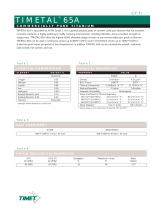
The chemical composition of TIMETAL 65A includes Oxygen (0.35%), Nitrogen (0.05%), Carbon (0.08%), Iron (0.30%), Hydrogen (0.015%), with residual elements each at 0.10% and a total of 0.40%. The remainder is Titanium.
The chemical composition of TIMETAL 65A includes Oxygen (0.35%), Nitrogen (0.05%), Carbon (0.08%), Iron (0.30%), Hydrogen (0.015%), with residual elements each at 0.10% and a total of 0.40%. The remainder is Titanium.
Physical Properties:
The density of TIMETAL 65A is 0.163 lb/in³ (4.51 g/cm³). It has a beta transus temperature of 1690°F (920°C), thermal conductivity of 12.60 Btu/hr-ft-°F (21.79 W/m-K), and electrical resistivity of 21 µΩ•in (0.54 µΩ•m). It is nonmagnetic and has a mean coefficient of thermal expansion ranging from 4.8 x 10⁻⁶ in/in-°F (8.6 x 10⁻⁶ m/m-°C) at 68-212°F (20-100°C) to 5.4 x 10⁻⁶ in/in-°F (9.7 x 10⁻⁶ m/m-°C) at 68-932°F (20-500°C). The elastic modulus is between 15.2-17.4 Msi (105-120 GPa).
The density of TIMETAL 65A is 0.163 lb/in³ (4.51 g/cm³). It has a beta transus temperature of 1690°F (920°C), thermal conductivity of 12.60 Btu/hr-ft-°F (21.79 W/m-K), and electrical resistivity of 21 µΩ•in (0.54 µΩ•m). It is nonmagnetic and has a mean coefficient of thermal expansion ranging from 4.8 x 10⁻⁶ in/in-°F (8.6 x 10⁻⁶ m/m-°C) at 68-212°F (20-100°C) to 5.4 x 10⁻⁶ in/in-°F (9.7 x 10⁻⁶ m/m-°C) at 68-932°F (20-500°C). The elastic modulus is between 15.2-17.4 Msi (105-120 GPa).
Heat Treatment:
Annealing is performed at 1292°F (700°C) for 1 hour followed by air cooling, while stress relieving is done at 932°F (500°C) for 30 minutes followed by air cooling.
Annealing is performed at 1292°F (700°C) for 1 hour followed by air cooling, while stress relieving is done at 932°F (500°C) for 30 minutes followed by air cooling.
Mechanical Properties:
Typical mechanical properties include an ultimate tensile strength (UTS) and 0.2% yield strength (YS) with elongation and reduction in area values provided for various conditions.
Typical mechanical properties include an ultimate tensile strength (UTS) and 0.2% yield strength (YS) with elongation and reduction in area values provided for various conditions.
Fatigue and Tensile Properties:
The document provides detailed fatigue and tensile properties, including ultimate fatigue limit and tensile strength across different conditions and temperatures.
The document provides detailed fatigue and tensile properties, including ultimate fatigue limit and tensile strength across different conditions and temperatures.
Contact Information:
For further information, contact details for TIMET's sales offices and technical support in North America and Europe are provided.
For further information, contact details for TIMET's sales offices and technical support in North America and Europe are provided.
See more
Catalog excerpts
* Typical values at room temperature of about 68-78°F (20-25°C) CHEMICAL COMPOSITIONTABLE 3 TABLE 4TYPICAL MECHANICAL PROPERTIES UTS 0.2% YS Elongation Reduction in Area Bend
Open the catalog to page 1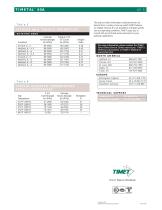
TECHNICAL SUPPORT First in Titanium Worldwide TMC-0160 Printed in USA ©2000 Titanium Metals Corporation
Open the catalog to page 2All TIMET catalogs and technical brochures
 TIMETAL ® 10-2-3
2 Pages
 TIMETAL ® 17
2 Pages
 TIMETAL ® 21S
4 Pages
 TIMETAL ® Grade 12
2 Pages
 TIMETAL 230
2 Pages
 TIMETAL 75A
2 Pages
 TIMETAL 50A
2 Pages
 TIMETAL 35A
2 Pages
*Prices are pre-tax. They exclude delivery charges and customs duties and do not include additional charges for installation or activation options. Prices are indicative only and may vary by country, with changes to the cost of raw materials and exchange rates.