

TIMETAL ® 21S

TIMETAL ® 21S
Catalog excerpts
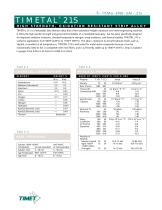
ELEMENT WEIGHT % Ti-15Mo-3Nb-3Al-.2SiTIMETAL® 21S HIGH STRENGTH, OXIDATION RESISTANT STRIP ALLOY TIMETAL 21S is a metastable beta titanium alloy that offers substantial weight reductions over other engineering materials. It offers the high specific strength and good cold formability of a metastable beta alloy, but has been specifically designed for improved oxidation resistance, elevated temperature strength, creep resistance, and thermal stability. TIMETAL 21S is useful for applications from 550°F (228°C) to 1100°F (593°C). The alloy's resistance to aircraft hydraulic fluids, such as Skydrol, is excellent at all temperatures. TIMETAL 21S is well suited for metal matrix composites because it can be economically rolled to foil, is compatible with most fibers, and is sufficiently stable up to 1500°F (816°C). Strip is availabl e in gauges from 0.016 in (0.4mm) to 0.090 in (2.3mm). Property T (°F) T (°C) Value Value SI Specific Heat Capacity Temperature air cool equivalent air cool equivalent Modulus of Elasticity Solution Treated 75 24
Open the catalog to page 1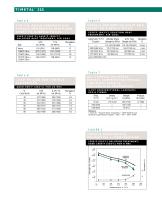
1 5 5 0 ° F (843°C)-1 650°F (900°C) SOLUTION HEAT TREATMENT, AIR COOL Age ksi (MPa) ksi (MPa) % Cold Work ksi (MPa) ksi (MPa) % 4-PLY UNIDIRECTIONAL LAMINATE; SCS-6 FIBERS Temp. Density Strength Modulus Reference: J. Sorensen. “Titanium Matrix Composites — NASP Materials and Structures Augmentation Program,” AIAA — 90 — 5207, 10/90.
Open the catalog to page 2
TIMETAL 21S is formed in the solution heat tr eated (as supplied) condition, then aged to the desir ed strength level. The forming characteristics of TIMETAL 21S are similar to those of TIMETAL® 15-3. Typical minimum bend radii ar e 1.0 - 1.5 times the thickness. Cold reductions greater than 80% are possible in compressive operations, including rolling, spinning and swaging. Because of relatively low work hardenability, maximum tensile deformations are achieved when strains ar e uniform, such as in hydr oforming and bulge-forming. CHEMIC AL MILLING HYDROGEN PICKUP FOR SOLUTION H E AT T R E AT...
Open the catalog to page 3
RESIDUAL ROOM TEMPERATURE TENSILE PROPERTIES FOR 0.052 in STRIP AGED AT 1 2 7 5 ° F (641 ° C) FOR 8 HRS PLUS 1200°F (691°C) FOR 8 HRS PRIOR TO EXPOSURE IN AIR STRESS STABILITY AT 1000°F (538°C) — 30 ksi (207 MPa) AGED AT 1100°F (593°C) FOR 8 HRS BEFORE EXPOSURE Exposure Time hrs. Surface Removed (1) Ultimate Tensile 0.2% Yield Strength Strength Elong. ksi (MPa) ksi (MPa) % Exposure RT Tensile After Exposure Time hrs UTS ksi (MPa) YS ksi (MPa) % Elong. None None Broke Before Yield Broke Before Yield (1) Descaled and pickled to remove 0.004 in (0.010cm) Warm Airframe of Engine Structure...
Open the catalog to page 4All TIMET catalogs and technical brochures
 TIMETAL ® 10-2-3
2 Pages
 TIMETAL ® 17
2 Pages
 TIMETAL ® Grade 12
2 Pages
 TIMETAL 230
2 Pages
 TIMETAL 75A
2 Pages
 TIMETAL 65A
2 Pages
 TIMETAL 50A
2 Pages
 TIMETAL 35A
2 Pages