

TIMETAL ® 17

TIMETAL ® 17
TIMETAL® 17 is a high-strength, deep hardenable forging alloy primarily used in jet engines. It is a near-alpha alloy that can be heat-treated to various strength levels in sections up to 6 inches. The alloy offers good ductility, toughness, low-cycle and high-cycle fatigue properties, and high creep resistance at intermediate temperatures.
The alloy consists of Aluminum (4.5-5.5%), Tin (1.6-2.4%), Zirconium (1.6-2.4%), Molybdenum (3.5-4.5%), Chromium (3.5-4.5%), with minor amounts of Carbon, Nitrogen, Oxygen, Hydrogen, and residuals.
Density is 0.168 lb/in³ (4.65 g/cm³). The Beta Transus temperature is 1635°F (890.5°C). The tensile modulus ranges from 16-16.5 Msi (110-113 GPa).
Solution Treat & Age (STA) involves heating at 1475°F for 4 hours followed by water quenching, then aging at 1175°F for 8 hours with air cooling. Stress relief before finish machining is done at 1020°F for 4 hours with air cooling.
- Low Cycle Fatigue: At 75°F, the total cycles to failure range from 3,180 to 60,600 depending on strain levels. At 600°F, cycles range from 3,600 to over 86,000.
- High Cycle Fatigue: At 75°F, cycles to failure range from 21,000 to 7,000,000 depending on stress levels. At 600°F, cycles range from 37,000 to over 15,000,000.
- Tensile Properties: At 77°F, the ultimate tensile strength (UTS) ranges from 160-180 ksi with 8-15% elongation.
- Fracture Toughness: Yield strength is 168 ksi with KIC values ranging from 26-31 ksi√in.
- Stress Rupture: At 400°F, stress levels range from 137 to 145 ksi with time to rupture from 0.01 to over 1,000 hours.
- Creep Properties: At 400°F, stress levels range from 115 to 120 ksi with time to 0.2% strain from 0.01 to 2,200 hours.
Consult TIMET technical personnel for specific applications and operating conditions. Contact information for North America and Europe is provided for further assistance.
Catalog excerpts
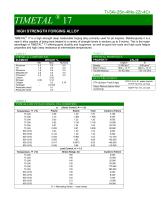
TIMETAL® 17 is a high strength deep hardenable forging alloy primarily used for jet engines. Metallurgical^ it is a near-p alloy capable of being heat treated to a variety of strength levels in sections up to 6 inches. This is the major advantage of TIMETAL® 17 offering good ductility and toughness, as well as good low-cycle and high cycle fatigue properties and high creep resistance at intermediate temperatures. CHEMICAL COMPOSITION (PHYSICAL PROPERTIES HEAT TREATMENT STA (Solution Treat & Age) Stress Relieve (before finish machining) 1475°F for 4 hr, water quench, 1175°F for 8 hr, air cool 1020°F for 4 hr, air cool TYPICAL LOW CYCLE FATIGUE, STA CONDITION As (Strain Control, A* = 1.0) Temperature, °F (°C) Plastic Elastic Load Control, A* = 1.0 Stress Range, ksi 160 155 145 135 130 120 130 125 122 121 _120_ Alternating Stress -r- mean stress
Open the catalog to page 1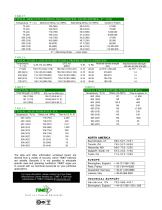
TYPICAL HIGH CYCLE FATIGUE, STA CONDITION (LOAD CONTROL, A* = 0.95) Temperature, °F (°C) Maximum Stress, ksi (MPa) Alternating Stress, ksi (MPa) Cycles to Failure A* = Alternating Stress + mean stress TYPICAL TENSILE AND NOTCHED TENSILE PROPERTIES, STA CONDITION Notched tensile strength _(ksi)_ At 75°F= 200-220 210-220 200-210 185-195 185-195 Notched tensile strength + ultimate tensile strength FRACTURE TOUGHNESS TYPICAL STRESS RUPTURE PROPERTIES (STA) Yield Strength, ksi (MPa) KIC, ksiVin (MPaVm) 168(1158) 26-31 (28.6-34.1) TYPICAL CREEP PROPERTIES, STA Temperature, °F(°C) Stress, ksi (MPa)...
Open the catalog to page 2All TIMET catalogs and technical brochures
 TIMETAL ® 10-2-3
2 Pages
 TIMETAL ® 21S
4 Pages
 TIMETAL ® Grade 12
2 Pages
 TIMETAL 230
2 Pages
 TIMETAL 75A
2 Pages
 TIMETAL 65A
2 Pages
 TIMETAL 50A
2 Pages
 TIMETAL 35A
2 Pages