
- Catalogs
- Swing Flugsportgeräte GmbH
- MITO 2 RS

MITO 2 RS
MITO 2 RS
This document provides guidelines for inspecting paragliders and paramotors under the German Ordinance on Testing Aviation Equipment (LuftGerPV). It highlights the owner's duty to ensure inspections follow manufacturer instructions and occur at specified intervals. Special rules apply to 'heavy trikes' with an unladen mass over 120 kg.
Inspection Intervals
Inspection intervals differ by glider type, with some requiring annual checks or every 100 flight hours, while others need inspection every two years or 150 flight hours. Adherence to the intervals in the Instruction Manual and equipment labeling is crucial.
Who Can Carry Out the Inspection?
Inspections must be performed by individuals with a current unrestricted license for paragliders/hang-gliders. Additional training and experience are necessary for third-party or tandem glider inspections. Wing units for heavy trikes must be inspected by the manufacturer or an authorized importer.
Documents and Equipment Required
Essential documents include the manufacturer's maintenance instructions, airworthiness instructions, and previous inspection reports. Required equipment includes a gauge, Bettsometer, and line length table.
Inspection Procedure
The inspection process involves:
- Identifying equipment using certification labels and documentation.
- Inspecting the canopy for porosity, tear resistance, holes, and worn areas.
- Checking connections such as risers and quick links for wear and functionality.
- Assessing line strength and lengths, ensuring they meet specified standards.
- Conducting a visual inspection of trim and adjustment, particularly brake lines.
Canopy Inspection
Porosity is measured with specific instruments, and tear resistance is tested with a Bettsometer. Significant wear or damage requires returning the glider to the manufacturer.
Connections and Lines
Inspect risers and quick links for wear and ensure all stitching is firm. Line strength is tested using a tensile strength device, with specific lines selected for testing.
Conclusion
All inspections must be documented, and any defects or deviations from standards should be addressed by returning the glider to the manufacturer or an authorized inspector.
Inspection and Maintenance Procedures for Paragliders
1. Line Strength and Replacement:
Lines must hold at least 25kg regardless of 'g' load. If line values are above the upper limit, they are acceptable. If values fall between limits, inspect soon; below limits, replace the cascade. Replaced lines are marked and recorded with replacement date and flight hours.
2. Visual Inspection of Lines:
Inspect main, cascade, and brake lines for damage, starting from the middle. Check sewing, sheath condition, loops, knots, stitching, and quick links. Defective lines must be replaced immediately, using the line plan for ordering.
3. Measuring Line Length and Trim:
Measure lines with a 5daN load; compare results to Maintenance and Service book. Permissible tolerance varies by line cascade; ensure correct trim. Adjustments and replacements must be recorded in the inspection report.
4. Visual Inspection of Trim and Adjustment:
Inflate glider and inspect canopy and lines before test flight. Ensure brake lines are correctly set up before flight.
5. Material and Technical Information:
Refer to the Maintenance and Service book, available online.
6. Documentation:
Record all measurements and repairs in the inspection report. Reports must be signed, dated, and kept for 4 years.
7. Inspection Records:
Include paraglider model, size, serial number, date, inspector, and signature.
Catalog excerpts
Version: Date: Paraglider and paramotor glider inspection
Open the catalog to page 1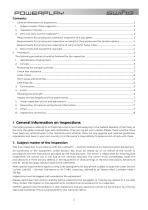
I General information on inspections The legal provisions referred to in these instructions are those applying in the Federal Republic of Germany at the time the glider received type-test certification. They are not set out in detail. Please check whether there have been any amendments in the meantime and whether there are any regional and national guidelines, regulations and laws (in your own country). It is the owner’s responsibility to observe and comply with these. 1. Subject matter of the inspection This is an inspection in accordance with the LuftGerPV – German Ordinance on Testing Aviation...
Open the catalog to page 2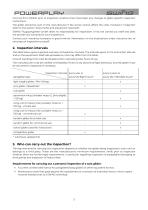
Find out from SWING prior to inspection whether there have been any changes to glider-specific inspection instructions. The glider should be sent to the manufacturer if the owner cannot afford the costs involved in inspection (refer to the section "Documents and equipment required”). SWING Flugsportgerate GmbH takes no responsibility for inspections it has not carried out itself and does not provide any warranty for such inspections. Contact your insurance company in good time for information on the implications under insurance law of carrying out inspections yourself. The table below gives a...
Open the catalog to page 3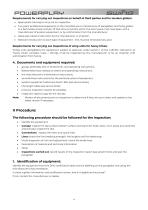
Requirements for carrying out inspections on behalf of third parties and for tandem gliders: • Appropriate training to carry out an inspection. • Two years' professional experience in the manufacture or maintenance of paragliders and hang-gliders or a technically similar activity. Of that time, 6 months within the last 2 years must have been with a manufacturer of aviation equipment, or by confirmation from the manufacturer. • Adequate relevant instruction by the manufacturer or importer. • Relevant introduction to each type of equipment - this must be renewed every year. Requirements for carrying...
Open the catalog to page 4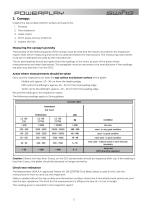
2. Canopy: Inspect the top surface, bottom surface and seams for: 1. 2. Tear resistance 3. Holes / tears 4. Worn areas and any stretches 5. Inspect the ribs Measuring the canopy’s porosity The porosity of the following parts of the canopy must be read and the results recorded in the inspection report. Note which measuring instrument is used (and follow the instructions). The measuring instruments must be re-calibrated annually by the manufacturer. The air permeability should be higher than the readings in the chart, at each of the areas where measurements are taken (see below). The paraglider...
Open the catalog to page 5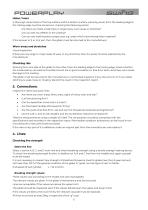
Holes / tears A thorough visual check of the top surface and the bottom surface, panel by panel, from the leading edge to the trailing edge must be carried out, checking the following points: Are there any holes, small holes or larger tears, worn areas or stretches? Can you see any defects in the coating? Can you see anything else conspicuous e.g. areas which have already been repaired? If the answer to 1) or 2) is 'yes', then the glider must be returned to the manufacturer. Worn areas and stretches Visual inspection: If there are any large or major areas of wear or any stretches, then the panel...
Open the catalog to page 6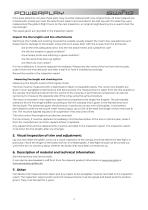
If the lines tested do not pass these tests, they must be replaced with new original lines. All lines replaced are marked with a black pen near the attachment (seam) and recorded in the test log with the date they were replaced and the glider's flight hours. At the next inspection, an original neighbouring line is used to test the line strength. The values given are recorded in the inspection report. Inspect the line lengths and line attachments Starting at the middle and working towards the outside, visually inspect the main lines, cascade lines and brake lines for damage to the sheath, kinks...
Open the catalog to page 7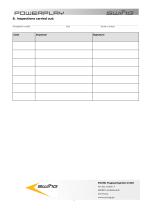
Paraglider model Serial number SWING Flugsportgerate GmbH An der Leiten 4 82290 Landsberied Germany www.swing.de
Open the catalog to page 8All Swing Flugsportgeräte GmbH catalogs and technical brochures
 EscApe
24 Pages
 Orange Cross
28 Pages
 BRAVE 4
1 Page
 Connect Race lite
33 Pages
 CONNECT REVERSE 3
32 Pages
 ARCUS 2 RS
48 Pages
Archived catalogs
 Mirage RS PLUS
16 Pages
 Spitfire 2 Plus
22 Pages
 TWIN RS 2
2 Pages
 ARCUS RS LITE
44 Pages
 AGERA RS
2 Pages
 Discus
2 Pages
 scorpio
2 Pages
 Hybrid
2 Pages
 NEXUS serie
2 Pages
 discus series
2 Pages
 ARCUS 7
2 Pages
- Sport paraglider
- Single place paraglider
- Parachute
- Performance paraglider
- Single place free flight harness
- Paragliding free flight harness
- Reserve parachute
- Single place parachute
- Piston engine paramotor
- Single-seat paramotor
- Light free flight harness
- Sport parachute
- Seated position free flight harness
- Mountain paraglider
- Intermediate paraglider
- Cross paraglider
- Airbag harness bag
- Two place paraglider