
- Catalogs
- SupAir-VLD
- KINDER 2

KINDER 2

KINDER 2
The KINDER 2 is a tandem passenger harness designed for paragliding, requiring pilot knowledge of tandem flying. It meets European and German safety standards (EN 1651:2018 and LTF Nfl II 91/09). Users are advised to adjust the harness on static hang-posts before the first flight.
Technical Specifications
The harness is designed for children aged 6 to 12, with a pilot size range of 100-150 cm and weight range of 20-60 kg. It weighs 1.95 kg and includes features like a polypropylene seat plate and BUMPAIR back protection. It is certified for a maximum in-flight weight of 80 kg and is suitable for tandem flights but not for aerobatic flying or use with a reserve parachute.
Components and Assembly
The harness includes a polypropylene seat plate and self-locking zicral carabiners. Accessories like the seat plate and BUMPAIR should be installed carefully following the provided instructions.
Adjustments
Proper adjustment of the harness is crucial for safety and comfort. This includes adjusting the shoulder straps, backrest, and chest strap according to the wing manufacturer's recommendations.
Flight Phases
The manual outlines procedures for pre-flight checks, take-off, in-flight adjustments, and landing. It emphasizes the importance of maintaining a vertical posture during take-off and landing upwind in a standing posture.
Maintenance
Regular cleaning and maintenance are recommended, using mild cleaning agents and avoiding harsh chemicals. Carabiners and buckles should be checked regularly, especially in dusty or marine environments. The harness should be stored in a dry, cool place away from UV exposure.
Warranty and Disclaimer
SUPAIR offers a five-year limited warranty against manufacturing defects. The harness is intended exclusively for paragliding, and SUPAIR is not responsible for misuse or accidents.
Pilot's Gear
Pilots are advised to wear certified helmets, appropriate clothing, and carry a reserve parachute. Insurance and pilot certification are also recommended.
Service Book
A section is provided for recording maintenance and resale information, ensuring the harness is kept in optimal condition.
Catalog excerpts

User’s manual PARC ALTAÏS 34 RUE ADRASTÉE 74650 ANNECY CHAVANOD FRANCE RCS 387956790 Indice de révision : V1 09/02/20
Open the catalog to page 1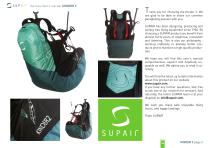
Harness User’s manual | KINDER 2 hank you for choosing the Kinder 2. We are glad to be able to share our common paragliding passion with you. SUPAIR has been designing, producing and selling free flying equipment since 1984. By choosing a SUPAIR product you benefit from almost thirty years of expertise, innovation and listening. This is also our philosophy : working endlessly to develop better products and to maintain a high quality production. We hope you will find this user’s manual comprehensive, explicit and hopefully enjoyable as well. We advise you to read it carefully. You will find the...
Open the catalog to page 2
Harness User’s manual | KINDER 2 Introduction 4 Technical specifications 5 Size choice 6 Components list 6 Harness Overview 7 Accessories assembly 8 Seat plate 8 Carabiners8 Bumpair9 Adjustments 10 The various adjustments 10 Adjusting the harness 11 Spreader bars/harness Connection 12 Flight phases 13 Pre-Flight check 13 Take-off 13 In flight 13 Landing 14 Towing 14 Mandatory controls 14 In case of an incident 15 Maintenance 16 Harness cleaning and maintenance 16 Storage and transport 16 Product longevity 16 LIST OF CONTENTS Repairs / spare parts Materials Recycling Warranty Disclaimer Pilot’s...
Open the catalog to page 3
Harness User’s manual | KINDER 2 Welcome to the world of paragliding according to SUPAIR, a world of shared passion. This harness has all the makings of a great one. However, it is a passenger tandem harness and not a solo harness: your presence as a pilot and your knowledge of tandem flying are required. Please also observe the flying and insurance regulations for tandem flights applicable in your country. The well though-out design and choice of materials were guided by the same quality and durability objectives. The KINDER 2 harness was certified EN 1651 : 2018 and LTF Nfl II 91/09. Indicating...
Open the catalog to page 4
Harness User’s manual | KINDER 2 TECHNICAL SPECIFICATIONS Harness size Pilot size (cm) Pilot weight (mini - maxi) (kg) Harness weight (+ carabiners+speedbar)(kg) Designed for Back lenght (cm) Backrest tilt adjustment (cm) Seat length (cm) Seat width (cm) Carabiners height (cm) Carabiners distance (cm) Back protection Certification Maximum in flight weight ( certification ) Tandem (Pilot or Passenger) Aerobatic flying Towing Reserve parachute Back lenght Seat width Backrest tilt adjustment Carabiners height Seat length Carabiners distance
Open the catalog to page 5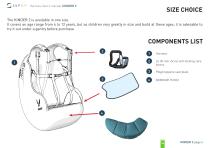
Harness User’s manual | KINDER 2 SIZE CHOICE The KINDER 2 is available in one size. It covers an age range from 6 to 12 years, but as children vary greatly in size and build at these ages, it is advisable to try it out under a gantry before purchase. 2x 30 mm Zicral self-locking carabiners Polypropylene seat plate
Open the catalog to page 6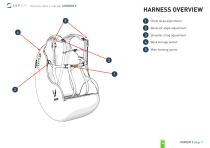
Harness User’s manual | KINDER 2 HARNESS OVERVIEW Backrest angle adjustment Shoulder strap adjustment Back storage pocket Chest strap adjustment Main hooking points
Open the catalog to page 7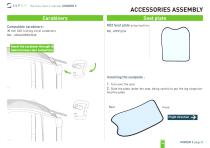
Harness User’s manual | KINDER 2 ACCESSORIES ASSEMBLY Carabiners Compatible carabiners : 30 mm Self-locking zicral carabiners Réf. : MAILCOMOUS30 Seat plate KD2 Seat plate polypropylène Réf. :MPPL034 Insert the carabiner through the main harness riser connection. 1. Turn over the seat 2. Slide the plate under the seat, being careful to put the leg straps behind the plate Front Flight direction
Open the catalog to page 8
Harness User’s manual | KINDER 2 ACCESSORIES ASSEMBLY BUMPAIR Insert the bumpair behind the seat.
Open the catalog to page 9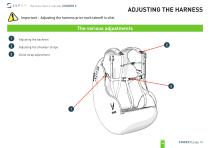
Harness User’s manual | KINDER 2 Important : Adjusting the harness prior each takeoff is vital. Adjusting the shoulder straps Chest strap adjustment
Open the catalog to page 10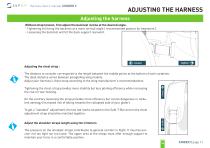
Harness User’s manual | KINDER 2 ADJUSTING THE HARNESS Adjusting the harness Without strap tension, first adjust the backrest incline at the desired angle. - Tightening will bring the backrest at a more vertical angle ( recommended posture for beginners ). - Loosening the backrest will tilt the back support rearward. Adjusting the chest strap : The distance to consider corresponds to the length between the middle points at the bottom of each carabiner. The ideal distance varies between paragliding wing models. Adjust your harness’s chest strap according to the wing manufacturer’s recommendations....
Open the catalog to page 11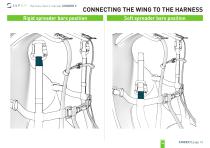
Harness User’s manual | KINDER 2 CONNECTING THE WING TO THE HARNESS Rigid spreader bars position Soft spreader bars position
Open the catalog to page 12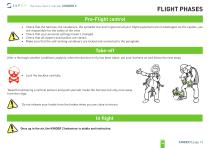
Harness User’s manual | KINDER 2 FLIGHT PHASES Pre-Flight control • Check that the harness, the carabiners, the spreader bar and in general all your flight equipment are not damaged. As the captain, you are responsible for the safety of the crew • Check that your personal settings haven’t changed. • Check that all zippers and buckles are closed. • Make sure that the self-locking carabiners are locked and connected to the paraglider. Take-off After a thorough weather conditions analysis, when the decision to fly has been taken, put your harness on and follow the next steps • Lock the buckles carefully....
Open the catalog to page 13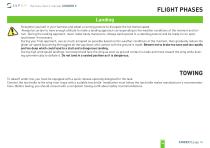
Harness User’s manual | KINDER 2 FLIGHT PHASES Landing Straighten yourself in your harness and adopt a running posture to dissipate the horizontal speed. Always be certain to have enough altitude to make a landing approach corresponding to the weather conditions of the moment and terrain. During the landing approach, never make hasty maneuvers. Always land upwind in a standing posture and be ready to run upon touchdown if necessary. During your final approach, use as much airspeed as possible based on the weather conditions of the moment, then gradually reduce the glider air speed by pushing...
Open the catalog to page 14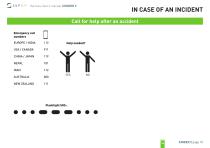
Harness User’s manual | KINDER 2 Call for help after an accident Emergency call numbers EUROPE / INDIA CHINA / JAPAN Help needed?
Open the catalog to page 15
Harness User’s manual | KINDER 2 Harness cleaning and maintenance It is a good idea to clean your harness from time to time. We recommend using a brush and soft solvents only ( soap or mild cleaning agents ). Rinse thoroughly. Never use aggressive chemicals such as strong solvents which could be harmful to the harness’s fabric, webbings, stitching and weaken its integrity. The zip fasteners should be lubricated from time to time, using a silicon spray. If you regularly use your harness in a dusty environment ( dirt, sand, etc... ), we advise you to regularly check and maintain your carabiners...
Open the catalog to page 16All SupAir-VLD catalogs and technical brochures
 RADICAL 3
30 Pages
 VIP LITE
14 Pages
 EVEREST3
18 Pages
 MINIMAX BUMP
17 Pages
 EVO LITE
39 Pages
 DELIGHT 3
31 Pages
 SKYPPER 2
37 Pages
 ACRO 4
34 Pages
 ALTIRANDO LITE
33 Pages
 PIXAIR 2
35 Pages
 ACCESS 2 BUMP
38 Pages
 ACCESS 2 AIRBAG
37 Pages
 MINIMAX 3
22 Pages
 WALIBI 3
38 Pages
 STRIKE 2
40 Pages
 LOUSTIC 2
20 Pages
 FLUID
FLUID30 Pages
 START
START15 Pages
 SHINE
SHINE22 Pages
 STEP
STEP36 Pages
 LEAF 2
36 Pages
 LEAF 2 LIGHT
32 Pages
 SAVAGE
30 Pages
 STEP light
29 Pages
 SORA 2 PLUS
28 Pages
 EONA 3
36 Pages
 CATALOGUE SUPAIR 2017 2018
39 Pages

- Sport paraglider
- Single place paraglider
- Performance paraglider
- Single place free flight harness
- Paragliding free flight harness
- Reserve parachute
- Single place parachute
- Light free flight harness
- Sport parachute
- Seated position free flight harness
- Mountain paraglider
- Performance parachute
- Intermediate paraglider
- Cross paraglider
- Airbag harness bag
- Beginner paraglider
- Two place paraglider
- Two place parachute