
- Catalogs
- SupAir-VLD
- EVEREST3

EVEREST3

EVEREST3
The SUP’AIR EVEREST3 harness is designed for beginner and progressing paragliders, offering comfort and safety for cross-country flights. It is certified under EN 1651:1999, meeting European safety standards. Users are advised to perform a hang-test before the first flight.
Technical Specifications
The harness is available in two sizes (S/M and L) with specific dimensions for pilot height, weight, and harness weight. It is designed exclusively for paragliding and is not suitable for acrobatic flying.
Size Choice
A height/weight chart is provided to assist in selecting the correct harness size. A preliminary hang-test is recommended to ensure proper fit.
Components and Equipment Overview
The harness includes Edelrid Ease screwgate carabiners, storage pockets, and options for a light double-stage accelerator/speed-bar. Key components include main hooking points, speed-bar grommets, chest and leg straps.
Setup and Connection
Instructions are provided for connecting the wing to the harness using self-locking carabiners, ensuring risers are untwisted and properly positioned. The speed-bar setup involves threading lines through grommets and adjusting length according to wing specifications.
Flight Behavior and Phases
Initial flights should be conducted in calm conditions. The harness offers precise piloting and comfort for mountaineering adventures. Pre-flight checks include inspecting the harness and carabiners, and ensuring the speed-bar is correctly connected.
Speedbar Use
Use the speed-bar cautiously to avoid risks of collapses. It should not be used as a footrest during takeoff. Proper technique involves symmetrical pressure application and reversing the procedure to decelerate.
Landing and Towing
Landings should be made with sufficient altitude and upwind. Towing requires a quick release system connected to the main carabiner points.
Maintenance and Care
Regular cleaning with mild agents is recommended. The harness should be stored in a dry, cool place, and inspected biannually for wear and tear. Carabiners should be replaced every 5 years or 500 flight hours.
Materials and Recycling
The harness is made from environmentally friendly materials, with components that are recyclable. Users are encouraged to dispose of materials according to local recycling rules.
Warranty and Disclaimer
SUP’AIR offers a five-year limited warranty against manufacturing defects. The harness is intended solely for paragliding, and SUP’AIR is not responsible for misuse or accidents.
Service Book
A section is provided for recording maintenance and resale information.
Catalog excerpts

SUP’AIR - VLD 34 rue Adrastée Parc Altaïs 74650 Annecy - Chavanod FRANCE 45°54.024’N / 06°04.725’E User’s manua
Open the catalog to page 1
Harness User’s manual Thank you for choosing the EVEREST3 We are glad to be able to share our common paragliding passion with you. SUP’AIR has been designing, producing and selling free flying equipment since 1984. By choosing a SUP’AIR product you benefit from almost thirty years of expertise, innovation and listening. Our mission statement: research and develop to constantly enhance our product line. We hope you will find this user’s manual comprehensive, explicit and hopefully enjoyable as well. We advise you to read it carefully. You will find the lastest udated information about this product...
Open the catalog to page 2
Harness User’s manual Introduction Technical specifications. Size choice Components list Equipment overview Pulling on the harness Wing/harness connection Speedbar setup Flight behavior Flight phases Pre-Flight check Takeoff Speed-bar use Landing Towing Mandatory thorough checkup Maintenance Harness cleaning and maintenance Storage and transport Product lifespan Repairs Spare parts. Materials Recycling Warranty Disclaimer Pilot’s gear Service Book
Open the catalog to page 3
Harness User’s manual Welcome to the paragliding world according to SUPAIR a world of shared passion. The EVEREST3 was designed for pilots coming out of school or in progression. It brings comfort and peace of mind to pilots experiencing their first XC ( Cross-Country ) flights to discover new horizons ! The well though out design and materials choices were guided by light and compact objective keeping a highl quality level. The harness EVEREST3 harness was certified EN 1651 : 1999 Indicating that it meets European and German safety requirements. After reading this manual we suggest you to check...
Open the catalog to page 4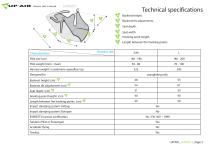
Harness User’s manual Technical specifications Harness size Backrest tilt adjustments. Seat depth. Seat width Backrest height. Hooking point height. Length between the hooking points. Pilot weight (mini - maxi) Harness weight (+carabiners+speedbar) (g) paragliding only Hooking point height. (cm) Length between the hooking points. (cm) Backrest tilt adjustments (cm) Impact damping system: Airbag Impact damping system: Bumpair Tandem (Pilot or Passenger) Acrobatic flying
Open the catalog to page 5
Harness User’s manual Size choice Choosing the right harness size is important. You will find below a height/weight chart to help you with your size choice. With its hammock architecture and reclined flying posture, we advise you to try out the harness during a hang-test first at one of our retailers location to choose the correct size. For a complete list of our retailers list click here : www.supair.com Preliminary hang-test.
Open the catalog to page 6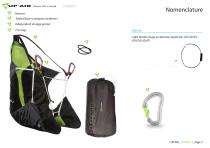
Harness User’s manual Edelrid Ease screwgate carabiners independent storage pocket Light double stage accelerator/speed-bar (réf. ACCELSOUPLELIGHT)
Open the catalog to page 7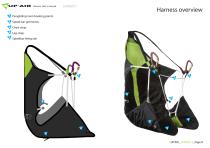
Harness User’s manual Harness overview 1 Paragliding main hooking points. 2 Speed-bar grommets. 3 Chest strap 4 Leg strap. 5 Speedbar fixing tab
Open the catalog to page 8
Harness User’s manual Carabiners assembly with «O» ring Pulling on the harness 1. Thread
Open the catalog to page 9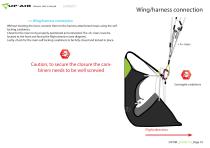
Harness User’s manual Wing/harness connection >> Wing/harness connection Without twisting the risers, connect them to the harness attachment loops using the selflocking carabiners. Check for the risers to be properly positioned and untwisted. The «A» risers must be located at the front and facing the flight direction (see diagram). Lastly, check for the main self-locking carabiners to be fully closed and locked in place. « A » risers Caution, to secure the closure the carabiners needs to be well screwed Screwgate carabiners Flight direction. SUP’AIR _EVEREST3
Open the catalog to page 10
Harness User’s manual Speed-bar assembly LIGHT 2B speed-bar/accelerator. Ref..: ACCELSOUPLELIGHT Regarding either side of the harness: 1. Push the speed-bar line through the grommet located at the front of the seat. 1 2. Push the speed-bar line through the grommet located on the lateral skirt of the harness. 2 3. Finally, attach a cimped hook to the cord before connecting it to the glider’s speed-bar/accelerator. 4. Simulate the speed-bar/accelerator’s functionality by sliding the cord back and forth. >> Installing the accelerator. Connect it to the wing using the split hooks. Once the accelerator/speedbar...
Open the catalog to page 11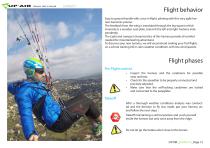
Harness User’s manual Flight behavior Easy to ground handle with, once in flight, piloting with this very agile harness becomes precise. The feedback from the wing is translated through the leg suports which inversely to a wooden seat plate, transmit the left and right motions independently. The Light and compact characteristics of this harness provide all comfort needed for mountaineering adventures To discover your new harness, we will recommend making your first flights on a school training hill in calm weather conditions with low wind speeds. Flight phases Pre-Flight control. • • • Inspect...
Open the catalog to page 12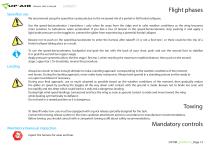
Harness User’s manual Flight phases Speedbar use. We recommend using the speed-bar cautiously due to the increased risk of a partial or full frontal collapses. Use the speed-bar/accelerator ( transitions ) only when far away from the ridge and in calm weather conditions as the wing becomes more sensitive to turbulence when accelerated. If you feel a loss of tension in the speed-bar/accelerator, stop pushing it and apply a light brake pressure on the toggles to prevent the glider from experiencing a potential frontal collapse. Beware not to push on the speed-bar/accelerator to enter the harness...
Open the catalog to page 13
Harness User’s manual Harness cleaning and maintenance. It is a good idea to clean your harness from time to time. We recommend using a brush and soft solvents only ( soap or mild cleaning agents ). Rinse thoroughly. Never use aggressive chemicals such as strong solvents which could be harmful to the fabric, webbings, stitching and weaken the overall integrity of the harness. The zippers should be lubricated from time to time using a silicon spray. If you regularly use your harness in a dusty environment ( dirt sand etc... ) we advise you to regularly check and maintain your carabiners and buckles...
Open the catalog to page 14All SupAir-VLD catalogs and technical brochures
 RADICAL 3
30 Pages
 VIP LITE
14 Pages
 MINIMAX BUMP
17 Pages
 EVO LITE
39 Pages
 DELIGHT 3
31 Pages
 SKYPPER 2
37 Pages
 ACRO 4
34 Pages
 ALTIRANDO LITE
33 Pages
 PIXAIR 2
35 Pages
 ACCESS 2 BUMP
38 Pages
 ACCESS 2 AIRBAG
37 Pages
 MINIMAX 3
22 Pages
 WALIBI 3
38 Pages
 STRIKE 2
40 Pages
 KINDER 2
20 Pages
 LOUSTIC 2
20 Pages
 FLUID
FLUID30 Pages
 START
START15 Pages
 SHINE
SHINE22 Pages
 STEP
STEP36 Pages
 LEAF 2
36 Pages
 LEAF 2 LIGHT
32 Pages
 SAVAGE
30 Pages
 STEP light
29 Pages
 SORA 2 PLUS
28 Pages
 EONA 3
36 Pages
 CATALOGUE SUPAIR 2017 2018
39 Pages

- Sport paraglider
- Single place paraglider
- Performance paraglider
- Parachute
- Single place free flight harness
- Paragliding free flight harness
- Reserve parachute
- Single place parachute
- Light free flight harness
- Sport parachute
- Seated position free flight harness
- Mountain paraglider
- Performance parachute
- Intermediate paraglider
- Cross paraglider
- Airbag harness bag
- Beginner paraglider
- Two place paraglider
- Two place parachute