

Hangar Door Buyer's Guide
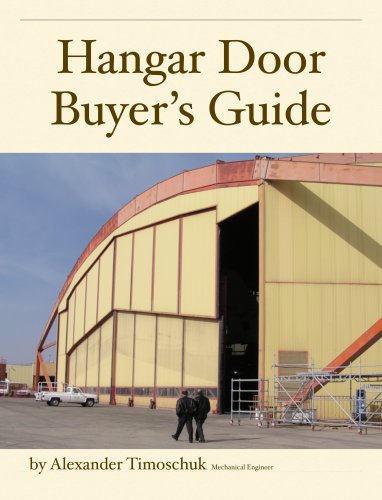
Hangar Door Buyer's Guide
Hangar doors must endure various forces beyond those dictated by building codes, including drive system forces and wheel servicing loads. Most manufacturers do not provide diagonal bracing, relying instead on exterior cladding screws, which can lead to structural issues over time. The bottom member of the door, which houses the wheels, is crucial for proper operation and should be designed to resist more than just wind load.
Bottom rolling hangar doors run on rails embedded in concrete, which must support both the door's weight and wind load. The rails should be made from hard materials as specified by standards like ASCE or BS11. Installation of these rails is often left to contractors, which can lead to errors. Proper installation is critical, as changes are impossible once concrete is poured.
Effective drainage systems are essential to prevent water accumulation and subsequent erosion of concrete and rusting of rails. Manufacturers should provide drainage systems integrated with the building's drainage to avoid costly and ineffective homemade solutions.
Key components include wheels, top rollers, and door bumpers. Wheels should be large, made of hardened alloy steel, and equipped with large bearings and axels for durability. Top rollers must accommodate roof deflection and transfer wind loads effectively. Door bumpers should be robust enough to absorb impact loads.
Proper sealing is crucial to prevent environmental infiltration, which can lead to increased heating costs or maintenance issues. The design must allow for easy maintenance and replacement of seals, especially at the top of the door.
Drive systems should use high-quality gearboxes and motors, with a preference for helical bevel gearboxes over worm gears. Controls should be sophisticated, incorporating features like Variable Speed Drives (VSDs) for smooth operation, and should meet recognized standards like UL.
Catalog excerpts

Hangar Door Buyer’s Guide by Alexander Timoschuk Mechanical Engineer
Open the catalog to page 1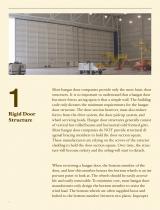
Rigid Door Structure ! Most hangar door companies provide only the most basic door structures. It is so important to understand that a hangar door has more forces acting upon it that a simple wall. The building code only dictates the minimum requirements for the hangar door structure. The door section however, must also endure forces from the drive system, the door pick-up system, and wheel servicing loads. Hangar door structures generally consist of vertical hot rolled beams and horizontal cold-formed girts. Most hangar door companies do NOT provide structural diagonal bracing members to hold...
Open the catalog to page 2
Hangar Door Structure Engineered to be rigid. Designed to be attractive. Built with craftsmanship. Understanding what you are buying is the only way to get your moneys worth. Don’t get fooled with false economies. wheel mounting will lead to poor rolling of the door as well as premature rail wear. In many cases, the bolts that secure the wheel are supporting the entire door weight. With small door sections, design flaws sometimes take longer to surface. For larger doors, many companies couple multiple small sections to make one larger section. This technique has serious limitation when not addressed...
Open the catalog to page 3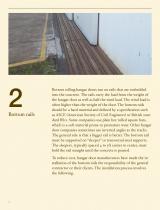
Bottom rails Bottom rolling hangar doors run on rails that are embedded into the concrete. The rails carry the load from the weight of the hangar door as well as half the wind load. The wind load is often higher than the weight of the door. The bottom rails should be a hard material and defined by a specification such as ASCE (American Society of Civil Engineers) or British standard BS11. Some companies use plain hot rolled square bars, which is a soft material prone to premature wear. Other hangar door companies sometimes use inverted angles as the tracks. The general rule is that a bigger rail...
Open the catalog to page 4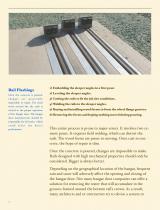
Kail Flashings Once the concrete is poured, changes are practically impossible to make. The form work around the the rails is critical to the proper operation of the hangar door. The hangar door manufacturer should be responsible for all works which could af hct the door’s performance. 1) Embedding the sleeper angles in a first pour. 2) Leveling the sleeper angles. 3) Cutting the rails to fit the job site conditions. 4) Welding the rails to the sleeper angles. 5) Buying and installing wood forms to form the wheel flange grooves. 6) Removing the forms and hoping nothing moved during pouring. This...
Open the catalog to page 5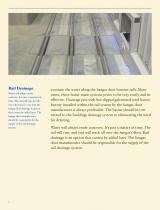
Rail Drainage Water will always erode concrete, it is just a question of time. The rail will rust and the rust will track it’s way into the hangar. Rail drainage is option that cannot be added later. The hangar door manufacturer should be responsible for the evacuate the water along the hangar door bottom rails. Many times, these home-made systems prove to be very costly and ineffective. Drainage pits with hot dipped galvanized steel basins factory installed within the rail system by the hangar door manufacturer is always preferable. The basins should be connected to the buildings drainage system...
Open the catalog to page 6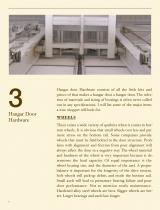
Hangar Door Hardware Hangar door Hardware consists of all the little bits and pieces of that makes a hangar door a hangar door. The selection of materials and sizing of bearings is often never called out in any specifications. I will list some of the major items a wise shopper will look for. WHEELS There exists a wide variety of qualities when it comes to bottom wheels. It is obvious that small wheels cost less and put more stress on the bottom rail. Some companies provide wheels that must be field bolted to the door structure. Problems with alignment and friction from poor alignment will always...
Open the catalog to page 7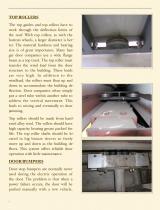
TOP ROLLERS The top guides and top rollers have to work through the deflection limits of the roof. With top rollers, as with the bottom wheels, a larger diameter is better. The material hardness and bearing size is of great importance. Many hangar door companies use a wide flange beam as a top track. The top roller must transfer the wind load from the door structure to the building. These loads are ver y high. In addition to the windload, the rollers must float up and down to accommodate the building deflection. Door companies often simply put a steel tube within another tube to address the vertical...
Open the catalog to page 8
Many hangar door companies provide doorstop bumpers within the top track assemblies. The problem with situating bumpers in the top rails is that the loads required to stop a big door section is tremendously high. The building supplier normally does NOT account for this load. Spec-Dor provides doorstop bumpers that are at the end of the bottom rails. Spec-Dor provides a heavy steel plate that gets embedded into the concrete. The bumpers have large calibrated rubber bumpers that can absorb the crashing load and transfers them to the floor.
Open the catalog to page 9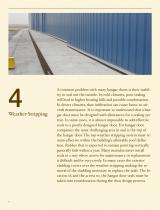
A common problem with many hangar doors is their inability to seal out the outside. In cold climates, poor sealing will lead to higher heating bills and possible condensation. In desert climates, dust infiltration can cause havoc to aircraft maintenance. It is important to understand that a hangar door must be designed with allowances for a sealing system. In some cases, it is almost impossible to add effective seals to a poorly designed hangar door. For hangar door companies the most challenging area to seal is the top of the hangar door. The top weather-stripping system must remain effective...
Open the catalog to page 10
Door Controls and Drives The proper way to motorize a hangar door is with a gearbox driven by an electric brake motor. The gearbox drives one, or more, of the hangar door’s wheels with a chain and sprockets. Hangar door companies, have been providing what appears to be similar drive systems for years. Unfortunately, drive systems are rarely specified in detail. As a result, some hangar door manufacturers undersize, omit, or provide low end products. The type of gearbox is also important. Worm gearboxes are very economical but cannot be back driven. With worm gear gearboxes, towing the hangar...
Open the catalog to page 11All Specdor catalogs and technical brochures
 Portefeuille Spec-Dor
32 Pages
 Brochure Spec-Dor
4 Pages
Archived catalogs
 Portefeuille Spec-Dor
32 Pages