
- Catalogs
- Southbourne Rubber
- CHEMICAL RESISTANCE CHART

CHEMICAL RESISTANCE CHART
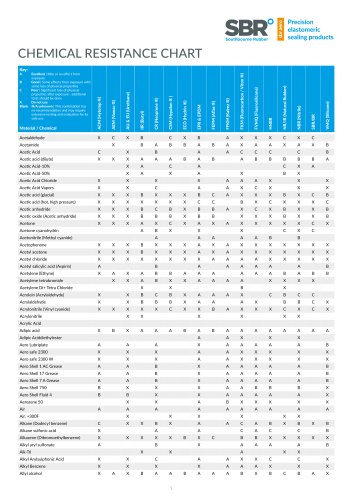
CHEMICAL RESISTANCE CHART
- A: Excellent - Little or no effect from exposure.
- B: Good - Some effects from exposure with some loss of physical properties.
- C: Poor - Significant loss of physical properties after exposure; additional tests should be done.
- X: Do not use.
- Blank: N/A unknown - This combination has no recommendation and may require extensive testing and evaluation for its safe use.
- CM (Hytemp®)
- AEM (Vamac®)
- AU & EU (Urethane)
- IIR (Butyl)
- CR (Neoprene®)
- CSM (Hypalon®)
- ECO (Hydrin®)
- EPR & EPDM
- FEPM (Aflas®)
- FFKM (Kalrez®)
- FKM (Fluorocarbon/Viton®)
- FVMQ (Fluorosilicone)
- HNBR
- NR/IR (Natural Rubber)
- NBR (Nitrile)
- SBR/BR
- VMQ (Silicone)
- Acetaldehyde: Generally not recommended for most materials, with some exceptions like Butyl (B) and EPDM (A).
- Acetic Acid: Varies from excellent resistance in Butyl (A) to poor in others like Neoprene (C).
- Ammonia: Shows good resistance in materials like Butyl (A) and EPDM (A).
- Benzene: Generally not recommended (X) for most materials.
- A: Excellent - Little or no effect from exposure.
- B: Good - Some effects from exposure with some loss of physical properties.
- C: Poor - Significant loss of physical properties after exposure; additional tests should be done.
- X: Do not use.
- Blank: N/A unknown - This combination has no recommendation and may require extensive testing and evaluation for its safe use.
- Potassium Compounds: Generally show excellent resistance (A) across most materials.
- Propane (LPG): Shows varied resistance, with some materials rated as poor (C) or not recommended (X).
- Sodium Compounds: Sodium bicarbonate and its solutions generally show good to excellent resistance across materials.
- Silicone Products: Silicone grease and oil show excellent resistance across most materials, with some exceptions.
- A: Excellent - Little or no effect from exposure.
- B: Good - Some effects from exposure with some loss of physical properties.
- C: Poor - Significant loss of physical properties after exposure; additional tests should be done.
- X: Do not use - The material is not compatible with the chemical.
- Blank: N/A unknown - No recommendation; may require extensive testing and evaluation for safe use.
- CM (Hytemp®)
- AEM (Vamac®)
- AU & EU (Urethane)
- IIR (Butyl)
- CR (Neoprene®)
- CSM (Hypalon®)
- ECO (Hydrin®)
- EPR & EPDM
- FEPM (Aflas®)
- FFKM (Kalrez®)
- FKM (Fluorocarbon/Viton®)
- FVMQ (Fluorosilicone)
- HNBR
- NR/IR (Natural Rubber)
- NBR (Nitrile)
- SBR/BR
- VMQ (Silicone)
Catalog excerpts
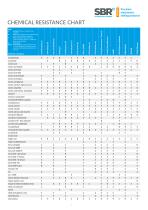
A Excellent | little or no effect from exposure B Good | Some effects from exposure with some loss of physical properties C Poor | Significant loss of physical properties after exposure - additional tests should be done jg Blank N/A unknown | This combination has £ extensive testing and evaluation for its Material / Chemical Precision elastomeric sealing products Acetic acid (dilute) X Acetic Acid Chloride X Acetic Acid Vapors X Acetic acid (glacial) X Acetic acid (hot, high pressure) X Acetic oxide (Acetic anhydride) X Acetone cyanohydrin Acetonitrile (Methyl cyanide) Acetyl salicylic acid (Aspirin) A Acetylene tetrabromide Acetylene Di+ Tetra Chloride Acrolein (Acrylaldehyde) X Acrylonitrile (Vinyl cyanide) X Acrylenitrile Acrylic Acid Adipic Aciddiethylester Aero Lubriplate A Aero Shell 1 AC Grease A Aero Shell 17 Grease A Aero Shell 7 A Grease A Aero Shell Fluid 4 B Alkane (Dodecyl benzene) C Alkane sulfonic acid X Alkyl aryl sulfonate A Alkyl Arylsulphonic Acid X
Open the catalog to page 1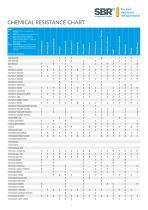
A Excellent | little or no effect from exposure B Good | Some effects from exposure with some loss of physical properties C Poor | Significant loss of physical properties after exposure - additional tests should be done Blank N/A unknown | This combination has no recommendation and may require extensive testing and evaluation for its safe use Material / Chemical Allyl bromide Allyl chloride Aluminium fluoride Aluminum Formate Aluminium hydroxide Aluminium potassium sulfate X C Aluminium sodium sulfate A Aluminium-Potassiumsulfate Solution Aluminum Chloride Solution A Aluminum Hydroxide Solution...
Open the catalog to page 2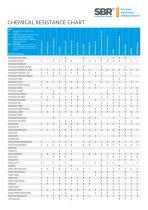
Key: A Excellent | little or no effect from exposure B Good | Some effects from exposure with some loss of physical properties C Poor | Significant loss of physical properties after exposure - additional tests should be done Blank N/A unknown | This combination has no recommendation and may require extensive testing and evaluation for its safe use Precision elastomeric sealing products Ammonium dichromate Ammonium fluoride Ammonium fluosilicate Ammonium hydrogen fluoride Ammonium hydroxide, 3 molar Ammonium hydroxide, conc. Ammonium Hydroxide Solution Ammonium iodide Ammonium nitrate Ammonium...
Open the catalog to page 3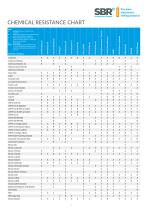
A Excellent | little or no effect from exposure B Good | Some effects from exposure with some loss of physical properties C Poor | Significant loss of physical properties after exposure - additional tests should be done jg Blank N/A unknown | This combination has £ extensive testing and evaluation for its Material / Chemical Antimony pentachloride Antimony trichloride Arsenic Acid, Solution C Arsenic trichloride ASTM fuel A (aliphatic) B ASTM fuel B (30% aromatic) X ASTM fuel C (50% aromatic) X ASTM oil 1 (high aniline) A ASTM oil 2 (medium aniline) A ASTM oil 4 (high aniline) B ATM-Brake Fluid...
Open the catalog to page 4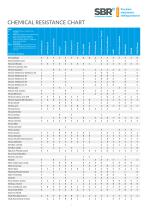
A Excellent | little or no effect from exposure B Good | Some effects from exposure with some loss of physical properties C Poor | Significant loss of physical properties after exposure - additional tests should be done jg Blank N/A unknown | This combination has £ extensive testing and evaluation for its Material / Chemical Precision elastomeric sealing products Benzene Carboxylic Acid Benzine (Gasoline) C Benzoic Acid Benzoic Acid, Solution B Benzene sulfonic acid, 10% X Benzine (Ligroin) (Nitrobenzine) A Benzotrichloride Benzyl Acetate Benzyl Ether Benzoyl peroxide Benzyl acetate Benzyl chloride...
Open the catalog to page 5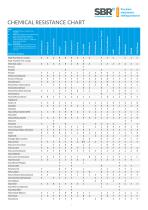
A Excellent | little or no effect from exposure B Good | Some effects from exposure with some loss of physical properties C Poor | Significant loss of physical properties after exposure - additional tests should be done Blank N/A unknown | This combination has no recommendation and may require extensive testing and evaluation for its safe use Material / Chemical Precision elastomeric sealing products Brake fluid (silicone oil base) Brake Fluid (Hd-557) 12 Days Brine (Salt water) Bromine pentafluoride Bromine trifluoride Bromochloro trifluoroethane Bromoethane (Ethyl bromide) Butane (Butyl hydride)...
Open the catalog to page 6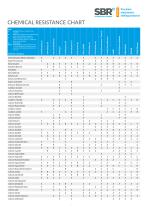
A Excellent | little or no effect from exposure B Good | Some effects from exposure with some loss of physical properties C Poor | Significant loss of physical properties after exposure - additional tests should be done jg Blank N/A unknown | This combination has £ extensive testing and evaluation for its Material / Chemical Precision elastomeric sealing products Butyl phthalate (Dibutyl phthalate) X Butyl stearate Butylene (Butene) Butyric Acid Butyl Ester X Butyric anhydride Butyrone (Dipropyl ketone) Cadmium Acetate Calcium Aluminate Calcium Bichromate Calcium Bisulfide Calcium Hydroxide Calcium...
Open the catalog to page 7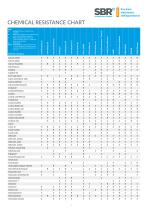
Precision elastomeric sealing products CHEMICAL RESISTANCE CHART Key: FVMQ (Fluorosilicone) NR/IR (Natural Rubber) Calcium sulfide Calcium sulfite Calcium thiosulfate Caliche liquors Camphor Material / Chemical Excellent | little or no effect from exposure B Good | Some effects from exposure with some loss of physical properties C Poor | Significant loss of physical properties after exposure - additional tests should be done X Do not use Blank N/A unknown | This combination has no recommendation and may require extensive testing and evaluation for its safe use Cane sugar liquor Capric acid (Caproic...
Open the catalog to page 8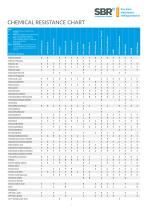
Precision elastomeric sealing products CHEMICAL RESISTANCE CHART Chlorine trifluoride Chlorine, dry Chlorine, liquid Chlorinated Solvents NR/IR (Natural Rubber) Chlorine dioxide Material / Chemical Excellent | little or no effect from exposure B Good | Some effects from exposure with some loss of physical properties C Poor | Significant loss of physical properties after exposure - additional tests should be done X Do not use Blank N/A unknown | This combination has no recommendation and may require extensive testing and evaluation for its safe use FVMQ (Fluorosilicone) Chlorobutadiene (Chloroprene)...
Open the catalog to page 9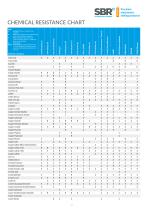
Precision elastomeric sealing products CHEMICAL RESISTANCE CHART Key: FVMQ (Fluorosilicone) NR/IR (Natural Rubber) Citric acid Material / Chemical Excellent | little or no effect from exposure B Good | Some effects from exposure with some loss of physical properties C Poor | Significant loss of physical properties after exposure - additional tests should be done X Do not use Blank N/A unknown | This combination has no recommendation and may require extensive testing and evaluation for its safe use Citrous Oils Cobalt chloride Cocoa Butter Coconut Grease Coconut, Fatty Acid Coffee Extract Coliche...
Open the catalog to page 10All Southbourne Rubber catalogs and technical brochures
 MATERIAL PORTFOLIO
2 Pages
 COMPANY OVERVIEW
6 Pages
 MEDICAL BROCHURE
6 Pages
 AEROSPACE LINE CARD
2 Pages
 DEFENCE BROCHURE
3 Pages
 CIVIL BROCHURE
3 Pages
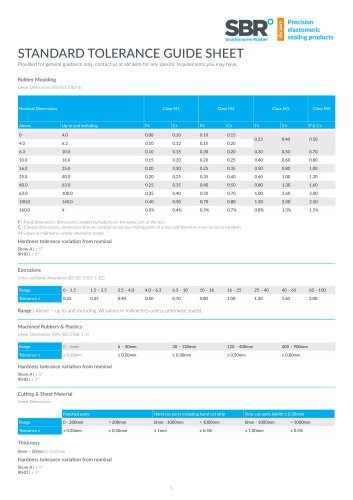 tolerance table
1 Page
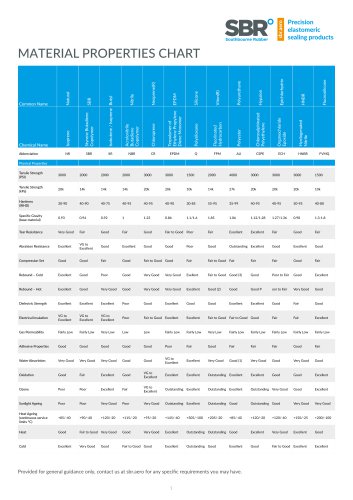 Material properties chart
1 Page