
- Catalogs
- SICK SENSOR INTELLIGENCE
- Safety Switches


Safety Switches

Safety Switches
Safety switches are essential for ensuring the safety of both personnel and machinery by monitoring movable physical guards and determining the position of hazardous movements. The product range includes electro-mechanical and non-contact safety switches, safety locking devices, and safety command devices, all designed to integrate with safe control solutions.
The document highlights the significance of safety switches in industrial settings, focusing on their role in preventing the manipulation and bypassing of protective devices. It references the international standard EN ISO 14119, which provides guidelines for designing and selecting interlocking devices.
These switches, such as the i12S, i16S, i17S, and i110S, are used for safe and economical door monitoring with retaining force. They feature slow-action switching elements, plastic or metal housings, and IP67 enclosure ratings.
Products like RE1, RE2, and STR1 offer high coding levels for enhanced manipulation protection. They are suitable for applications requiring non-contact operation and high safety standards.
Devices such as TR10 Lock and i14 Lock provide interlocking with guard locking, using either power-to-release or power-to-lock principles. They are designed to meet various coding levels and safety requirements.
These include emergency stop pushbuttons (ES11, ES21), rope pull switches (110RP, 150RP), and enabling switches (E100), which are essential for triggering emergency stops and resetting protective devices.
SICK offers various wiring methods, including individual wiring, series connection of sensors with volt-free contacts, and monitored semiconductor outputs. The Flexi Loop system provides a flexible and safe series connection solution.
The document details achievable performance levels for safety switches and evaluation units, emphasizing the importance of selecting the right combination to meet safety standards.
The document provides detailed specifications and applications for each product family, including enclosure ratings, safety integrity levels, and performance levels. It emphasizes the reliability and compliance of these products with international safety standards.
SICK LifeTime Services offer comprehensive support, including consulting, training, upgrades, and system optimization. Customers can register on the SICK website for easy access to products, documentation, and order management.
SICK is a leading manufacturer of intelligent sensors with a global presence in over 50 countries. The company focuses on delivering sensor solutions that enhance safety and efficiency in industrial applications.
Catalog excerpts

PRODUCT OVERVIEW Safety switchesOVERVIEW OF THE PRODUCTS Electro-mechanical safety switches, non-contact safety switches, safety locking devices, safety command devices SICK Sensor Intelligence.
Open the catalog to page 1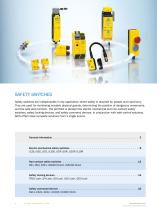
SAFETY SWITCHES Safety switches are indispensable in any application where safety is required for people and machinery. They are used for monitoring movable physical guards, determining the position of dangerous movements, and the safe stop function. The portfolio is divided into electro-mechanical and non-contact safety switches, safety locking devices, and safety command devices. In conjunction with safe control solutions, SICK offers ideal complete solutions from a single source. Safety locking devices . . . . . . . . . . . . . . . . . . . . . . . . . . . . . . . . . . . . . . . . . . . 14...
Open the catalog to page 2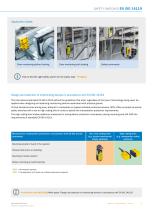
Door monitoring without locking How to find the right safety switch for the safety task ^ Page 6 Design and selection of interlocking devices in accordance with EN ISO 14119 The international standard EN ISO 14119 defines the guidelines that shall, regardless of the type of technology being used, be applied when designing and selecting interlocking devices associated with physical guards. Critical situations arise during every attempt to manipulate or bypass installed protective devices. SICK offers uncoded as well as safety switches with a low or high coding level in order to satisfy the manipulation...
Open the catalog to page 3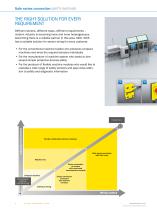
Safe series connection SAFETY SWITCHES THE RIGHT SOLUTION FOR EVERY REQUIREMENT Different sectors, different tasks, different requirements – modern industry is becoming more and more heterogeneous. Good thing there is a reliable partner in this area: SICK. SICK has a suitable solution for sensor wiring for every customer. • For the conventional machine builder who produces compact machines and wires the required sensors individually • For the manufacturer of machine system who wants to wire several simple protective devices safely • For the producer of flexible machine modules who would like...
Open the catalog to page 4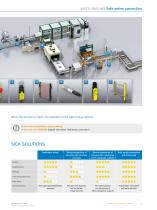
SAFETY SWITCHES Safe series connection When the decision is hard: The selection of the right wiring method When youg www.sick.com/eliminate_fault_masking are looking for the right wiring method, SICK can support you with its many years of comprehensive knowledge in the field of industrial safety. connection“) www.sick.com/8018283 (Special information "Safe series SICK SOLUTIONS Individual wiring Series connection of sensors with volt-free contacts Series connection of sensors with monitored semi-conductor outputs Safe series connection with Flexi Loop The safe and established solution The low-cost...
Open the catalog to page 5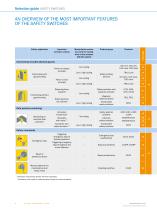
Selection guide safety switches AN OVERVIEW OF THE MOST IMPORTANT FEATURES OF THE SAFETY SWITCHES Interlocking with guard locking Power to release principle Power to lock principle Low coding Low / high coding Low coding Low / high coding Safety locking devices Retaining force required Retaining force not required Safety switches with separate actuator Magnetic safety switches Transponder safety switches Safe position monitoring Activation mechanicaP Activation with metal **) Activation with coded actuator **) Safety commands Triggering emergency stop at defined positions Emergency stop Triggering...
Open the catalog to page 6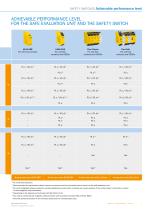
safety switches Achievable performance level Flexi classic For volt-free contacts and OSSDs Flexi Soft For volt-free contacts and OSSDs 1) PL d with fault exclusion. 2) Recommended for applications without overrun movement since the time delay cannot be set via the safe evaluation unit. 3)PL e with integrated dropout protection contact (additional contact which monitors the correct position of the contact block in the built-in version of the emergency stop pushbutton). 4) Depending on the frequency of activation (EN ISO 14119, 8.2). 5)Can only be combined with magnetic safety switches with equivalent...
Open the catalog to page 7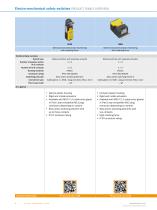
Electro-mechanical safety switches Product family overview Technical data overview Switch type Number of positive action N/C contacts Number of N/O contacts Housing material Enclosure rating Switching principle Connection type Flexi-Loop-ready Safe and economical door monitoring with retaining force Safe and economical door monitoring with retaining force Safety switches with separate actuator 1 / 2 Safety switches with separate actuator 1 / 2 1 / 0 Plastic IP67 (IEC 60529) Slow action switching element Cable gland, 1 x M16 / plug connector, M12, 4-pin – / l 1 / 0 Plastic IP67 (IEC 60529) Slow...
Open the catalog to page 8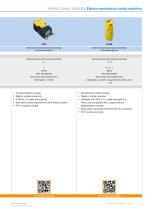
Safety switches with separate actuator 2 Safety switches with separate actuator 2 / 3 1 Plastic IP67 (IEC 60529) Slow action switching element Cable gland, 3 x M20 IP67 (IEC 60529) Slow action switching element Cable gland, 1 x M20 / plug connector, M12, 4-pin - / l Compact plastic housing Rigid or mobile actuators 3 M20 x 1.5 cable entry glands Slow-action switching elements with three contacts IP 67 enclosure rating Standardized metal housing Rigid or mobile actuators Available with M20 X 1.5 cable entry gland or Flexi Loop-compatible M12 plug connector (depending on variant) Slow-action switching...
Open the catalog to page 9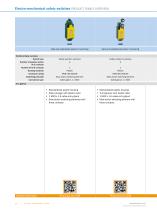
Technical data overview Switch type Safety position switches Safety position switches Number of positive action 2 2 Housing material Plastic Plastic Switching principle Slow action switching element Slow action switching element connection type Cable gland, 1 x M20 Cable gland, 1 x M20 Standardized plastic housing Roller plunger with plastic roller 1 M20 x 1.5 cable entry gland Slow-action switching elements with three contacts Standardized plastic housing Turning lever with plastic roller 1 M20 x 1.5 cable entry gland Slow-action switching element with three contacts...
Open the catalog to page 10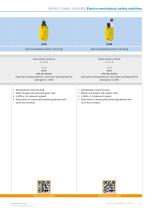
Safety position switches 1 / 2 / 3 1 / 2 Metal IP66 (IEC 60529) Snap action switching element / slow action switching element Cable gland, 1 x M20 Safety position switches 1 / 2 / 3 1 / 2 Metal IP66 (IEC 60529) Snap action switching element / slow action switching element Cable gland, 1 x M20 • Standardized metal housing • Roller plunger with stainless steel roller • 1 M20 x 1.5 cable entry gland • Slow-action or snap-action switching element with up to four contacts • Standardized metal housing • Metal turning lever with plastic roller • 1 M20 x 1.5 cable entry gland • Slow-action or snap-action...
Open the catalog to page 11All SICK SENSOR INTELLIGENCE catalogs and technical brochures
 REGISTRATION SENSORS
24 Pages
 CLV63x, CLV64x, CLV65x
102 Pages
 WTB16 Bluetooth®
135 Pages
 WE9LC-3_A71
3 Pages
 Automation light grids
8 Pages
 Encoders and Inclination Sensors
32 Pages
 Proximity Sensors
324 Pages
 Dust measuring devices
172 Pages
 Detection and Ranging Solutions
124 Pages
 Distance Sensors
404 Pages
 Vision
124 Pages
 Top-Products from SICK
556 Pages
 Fluid Sensors
243 Pages
 Registration Sensors
276 Pages
 Magnetic Cylinder Sensors
164 Pages
 Hand-Held Scanners IDMx
48 Pages
 IDENTIFICATION SOLUTIONS
24 Pages
 Our identification solutions
8 Pages
 FLOWSIC300 Ultrasonic Gas Flow Meter
177 Pages
 FLOWSIC300 Gas flow meters
12 Pages
 FLOWSIC500 Gas flow meters
16 Pages
 FLOWSIC600 Ultrasonic Gas Flow Meter
138 Pages
 FLOWSIC600 Gas Flow Meter
16 Pages
 ConVer
12 Pages
 GM32 In-situ gas analyzers
28 Pages
 GM35 In-Situ IR Gas Analyzer
16 Pages
 Encoders
788 Pages
 Photoelectric Sensors
949 Pages
 Opto Electronic Protective Devices
712 Pages
 GMS800 Extractive Gas Analyzers
20 Pages
 WT100-2 energetic
47 Pages
 VPS Pro Profiling systems
20 Pages
 G6 - Global Sensor
20 Pages


- Airport camera
- Surveillance radar
- Laser scanner
- Aeronautic laser scanner
- Non-contact laser scanner
- Land-based radar
- Spark optical emission camera
- Airport barcode reader
- Measurement laser scanner
- 2D barcode reader
- Fixed barcode reader
- 1D barcode reader
- Baggage barcode reader
- 3D laser scanner
- RFID airport reader
- Portable barcode reader
- Detection radar
- Portable RFID reader
- USB barcode reader
- Boarding pass barcode reader