
- Catalogs
- Shell International Petroleum Company Ltd
- AEROSHELL PISTON ENGINE OILS

AEROSHELL PISTON ENGINE OILS

AEROSHELL PISTON ENGINE OILS
AeroShell piston engine oils have evolved from straight mineral oils to advanced formulations with additives for enhanced thermal and oxidation stability. Initially, metallic salts were used, but due to ash deposits, non-metallic polymeric additives were developed, leading to the AeroShell W Oils range, widely adopted in civil and military aviation.
AeroShell has introduced various grades, including the semi-synthetic multigrade W oil (AeroShell Oil W 15W-50) with anti-wear and anti-corrosion additives. New grades for light sport aviation and diesel engines have also been developed. The transition from U.S. Military Specifications to SAE Standards (J-1966 and J-1899) has modernized performance standards for piston engine oils.
Piston engine oils reduce friction, provide cooling, protect against corrosion, and keep engines clean. AeroShell oils are intended for four-stroke aircraft engines and are not suitable for automotive engines. Selecting the correct oil grade and viscosity is crucial for optimal engine performance.
Regular oil changes are essential to remove contaminants and prevent corrosion, especially in low usage aircraft. Extending oil change intervals is generally not recommended due to potential warranty issues and engine life reduction. Break-in procedures often require straight mineral oils.
Radial engines require higher viscosity oils due to their unique design and stress levels. Vintage aircraft engines may need consultation for appropriate oil replacements. Routine oil analysis is recommended as part of maintenance to detect potential issues early.
AeroShell piston engine oils offer a range of products to meet the diverse needs of aviation piston engines, focusing on performance, protection, and compliance with modern standards.
AeroShell oils are available in different viscosity grades, each corresponding to specific SAE standards. The document lists the U.S., British, French, Russian, and NATO codes for each oil type, along with their typical properties such as density, viscosity, pour point, flash point, total acidity, sulfur content, copper corrosion, and ash content.
The oils are primarily used in four-stroke certified aircraft piston engines. Specific recommendations are provided for different engine types and conditions, such as break-in periods and temperature considerations. The document emphasizes consulting engine manufacturers for precise oil recommendations.
AeroShell oils are designed to promote engine cleanliness, reduce oil consumption, and protect against wear and corrosion. The document highlights the benefits of using these oils, including improved engine performance, reduced sludge formation, and enhanced protection against rust and corrosion.
The oils are approved by major engine manufacturers like Textron Lycoming, Teledyne Continental, and Pratt & Whitney. They meet various military and SAE specifications, ensuring compatibility with a wide range of aircraft engines.
- AeroShell Oils 65, 80, 100, 120: Straight mineral oils used primarily during engine break-in.
- AeroShell W Oils (W80, W100, W120): Non-ash dispersant oils offering stability and anti-foaming performance.
- AeroShell Oil W 15W-50: A semi-synthetic blend providing superior performance across a range of conditions.
- AeroShell Oils W80 Plus and W100 Plus: Single grade oils with enhanced anti-wear and anti-corrosion additives.
Operators are advised to follow manufacturer guidelines for oil selection and maintenance practices to ensure optimal engine performance and longevity. The document also notes the importance of monitoring oil temperatures and adjusting practices based on ambient conditions.
These oils do not require the addition of Lycoming additives and are approved for use in all Continental Motors liquid and air-cooled aircraft piston engines. They are approved by Textron Lycoming and Continental, and comply with various service bulletins and FAA directives. Key properties include a density of 0.883-0.887 kg/l, kinematic viscosity at 100°C of 14.0-19.5 mm²/s, and a flashpoint of 260-288°C.
Developed for light sport 2-stroke engines, this oil is suitable for both unleaded and leaded fuels and can be used in all climates. It is approved for ROTAX® 2-stroke engines and meets API TC requirements. Features include high film strength, engine cleanliness, and corrosion protection. It should not be used in engines requiring Ashless Dispersant oils.
Designed for 4-stroke aviation piston engines like ROTAX® 912 & 914, this oil supports engines using unleaded gasoline and Avgas 100LL. It meets API SL and JASO MA specifications and offers benefits such as reduced oil consumption and enhanced engine cleanliness. It is not suitable for engines requiring Ashless Dispersant oils.
This fully synthetic oil is for diesel aviation piston engines using Jet A or Jet A-1 fuel. It provides superior piston cleanliness and is approved by SMA and Thielert engines. It should not be used in spark ignition or Avgas engines.
Replacing Diesel 10W-40, this oil is also fully synthetic and designed for diesel engines using Jet fuel. It meets Mercedes Benz Specification 229.5 and is approved for Thielert/Centurion® and Austro Engine AE300. It offers excellent wear protection and engine cleanliness.
The document includes a chart showing the kinematic viscosity of various AeroShell oils across different temperatures, highlighting their performance in varying conditions.
Catalog excerpts

AEROSHELL PISTON ENGINE OILS AEROSHELL PISTON ENGINE OILS For many years the performance of aircraft piston engines was such that they could be lubricated satisfactorily by means of straight mineral oils, blended from specially selected petroleum base stocks. However, demand for oils with higher degrees of thermal and oxidation stability necessitated ‘fortifying’ them with the addition of small quantities of non-petroleum materials. The first additives incorporated in straight mineral piston engine oils were based on the metallic salts of barium and calcium. In highly-rated engines the performance of these oils with respect to oxidation and thermal stability was excellent, but the combustion chambers of the majority of engines could not tolerate the presence of the ash deposits derived from these metal-containing additives. Following extensive operational success in a wide range of civil engines, military specifications based on the general characteristics of AeroShell W Oils were prepared and issued. AeroShell W Oils were in service with the world’s airlines and aircraft operators for many years when they operated big transport piston-engined aircraft, during which time these oils became virtually the standard for all aircraft piston engines. Nevertheless, supplies of straight AeroShell Oils remained available primarily for running-in the aircraft piston engine and for the few operators who required them. Today these oils (both AeroShell W Oils and AeroShell Oils) are still required for the smaller piston-engined aircraft flying in air taxi operations, flying clubs or flown by private pilots. In the early 1980s a semi-synthetic multigrade W oil for piston engines (AeroShell Oil W 15W-50) was added to the range. This grade has become very popular amongst engine manufacturers and operators alike. In order to cater for those Lycoming engines which need improved load-carrying (i.e. those engine models which require the addition of Lycoming Additive LW 16702) AeroShell Oil W 15W-50 was upgraded in 1986 to include an antiwear additive. PISTON ENGINE OILS To overcome the disadvantages of harmful combustion chamber deposits, a non-metallic, i.e. non-ash forming, polymeric additive was developed which was incorporated in blends of selected mineral oil base stocks, to give the range of AeroShell W Oils.
Open the catalog to page 1
AEROSHELL PISTON ENGINE OILS In recent years utilisation of piston engine aircraft has decreased, resulting in the aircraft spending more time on the ground. This led to an increase in corrosion being seen inside the engine. In order to combat this, AeroShell Oil W 15W-50 was further upgraded in 1993 to include a very effective anti-corrosion additive package. 3.2 To cater for the demands of operators of light sport aviation piston engines, two new grades – AeroShell Oil Sport Plus 2 (for 2-stroke engines) and AeroShell Oil Sport Plus 4 (for 4-stroke engines) have recently been introduced. With...
Open the catalog to page 2
AEROSHELL PISTON ENGINE OILS PISTON ENGINE OILS Due to differences in metallurgy, operating conditions and fuel specifications, an aircraft oil will not meet all of the automobile/heavy-duty engine's requirements. In addition, the aviation oils are not qualified for this application and their use could result in voiding the warranty and/or reduction in engine life. Thus automobile oils MUST NOT be used in aircraft engines which use or specify SAE J-1899 or J-1966 oils. Similarly aviation oils MUST NOT be used in automobile engines. SELECTION OF RIGHT GRADE OF OIL For the majority of aircraft...
Open the catalog to page 3
AEROSHELL PISTON ENGINE OILS RADIAL ENGINES Many operators are interested in extending oil change intervals. As a general rule extensions are not recommended for the following reasons: Radial engines utilise special parts and, depending upon the type of aircraft, application and climate are often subject to specific problems not seen in other types of piston engines. - many engine manufacturers do not approve extended intervals - possibility of losing engine manufacturers’ warranty on the engine - possibility that extended intervals will shorten engine life In a radial engine each bank of cylinders...
Open the catalog to page 4
AEROSHELL PISTON ENGINE OILS It is important to note that the information gained is only as good as the sampling procedure. A single test is not enough to reveal trends and significant changes, it can only tell an operator if there is already a serious problem. Operators should therefore:■ T ake samples properly For best results, take the sample about midway through the draining of hot oil from the sump. A sample pulled off the bottom may be dirtier than normal. The sample should be taken the same way every time. An improperly taken sample can lead to mistaken conclusions about engine problems....
Open the catalog to page 5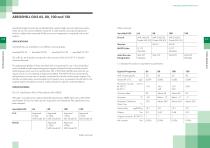
AEROSHELL PISTON ENGINE OILS PISTON ENGINE OILS AeroShell straight mineral oils are blended from selected high viscosity index base stocks. These oils do not contain additives except for a small quantity of pourpoint depressant (which is added when improved fluidity at very low temperature is required) and an antioxidant. APPLICATIONS AeroShell Oils are available in four different viscosity grades: AeroShell Oil 65 - AeroShell Oil 80 - AeroShell Oil 100 - AeroShell Oil 120 The suffix for each grade corresponds to the viscosity of the oil at 210°F in Saybolt Universal Seconds. The appropriate...
Open the catalog to page 6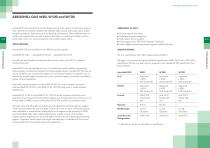
AEROSHELL PISTON ENGINE OILS PISTON ENGINE OILS AeroShell W Oils were the first non-ash dispersant oils to be used in aircraft piston engines. They combine non-metallic additives with selected high viscosity index base stocks to give exceptional stability, dispersancy and anti-foaming performance. These additives leave no metallic ash residues that can lead to deposit formation in combustion chambers and on spark plugs, which can cause pre-ignition and possible engine failure. APPLICATIONS AeroShell W Oils are available in four different viscosity grades: AeroShell Oil W80 - AeroShell Oil W100...
Open the catalog to page 7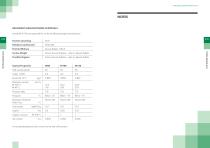
PISTON ENGINE OILS EQUIPMENT MANUFACTURERS APPROVALS AeroShell W Oils are approved for use by the following engine manufacturers:- Typical Properties A viscosity/temperature chart is shown at the end of this section. NOTES AEROSHELL PISTON ENGINE OILS PISTON ENGINE OILS
Open the catalog to page 8All Shell International Petroleum Company Ltd catalogs and technical brochures
 AeroShell Grease 22
2 Pages
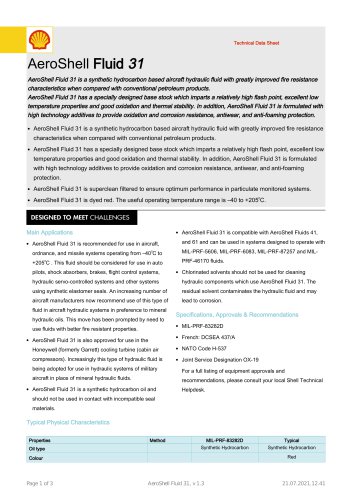 AeroShell Fluid 31
3 Pages
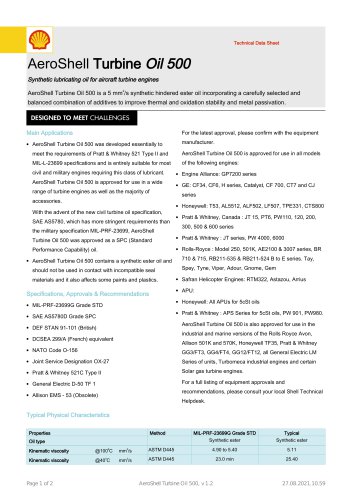 AeroShell Turbine Oil 500
2 Pages
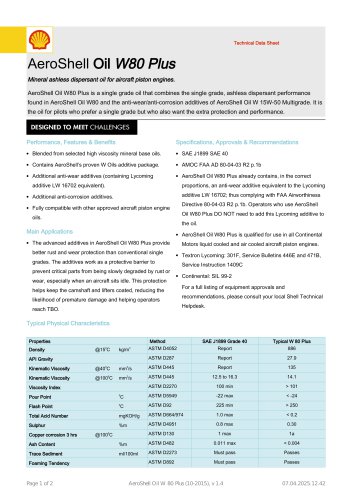 AeroShell Oil W80 Plus
2 Pages
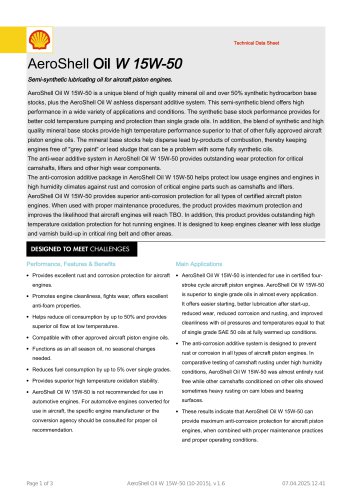 AeroShell Oil W 15W-50
3 Pages
Archived catalogs
 SHELL AVIATION FUELS
11 Pages
 AEROSHELL HYDRAULIC FLUIDS
19 Pages
 AEROSHELL TURBINE ENGINE OILS
28 Pages
 AEROSHELL GREASES
16 Pages