
- Catalogs
- Shell International Petroleum Company Ltd
- AEROSHELL GREASES

AEROSHELL GREASES

AEROSHELL GREASES
AeroShell greases are essential lubricants in aviation, consisting of a thickening agent in a liquid lubricant. They meet various performance requirements for aviation applications.
Greases are categorized into soap-based (aluminum, calcium, sodium, lithium) and non-soap-based (silica gel, clay, substituted urea). Shell's proprietary technologies like Microgel® and Lithium-Complex systems enhance performance beyond simple soap-type thickeners.
Microgel® greases use hectorite clay, offering no melting point, consistent consistency, excellent load-carrying ability, water resistance, and low oil separation.
Common specifications include MIL-PRF-23827 and BMS 3-33. AeroShell Grease 33, with a Lithium-Complex thickener, meets these standards and is a basis for future developments.
AeroShell greases are categorized into multi-purpose, load-carrying, extreme temperature, high-temperature, corrosion-inhibiting, general-purpose, and special greases.
Each grease has specific properties like operating temperature range, load-carrying ability, and resistance to water and corrosion. For instance, AeroShell Grease 7 operates from –73°C to +149°C.
Avoid mixing greases with different thickeners due to incompatibility. Remove old grease or use purging when changing greases.
Consult maintenance manuals for correct grease grade and application. Shorten re-greasing intervals after switching greases.
AeroShell greases are tailored for diverse aviation needs, emphasizing proper selection and application for optimal performance and safety.
Consistent use of chosen grease is recommended. Use grease guns or cartridges to prevent contamination. Avoid wooden scrapers and replace lids immediately when using tins or pails.
Consider lubrication requirements, engineering component factors, environmental factors, and endurance/application factors.
- AeroShell Grease 5: High temperature, suitable for wheel bearings. Range: –23°C to +177°C.
- AeroShell Grease 6: General purpose, suitable for airframe bearings. Range: –40°C to +121°C.
- AeroShell Grease 7: Multi-purpose, suitable for airframe lubrication. Range: –73°C to +149°C.
- AeroShell Grease 14: Helicopter multi-purpose, suitable for rotor bearings. Range: –54°C to +93°C.
- AeroShell Grease 15: Extreme temperature, suitable for high temperature service. Range: –73°C to +232°C.
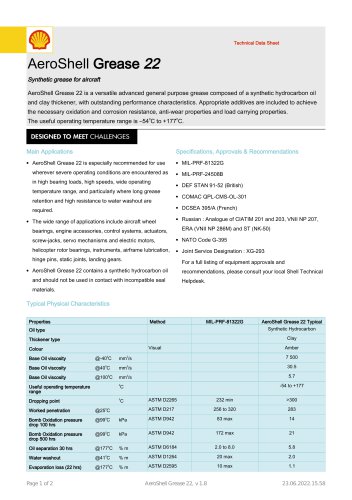
- AeroShell Grease 22: Versatile, suitable for severe conditions. Range: –65°C to +204°C.
- AeroShell Grease 33: Universal airframe, suitable for wide applications. Range: –73°C to +121°C.
Each grease meets specific standards. Verify compatibility with seal materials and application requirements.
These greases are designed for various aircraft, offering benefits like easier maintainability and reduced costs.
- AeroShell Grease 33: Approved by standards like MIL-PRF-23827C. Suitable for general-purpose airframe greasing.
- AeroShell Grease 64: Approved under MIL-G-21164D, fortified with molybdenum disulphide for enhanced properties.
- AeroShell Grease 33: Synthetic oil with lithium complex, effective between -73°C to +121°C, excellent anti-corrosion and anti-wear.
- AeroShell Grease 64: Similar to Grease 33, includes molybdenum disulphide for extreme pressure applications.
AeroShell Grease 33 is used in Boeing, Airbus, and other aircraft for general greasing. Grease 64 is for extreme pressure applications.
Both greases contain synthetic oil and should not be used with incompatible seal materials. Grease 64 was previously known as Grease 33MS.
Catalog excerpts

AEROSHELL GREASES AEROSHELL GREASES THE DEFINITION OF A GREASE IS: “A solid or semi-solid lubricant comprising a dispersion of a thickening agent in a liquid lubricant to which various additives have been added to improve particular properties”. Within the aviation industry, there are many grease lubricated applications covering a very wide range of performance requirements. Those requirements are being increasingly stretched through new technology developments and extended service intervals. Greases, depending on the thickening agent, are broadly classified as either soap-based or non-soap-based. The soap-based greases include, for example, aluminum, calcium, sodium or lithium soaps; the non-soaps silica gel, clay and substituted urea. The low melting points and water solubility of some soap greases limit their usefulness. As a result alternative thickening agents have been developed – soap-complex thickened greases, and non-soap greases with a much higher or no melting point. These thickening agents were developed for greases needing superior high temperature performance characteristics. Shell’s search for thickeners without the limitations of the simple soap-type, led to a family of proprietary technologies including our ‘Microgel®’ and Lithium-Complex systems. Microgel® greases rely on an inorganic grease thickening agent, based on hectorite clay, which has several advantages over simple soap-type thickeners. It provides the AeroShell greases in which it is used with excellent physical properties, as shown below. Those properties make them particularly suitable for multi-purpose as well as specialised applications. 1. No melting point, within any conceivable temperature range for aircraft greases. 2. Very little change in consistency with variation in temperature. 3. Extremely good load carrying ability without the need for extreme pressure additive. 4. xcellent water resistance due to the use of tenacious waterproofing agents developed E by Shell. 5. Low oil separation or ‘bleeding’, because of the high gelling efficiency. During recent years, the number of greases required for aircraft lubrication/maintenance has been reduced by more extensive use of multi-purpose greases. However, because of commercial and technological limitations, special greases are still required. Most aircraft grease requirements are covered by the products in the AeroShell grease range. Many different grease formulations have been developed to meet specific requirements. One of Shell’s recent objectives, as a major supplier of aviation greases, has been the development of wide performance range products where a single grease can cover a multitude of a
Open the catalog to page 1
To minimise the number of greases required per aircraft, the most widely used specification in the aviation industry today is the general purpose grease to MIL-PRF-23827. In the early 2000's the Boeing Company introduced a multi-purpose grease specification (BMS 3-33) to replace many of the different greases previously required in support of Boeing aircraft. This has led to the development of the accompanying specification SAE AMS 3052. The only grease to meet the most challenging set of requirements of the initial BMS 3-33A specification has been AeroShell Grease 33. This ground breaking grease,...
Open the catalog to page 2
GREASE WITH ENHANCED CORROSION INHIBITION AeroShell Grease 33 AeroShell Grease 64 - (with 5% molybdenum disulphide) AeroShell Grease 33 has enhanced corrosion resistance, and resistance to washout from water, de-icing fluids and other maintenance fluids. AeroShell Grease 64 is not subject to any speed restrictions and is widely accepted as an advanced multi-purpose grease. GENERAL PURPOSE GREASES WHICH HAVE A LIMITED OPERATING TEMPERATURE RANGE AeroShell Grease 6 AeroShell Grease 14 AeroShell Grease 6 has a useful temperature range of -40°C to +121°C, good load carrying ability and is inexpensive,...
Open the catalog to page 3
AEROSHELL GREASES APPLICATIONS Whenever an aircraft is certified, all of the greases are specified for each application point on the type certificate. The Type Certificate will specify, either by specification number or by specific brand names, those greases which are qualified to be used. The U.S. Federal Aviation Administration (FAA) regulations state that only greases qualified for specific applications can be used in certified aircraft. Therefore, it is the responsibility of the aircraft owner or designated representative to determine which greases should be used. The useful operating temperature...
Open the catalog to page 4
AEROSHELL GREASES Elastomer/Plastic Mineral Oil Based Synthetic Synthetic Ester Greases Hydrocarbon Based Greases Based Greases Flurocarbon (Viton) Very Good Very Good Very Good Acylonitrile Good Good Poor to Good (high nitrile content is better) Polyester Good Good Poor to Fair Silicone Poor to Good Poor to Good Poor to Fair Teflon Very Good Very Good Very Good Nylon Poor to Good Poor to Good Poor Buna-S Poor Poor Poor Perbunan Good Good Fair to Good Methacrylate Good Good Poor to Fair Neoprene Fair to Good Fair to Good Poor Natural Rubber Poor to Fair Poor to Fair Poor Polyethylene Good Good...
Open the catalog to page 5
AEROSHELL GREASES Always consult the Aircraft Maintenance Manual, Maintenance Planning Document or Component Overhaul Manual, and any associated Service Bulletins for advice on the correct grade of grease to be used in a particular mechanism and on the method of application and/or replacement of that grease. In particular, the latest issues of the following publications should be consulted for the most up-to-date advice: B oeing Service Letter 707-SL-20-012-C/727-SL-20-022C/737-SL-20-027-C/747-SL-20044-C/757-SL-20-022-C/767-SL-20-022-C/777-SL-20-006-C “Summary of Most Commonly Used Greases on...
Open the catalog to page 6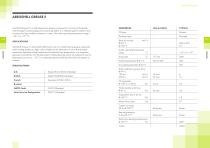
AEROSHELL GREASES AeroShell Grease 5 is a high temperature grease composed of a mineral oil thickened with Microgel®, possessing good load-carrying ability. It is inhibited against oxidation and corrosion and has excellent resistance to water. The useful operating temperature range is -23°C to +177°C. APPLICATIONS AeroShell Grease 5 is particularly effective for use as a wheel bearing grease, especially when landing speeds are high, and is suitable for the lubrication of aircraft and engine accessories operating at high speeds and at relatively high temperatures, e.g. magnetos, generators and...
Open the catalog to page 7All Shell International Petroleum Company Ltd catalogs and technical brochures
 AeroShell Grease 22
2 Pages
 AeroShell Fluid 31
3 Pages
 AeroShell Turbine Oil 500
2 Pages
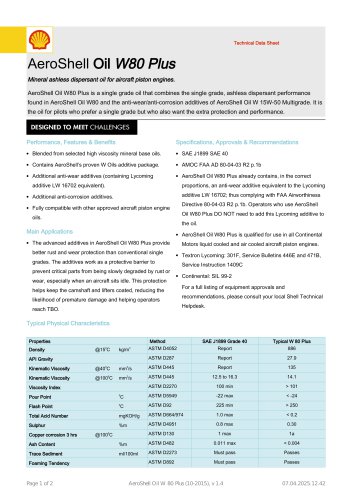 AeroShell Oil W80 Plus
2 Pages
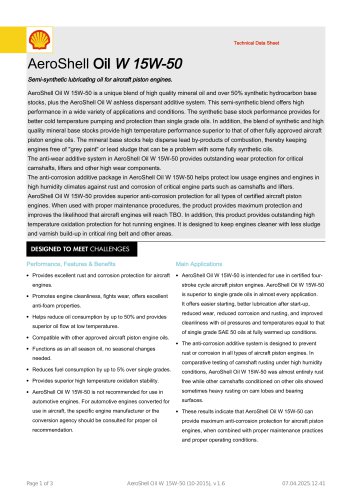 AeroShell Oil W 15W-50
3 Pages
Archived catalogs
 SHELL AVIATION FUELS
11 Pages
 AEROSHELL PISTON ENGINE OILS
16 Pages
 AEROSHELL HYDRAULIC FLUIDS
19 Pages
 AEROSHELL TURBINE ENGINE OILS
28 Pages