
- Catalogs
- SANDVIK MATERIALS TECHNOLOGY
- SANMAC 4571

SANMAC 4571

SANMAC 4571
Sanmac 4571 is a titanium-stabilized, molybdenum-alloyed austenitic chromium-nickel steel known for its improved machinability. It is suitable for producing flanges and other components according to AD-2000-W2 standards.
Standards and Certifications
Sanmac 4571 complies with several standards, including ASTM 316Ti, UNS S31635, EN 1.4571, and DIN X 6 CrNiMoTi 17 12 2. It is certified according to EN 10 204/3.1.
Chemical Composition
The nominal chemical composition includes 0.03% C, 0.4% Si, 1.8% Mn, ≤0.045% P, ≤0.030% S, 17% Cr, 11% Ni, 2.1% Mo, and Ti > 5x(C+N).
Forms of Supply
Sanmac 4571 is available in round-cornered square and round billets with various surface conditions and sizes. Tolerances and lengths vary depending on the billet type.
Mechanical Properties
At 20°C, the material exhibits a proof strength of ≥210 MPa, tensile strength of 515-700 MPa, and elongation of ≥40%. It maintains good impact strength at both room and cryogenic temperatures.
Physical Properties
Sanmac 4571 has a density of 8.0 g/cm³ and exhibits specific thermal conductivity and heat capacity values across different temperatures.
Corrosion Resistance
The steel offers good resistance to general, intergranular, pitting, and crevice corrosion. It is susceptible to stress corrosion cracking above 60°C in chloride environments.
Hot Working and Heat Treatment
Hot working is recommended at 1220-1260°C, followed by rapid cooling. Solution annealing should be performed at 1060-1070°C with rapid cooling.
Welding
Suitable welding methods include manual metal-arc and gas shielded arc welding. Preheating and post-weld heat treatment are generally unnecessary.
Machining
Sanmac 4571 is designed for improved machinability through optimized inclusions and chemical composition. Detailed machining recommendations are provided for various operations.
Applications
Sanmac 4571 is used in industries such as chemical, food, petrochemical, pulp and paper, and nuclear for components like flanges, valves, fittings, and couplings.
Disclaimer
Recommendations are for guidance only, and suitability for specific applications should be confirmed based on actual service conditions.
Catalog excerpts

Sanmac 4571,1.4571/316Ti, is a titanium-stabilized, molybdenum-alloyed austenitic chromium-nickel steel with improved machinability. STANDARDS - ASTM: 316Ti - UNS: S31635 - EN Number: 1.4571 - W.Nr.: 1.4571 - DIN: X 6 CrNiMoTi 17 12 2 Product standards - EN 10088-3 - ASTM A-314 Suitable for the production of flanges etc. according to AD-2000-W2. Certificates Status according to EN 10 204/3.1 CHEMICAL COMPOSITION (NOMINAL) % C Si Mn P S Cr Ni Mo Others Datasheet updated 19-01-2017 12:27:45 (supersedes all previous editions) FORMS OF SUPPLY Sizes and tolerances Round-cornered square as well as round billets are produced in a wide range of sizes according to the following tables. Larger sizes offered on request. Surface conditions Square billets Unground, spot ground or fully ground condition. Round billets Peel turned or black condition. Square billets Size Tolerance Length
Open the catalog to page 1
Sizes and tolerances apply to the rolled/forged condition. Peel turned round billets Size Tolerance Length Unground round billets Size Tolerance Length Other products - Welding wire - Covered electrodes - Seamless tube and pipe (Sanmac) - Hollow bar (Sanmac) MECHANICAL PROPERTIES Testing is performed on separately solution annealed and quenched test pieces. The following figures apply to material in the solution annealed and quenched condition. At 20°C (68°F) Metric units Proof strength Tensile strength Elong. Contr. HB Imperial units Proof strength Tensile strength Elong. Contr. HB...
Open the catalog to page 2
1 MPa = 1 N/mm2 a) Rp0.2 and Rp1.0 correspond to 0.2% offset and 1.0% offset yield strengths, respectively. b) Based on L0 = 5.65 VS0 where L0 is the original gauge length and S0 the original cross-sectional area. Impact strength Due to its austenitic microstructure, Sanmac 4571 has very good impact strength both at room temperature and at cryogenic temperatures. Tests on bar have demonstrated that the steel fulfils the requirements (60 J (44 ft-lb) at -196 °C (-320 °F)), according to the European standards EN13445-2(UFPV-2) and EN 10272. At high temperatures Metric units Temperature Proof...
Open the catalog to page 3
Specific heat capacity Temperature, °C J/kg °C Thermal expansion n Temperature, °C Per °C 1) Mean values in temperature ranges (x10-6) Modulus of elasticity u CORROSION RESISTANCE Datasheet updated 19-01-2017 12:27:45 (supersedes all previous editions)
Open the catalog to page 4
General corrosion Sanmac 4571 has good resistance in: – Organic acids at high concentrations and temperatures Inorganic acids, e.g. phosphoric and sulphuric acids, at moderate concentrations and temperatures. The steel can also be used in sulphuric acid with concentrations above 90% at low temperature. Salt solutions, e.g. sulphates, sulphides and sulphites Austic environments Intergranular corrosion Sanmac 4571 has better resistance to intergranular corrosion than unstabilized steels. The addition of titanium prevents precipitation of chromium carbides in the grain boundaries after prolonged...
Open the catalog to page 5
WELDING Suitable welding methods for Sanmac 4571 are manual metal-arc welding with covered electrodes and gas shielded arc welding, with the TIG and MIG methods as first choice. Preheating and post-weld heat treatment are not normally necessary. Due to the fact that this material is alloyed for improved machinability, there can be higher amounts of surface oxide on the weld bead, compared to standard W.Nr. 1.4571 steels. This may lead to arc instability during TIG welding. Correct setting of the weld current is important. Since this material has low thermal conductivity and high thermal expansion,...
Open the catalog to page 6
Figure 1. Machining chart for Sanmac 4541. The lowest recommended cutting speed is determined by the tendency of the material to stick to the insert (built-up edge), although the integrity of insert clamping and the stability of the machine are also of great significance. It is important to conclude, which wear mechanism is active, in order to optimise cutting data with the aid of the diagram. Turning Sanmac 4571 Recommended insert and cutting data (starting values) Geometry Feed speed MR GC2025 0.30 180 Medium-to-rough machining under less stable Drilling Sanmac 4571 The recommended...
Open the catalog to page 7
Insert Geometry Cutting data, Feed Cutting speed * GC1120 for diameters below 17.5 mm ** stable conditions, otherwise use GC1020 and cutting speed 180 m/min Drilling with Sandvik Coromant Delta C drill, diameter 3 - 12.7 mm Code R415.5. Grade GC1220 (diameter range 3 - 20 mm) Cutting data, Feed* Cutting speed mm/rev. m/min * The lower feed value should be selected for smaller diameters. Drilling with high speed steel (HSS) drill (diameter 1 -3 mm) Cutting data, Feed* Cutting speed* * The lower feed value should be selected for smaller diameters ** The higher cutting speed should be selected...
Open the catalog to page 8
Thread tapping Compared with uncoated threading taps, coated threading taps can improve productivity by up to 100%. For the advantages of coated threading taps to be realised, a generous flow of cooling fluid must be used. The recommendations apply to a tool life of 30 minutes. The higher range of cutting data should be chosen for coated threading taps Sawing Sanmac 4571 Cutting with bandsaws or cold saws gives the best cutting economy. If the demand for surface smoothness is great, circular sawing is preferable. Band sawing gives high productivity, is flexible and incurs low investment costs. When...
Open the catalog to page 9
Industrial categories Typical applications Discs Datasheet updated 19-01-2017 12:27:45 (supersedes all previous editions) Disclaimer: Recommendations are for guidance only, and the suitability of a material for a specific application can be confirmed only when we know the actual service conditions. Continuous development may necessitate changes in technical data without notice. This datasheet is only valid for Sandvik materials. www.smt.sandvik.com/contact-us SMT.SANDVIK.COM
Open the catalog to page 10All SANDVIK MATERIALS TECHNOLOGY catalogs and technical brochures
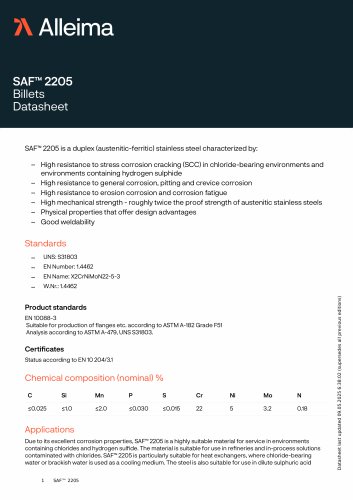 SAF™ 2205
14 Pages
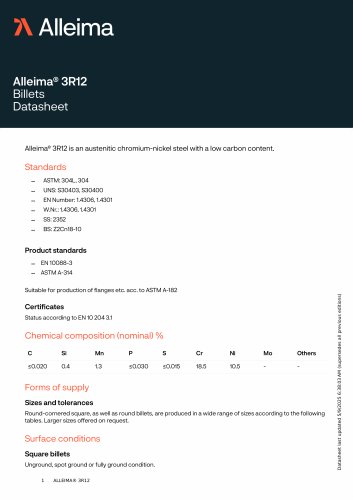 Alleima® 3R12
4 Pages
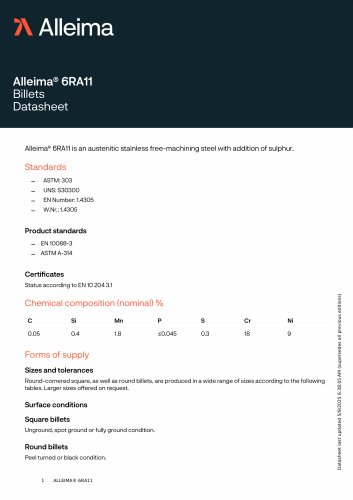 Alleima® 6RA11
3 Pages
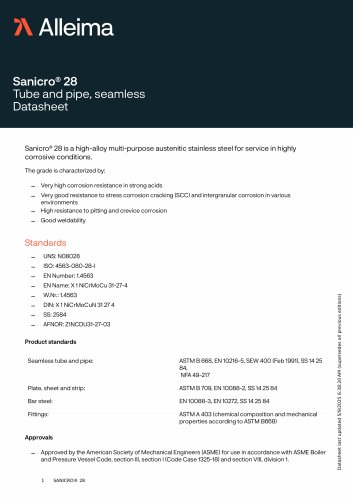 Sanicro® 28
19 Pages
 Sanicro® 35
11 Pages
Archived catalogs
 ROUND BAR SIZES AND GRADES
4 Pages
 SANDVIK ROCK DRILL STEEL
4 Pages
 STAINLESS STEELS FOR MACHINING
29 Pages
 AquaSan Ni50
2 Pages
 Sanmac®329
2 Pages
 APM 9980
4 Pages
 APM 2354, UNS S31603
3 Pages
 APM 2723
5 Pages
 APM 2377, UNS S31803
4 Pages
 Sandvik billets and blooms
10 Pages
 Sandvik precision strip steel
16 Pages
 APM 2327, UNS S32505
4 Pages


