
- Catalogs
- SANDVIK MATERIALS TECHNOLOGY
- SAF™ 2205

SAF™ 2205
SAF™ 2205
Catalog excerpts
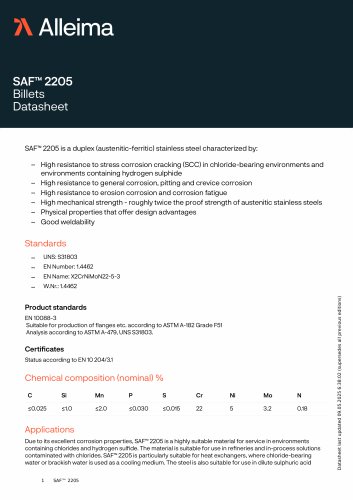
SAF™ 2205 is a duplex (austenitic-ferritic) stainless steel characterized by: - High resistance to stress corrosion cracking (SCC) in chloride-bearing environments and environments containing hydrogen sulphide - High resistance to general corrosion, pitting and crevice corrosion - High resistance to erosion corrosion and corrosion fatigue - High mechanical strength - roughly twice the proof strength of austenitic stainless steels - Physical properties that offer design advantages - Good weldability Suitable for production of flanges etc. according to ASTM A-182 Grade F51 Analysis according to ASTM A-479, UNS S31803. Certificates Status according to EN 10 204/3.1 Chemical composition (nominal) % C Si Mn P S Cr Ni Mo N Applications Due to its excellent corrosion properties, SAF™ 2205 is a highly suitable material for service in environments containing chlorides and hydrogen sulfide. The material is suitable for use in refineries and in-process solutions contaminated with chlorides. SAF™ 2205 is particularly suitable for heat exchangers, where chloride-bearing water or brackish water is used as a cooling medium. The steel is also suitable for use in dilute sulphuric acid Datasheet last updated 09.05.2025 6:38:02 (supersedes all previous editions)
Open the catalog to page 1
solutions and for handling organic acids, e.g. acetic acid and mixtures. The high strength of SAF™ 2205 makes the material an attractive alternative to the austenitic steels in structures subjected to heavy loads. The good mechanical and corrosion properties make SAF™ 2205 an economical choice in many applications, by reducing the life cycle cost of equipment. Industrial categories Typical applications Chemical industry Petrochemical industry Couplings Rings Sha s Forgings Discs Corrosion resistance General corrosion Impurities that increase corrosivity are o en present in acid process solutions....
Open the catalog to page 2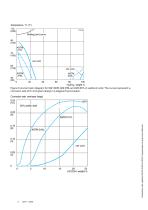
Corrosion rate, mm/year (mpy) HCOOH, weight-% Datasheet last updated 09.05.2025 6:38:02 (supersedes all previous editions)
Open the catalog to page 3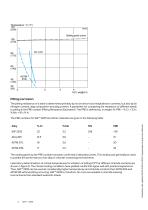
The pitting resistance of a steel is determined primarily by its chromium and molybdenum contents, but also by its nitrogen content, slag composition and slag content. A parameter for comparing the resistance of different steels to pitting is the PRE number (Pitting Resistance Equivalent). The PRE is defined as, in weight-%: PRE = % Cr + 3.3 x % Mo + 16 x % N The PRE numbers for SAF™ 2205 and other materials are given in the following table The ranking given by the PRE number has been confirmed in laboratory tests. This ranking can generally be used to predict the performance of an alloy in chloride-containing...
Open the catalog to page 4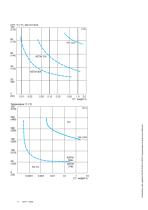
Datasheet last updated 09.05.2025 6:38:02 (supersedes all previous editions)
Open the catalog to page 5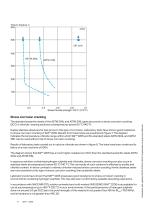
The standard austenitic steels of the ASTM 304L and ASTM 316L types are prone to stress corrosion cracking (SCC) in chloride- bearing solutions at temperatures above 60 °C (140 °F). Duplex stainless steels are far less prone to this type of corrosion. Laboratory tests have shown good resistance to stress corrosion cracking of SAF™ 2205. Results from these tests are presented in figure 7. The diagram indicates the temperature-chloride range within which SAF™ 2205 and the standard steels ASTM 304L and ASTM 316L can be used without risk of stress corrosion cracking. Results of laboratory tests carried...
Open the catalog to page 6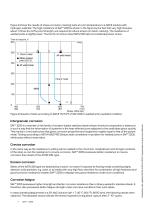
Figure 9 shows the results of stress corrosion cracking tests at room temperature in a NACE solution with hydrogen sulphide. The high resistance of SAF™ 2205 is shown in the figure by the fact that very high stresses, about 1.1 times the 0.2% proof strength, are required to induce stress corrosion cracking. The resistance of welded joints is slightly lower. The ferritic chromium steel ASTM 410 fails at considerably lower stress. Figure 9. Results of tests according to NACE TM 0177 of SAF 2205 in welded and unwelded condition. SAF™ 2205 is a member of the family of modern duplex stainless steels...
Open the catalog to page 7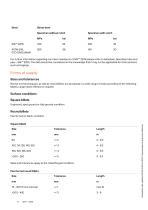
Stress level Specimen without notch Specimen with notch For further information regarding corrosion resistance of SAF™ 2205 please refer to datasheet, Seamless tube and pipe - SAF™ 2205. The data should be considered in the knowledge that it may not be applicable for thick sections such as forgings. Round-cornered square, as well as round billets, are produced in a wide range of sizes according to the following tables. Larger sizes offered on request. Unground, spot ground or fully ground condition. Peel turned or black condition. Square billets Size Tolerance Length Sizes and tolerances apply...
Open the catalog to page 8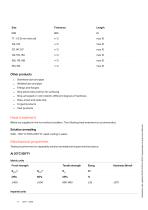
Tensile strength Elong. Hardness Brinell Size Tolerance Lengthmm mm m 77 - 112 (5 mm interval) +/-2 max 10 — Seamless tube and pipe — Welded tube and pipe — Strip electrodes and flux for surfacing — Strip, annealed or cold-rolled to different degrees of hardness — Plate, sheet and wide strip — Forged products — Cast products Billets are supplied in the hot worked condition. The following heat treatment is recommended. 1020 - 1100 °C (1870-2010 °F), rapid cooling in water. Testing is performed on separately solution annealed and quenched test piece. Datasheet last updated 09.05.2025 6:38:02 (supersedes...
Open the catalog to page 9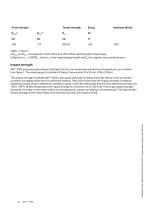
Proof strength Tensile strength Hardness Brinell 1 MPa = 1 N/mm 2 a) Rp0.2 and Rp1.0 correspond to 0.2% offset and 1.0% offset yield strengths respectively. b) Based on L0 = 5.65ÖS0 , where L0 is the original gauge length and S0 the original cross-sectional area. Impact strength SAF™ 2205 possesses good impact strength both at room temperature and at low temperatures, as is evident from figure 1. The values apply for standard Charpy-V specimens (10 x 10 mm, 0.39 x 0.39 in.). Datasheet last updated 09.05.2025 6:38:02 (supersedes all previous editions) The impact strength of welded SAF™ 2205 is also...
Open the catalog to page 10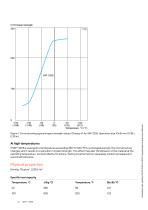
If SAF™ 2205 is exposed to temperatures exceeding 280 °C (540 °F) for prolonged periods, the microstructure changes which results in a reduction in impact strength. This effect may alter the behavior of the material at the operating temperature. Contact Alleima for advice. Testing is performed on separately solution annealed and quenched test piece. Specific heat capacity Temperature, °C J/(kg °C) Temperature, °F Btu/(lb °F) Datasheet last updated 09.05.2025 6:38:02 (supersedes all previous editions)
Open the catalog to page 11All SANDVIK MATERIALS TECHNOLOGY catalogs and technical brochures
 Alleima® 3R12
4 Pages
 Alleima® 6RA11
3 Pages
 Sanicro® 28
19 Pages
 Sanicro® 35
11 Pages
Archived catalogs
 SANMAC 4571
10 Pages
 ROUND BAR SIZES AND GRADES
4 Pages
 SANDVIK ROCK DRILL STEEL
4 Pages
 STAINLESS STEELS FOR MACHINING
29 Pages
 AquaSan Ni50
2 Pages
 Sanmac®329
2 Pages
 APM 9980
4 Pages
 APM 2354, UNS S31603
3 Pages
 APM 2723
5 Pages
 APM 2377, UNS S31803
4 Pages
 Sandvik billets and blooms
10 Pages
 Sandvik precision strip steel
16 Pages
 APM 2327, UNS S32505
4 Pages


