

APM 2723

APM 2723
- Soft Annealing: Heat to 850–900°C, cool in the furnace to 700°C, then in air.
- Stress Relieving: Heat to 600–700°C, hold for 2 hours, cool slowly to 500°C, then in air.
- Hardening and Tempering: Pre-heat to 450–500°C and 850–900°C, austenitize at 1050–1180°C, quench, and temper at 560°C three times.
Catalog excerpts

APM 2723 HOT ISOSTATIC PRESSED (HIP) PRODUCTS DATASHEET APM 2723 is a high alloyed powder metallurgical high speed steel corresponding to ASTM M3:2 with a combination of very good abrasive wear resistance and high compressive strength. Suitable areas of use include demanding cold-work applications like blanking of harder materials like carbon steel or cold-rolled strip steel, as well as use for cutting tools. As with all powder metallurgy tool steels, machinability and grindability are superior to conventional high speed steel due to the very fine microstructure. Thanks to the fully homogenous material achieved in the powder metallurgy process, the dimensional stability after heat treatment is excellent. The process also ensures that the cleanliness of the steel is very high with a low amount of non-metallic inclusions. STANDARDS - ASTM: M3:2 CHEMICAL COMPOSITION (NOMINAL) % Chemical composition (nominal) % C Cr Mo V W Datasheet updated 8/25/2017 11:34:54 AM (supersedes all previous editions) Balance Fe. FORMS OF SUPPLY Components can be supplied in a wide range of dimensions and shapes thanks to the flexibility provided by powder metallurgy and near net shape technology. The products are supplied in the soft annealed condition at approximately 260 HB. PHYSICAL PROPERTIES Density: 7.98 g/cm3, 0.287 lb/in3 Mean coefficient of thermal expansion, 20-100°C: 10.8x10⁻⁶/°C Modulus of elasticity1 Temperature, °C MPa Temperature, °F ksi
Open the catalog to page 1
HEAT TREATMENT Soft annealing Protect the steel from decarburization and oxidation and heat through to 850–900°C (1560–1650°F). Cool in the furnace at 10°C/h (20°F/h) to 700°C (1290°F), then freely in air. Stress relieving After rough machining the tool should be heated to 600–700°C (1110–1290°F), holding time 2 hours. Cool slowly to 500°C (930°F), then freely in air. Hardening and tempering Pre-heating temperature: 450–500°C (840– 930°F) and 850–900°C (1560–1650°F). Austenitizing temperature: 1050–1180°C (1920–2160°F) according to the desired final hardness, see diagram below. The tool should...
Open the catalog to page 2
Machining (grinding, turning, milling) Plastic forming Electrical Discharge Machining Welding (special procedure including preheating and filler materials of base material composition). Grinding During grinding, local heating of the surface, which may alter the temper, must be avoided. Grinding wheel manufacturers can furnish advice on the choice of grinding wheels. For grinding in hardened condition the use of CBN wheels is recommended. Electric discharge machining - EDM If EDM is performed in the hardened and tempered condition, finish with “fine-sparking”, i.e. low current, high frequency....
Open the catalog to page 3
Surface treatment The steel grade is a good substrate material for PVD and CVD coating. If nitriding is requested, a small zone of 215 |jm is recommended. The steel grade can also be steam-tempered if so desired. MACHINING The cutting data below are to be considered as guiding values which must be adapted to existing local conditions. For more information on machining visit sandvik.coromant.com. Turning Cemented carbide HSS Medium Finish Finish Cutting speed m/min 110-160 160-210 12-15 Cutting speed m/min Feed, mm/tooth Cutting depth, mm End milling Cutting speed m/min Feed,...
Open the catalog to page 4
Datasheet updated 8/25/2017 11:34:54 AM (supersedes all previous editions) Disclaimer: Recommendations are for guidance only, and the suitability of a material for a specific application can be confirmed only when we know the actual service conditions. Continuous development may necessitate changes in technical data without notice. This datasheet is only valid for Sandvik materials. www.smt.sandvik.com/contact-us SMT.SANDVIK.COM
Open the catalog to page 5All SANDVIK MATERIALS TECHNOLOGY catalogs and technical brochures
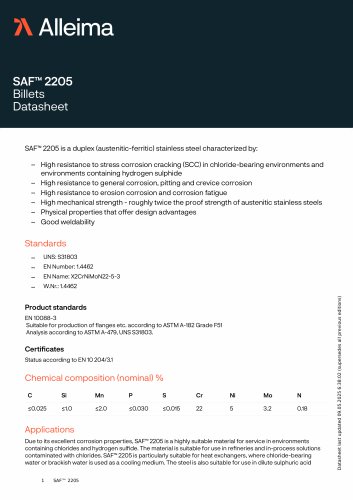 SAF™ 2205
14 Pages
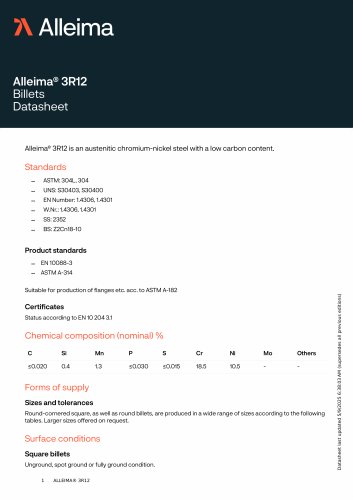 Alleima® 3R12
4 Pages
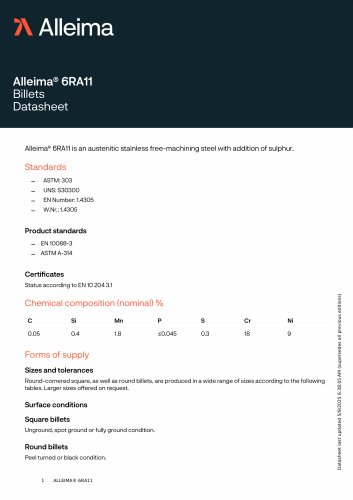 Alleima® 6RA11
3 Pages
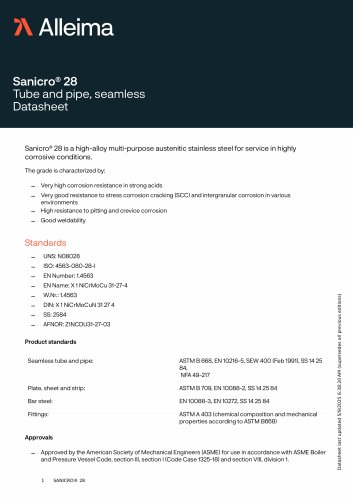 Sanicro® 28
19 Pages
 Sanicro® 35
11 Pages
Archived catalogs
 SANMAC 4571
10 Pages
 ROUND BAR SIZES AND GRADES
4 Pages
 SANDVIK ROCK DRILL STEEL
4 Pages
 STAINLESS STEELS FOR MACHINING
29 Pages
 AquaSan Ni50
2 Pages
 Sanmac®329
2 Pages
 APM 9980
4 Pages
 APM 2354, UNS S31603
3 Pages
 APM 2377, UNS S31803
4 Pages
 Sandvik billets and blooms
10 Pages
 Sandvik precision strip steel
16 Pages
 APM 2327, UNS S32505
4 Pages


