
- Catalogs
- SANDVIK MATERIALS TECHNOLOGY
- APM 2377, UNS S31803

APM 2377, UNS S31803

APM 2377, UNS S31803
APM 2377 is a duplex stainless steel produced through Hot Isostatic Pressing (HIP), known for its high strength and corrosion resistance, suitable for offshore components.
Standards and Approvals
APM 2377 complies with standards such as UNS S31803, S32205, EN 1.4462, NACE MR0175/ISO 15156, ASME B31.3, and is qualified according to NORSOK M650 D44.
Chemical Composition
The nominal chemical composition includes: C <0.03%, Cr 22%, Mo 3.2%, Ni 5%, N 0.18%.
Forms of Supply
Components are available in various dimensions and shapes, supplied in solution annealed and water quenched condition.
Applications
APM 2377 is ideal for environments with chlorides and hydrogen sulphide, suitable for offshore components like valve bodies and manifolds, and for handling dilute sulphuric and organic acids.
Mechanical Properties
At 20ºC, the material has a proof strength of 450 MPa, tensile strength of 655 MPa, elongation of 25%, and hardness ≤25 HRC. It maintains good mechanical properties at elevated temperatures.
Physical Properties
Density is 7.8 g/cm³, with a mean coefficient of thermal expansion of 13.5x10⁻⁶/°C.
Microstructure
HIPed components have isotropic properties, offering uniform mechanical properties in all directions.
Corrosion Resistance
APM 2377 offers superior resistance to general and pitting corrosion compared to ASTM 316L and 317L, with a critical pitting temperature of 25ºC. It also resists stress corrosion cracking in chloride environments.
Heat Treatment
Delivered in heat-treated condition; solution annealing at 1020-1100°C followed by water quenching is recommended for further processing.
Welding
APM 2377 has good weldability with recommended methods including manual metal-arc and gas shielded arc welding. Matching filler metals are advised for optimal properties.
Fabrication
Fabrication should use tools dedicated to stainless steel to prevent contamination.
Machining
APM 2377 requires lower cutting speeds than single-phase steels, with tougher insert grades recommended to handle tool wear and chipping.
Catalog excerpts
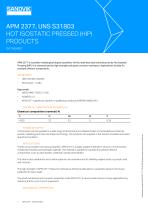
APM 2377, UNS S31803 HOT ISOSTATIC PRESSED (HIP) PRODUCTS DATASHEET APM 2377 is a powder metallurgical duplex (austenitic-ferritic) stainless steel manufactured by Hot Isostatic Pressing (HIP). It is characterized by high strength and good corrosion resistance. Applications include for example offshore components. STANDARDS - UNS: S31803, S32205 - EN Number: 1.4462 Approvals - NACE MR0175/ISO 15156 - ASME B31.3 - APM 2377 supplied by Sandvik is qualified according to NORSOK M650 D44 CHEMICAL COMPOSITION (NOMINAL) % Chemical composition (nominal) % C Cr Mo Ni N Datasheet updated 6/20/2017 1:34:45 PM (supersedes all previous editions) FORMS OF SUPPLY Components can be supplied in a wide range of dimensions and shapes thanks to the flexibility provided by powder metallurgy and near net shape technology. The products are supplied in the solution annealed and water quenched condition. APPLICATIONS Thanks to its excellent corrosion properties, APM 2377 is a highly suitable material for service in environments containing chlorides and hydrogen sulphide. The material is suitable for topside and subsea offshore components, such as valve bodies, manifolds, swivels and headers. The steel is also suitable for use in dilute sulphuric acid solutions and for handling organic acids, e.g. acetic acid and mixtures. The high strength of APM 2377 makes the material an attractive alternative to austenitic steels in structures subjected to heavy loads. The good mechanical and corrosion properties make APM 2377 an economical choice in many applications by reducing the life cycle cost of equipment. MECHANICAL PROPERTIES
Open the catalog to page 1
Mechanical properties at 20°C (68°F) Minimum* Typical * Minimum values according to ASTM 988 Impact toughness values valid for wall thickness up to 325mm (round bar) at T/4. Proof strength at elevated temperatures Temperature PHYSICAL PROPERTIES Density: 7.8 g/cm3, 0.28 lb/in3 Mean coefficient of thermal expansion, 20-100°C: 13.5x10⁻⁶/°C Modulus of elasticity* Temperature, °C MPa Temperature, °F ksi * (x103) MICROSTRUCTURE Hot isostatic pressed components have isotropic properties, meaning the mechanical properties are similar in all directions. Datasheet updated 6/20/2017 1:34:45...
Open the catalog to page 2
Fine isotropic microstructure of HIPed material vs. forged bar. CORROSION RESISTANCE In most media, APM 2377 possesses better resistance to general corrosion than steel of type ASTM 316L and 317L. Pitting corrosion Thanks to the high contents of chromium, molybdenum and nitrogen APM 2377 has good pitting and crevice corrosion resistance. A parameter for comparing the resistance of different steels to pitting corrosion is the PRE number (Pitting Resistance Equivalent). The PRE is defined as, in weight-%: PRE = % Cr + 3.3 x % Mo + 16 x % N. The critical pitting temperature of APM 2377 according...
Open the catalog to page 3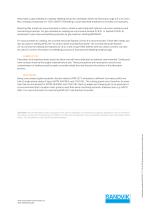
electrodes or gas shielded arc welding. Welding should be undertaken within the heat input range 0.5-2.5 kJ/mm. Max. interpass temperature is 150°C (482°F). Preheating or post-weld heat treatment is normally not necessary. Matching filler metals are recommended in order to obtain a weld metal with optimum corrosion resistance and mechanical properties. For gas-shielded arc welding we recommend Sandvik 22.8.3.L or Sandvik 22.8.3.LSi, developed to give improved welding properties by gas metal arc welding (MIG/MAG). For manual metal-arc welding, the covered electrode Sandvik 22.9.3.LR is recommended....
Open the catalog to page 4All SANDVIK MATERIALS TECHNOLOGY catalogs and technical brochures
 SAF™ 2205
14 Pages
 Alleima® 3R12
4 Pages
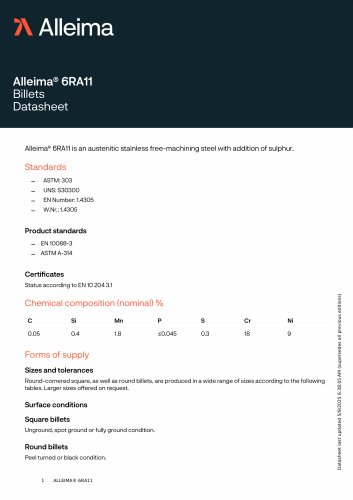 Alleima® 6RA11
3 Pages
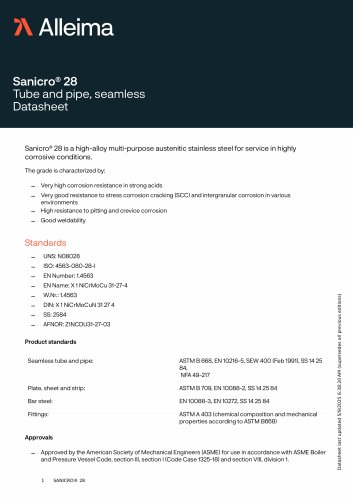 Sanicro® 28
19 Pages
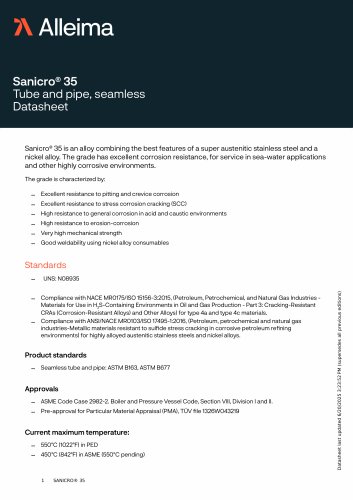 Sanicro® 35
11 Pages
Archived catalogs
 SANMAC 4571
10 Pages
 ROUND BAR SIZES AND GRADES
4 Pages
 SANDVIK ROCK DRILL STEEL
4 Pages
 STAINLESS STEELS FOR MACHINING
29 Pages
 AquaSan Ni50
2 Pages
 Sanmac®329
2 Pages
 APM 9980
4 Pages
 APM 2354, UNS S31603
3 Pages
 APM 2723
5 Pages
 Sandvik billets and blooms
10 Pages
 Sandvik precision strip steel
16 Pages
 APM 2327, UNS S32505
4 Pages


