
- Catalogs
- SANDVIK MATERIALS TECHNOLOGY
- APM 2354, UNS S31603

APM 2354, UNS S31603

APM 2354, UNS S31603
APM 2354 is a powder metallurgical, molybdenum-alloyed austenitic steel with superior corrosion resistance compared to ASTM 304 and 304L. It is commonly used in heat exchangers and condensers across various industries such as chemical, petrochemical, pulp and paper, and food.
Standards and Approvals
The chemical composition of APM 2354 conforms to ASTM A182-F61, ASTM 316L, and UNS S31603. It is approved under UNS S31603, EN Number 1.4435, ASTM A988, and ASME N-834.
Chemical Composition
The nominal chemical composition includes: C <0.03%, Cr 17%, Mo 2.7%, Ni 11.5%, N <0.1%.
Forms of Supply
APM 2354 components are available in various dimensions and shapes due to powder metallurgy and near net shape technology. They are supplied in a solution annealed and water-quenched condition.
Applications
This alloy is used where ASTM 304 and 304L steels are insufficient, such as in heat exchangers, condensers, pipelines, and coils. For higher strength and corrosion resistance, APM 2377 (22Cr Duplex) or APM 2327 (25Cr Super Duplex) are recommended.
Mechanical Properties
At 20ºC (68ºF), the minimum proof strength is 220 MPa (32 ksi), and typical tensile strength is 580 MPa (85 ksi) with 60% elongation. At 354ºC (670ºF), proof strength is 165 MPa (24 ksi) and tensile strength is 430 MPa (62 ksi) with 38% elongation.
Physical Properties
Density is 8.03 g/cm³. The mean coefficient of thermal expansion from 30-100°C is 16.5x10⁻⁶/°C.
Microstructure
Hot isostatic pressed components have isotropic properties, ensuring uniform mechanical properties in all directions.
Corrosion Resistance
APM 2354 offers high resistance to pitting corrosion due to its molybdenum content. It is susceptible to stress corrosion cracking above 60°C (140°F) in chloride environments.
Heat Treatment
Products are delivered heat-treated. If further processing is needed, solution annealing at 1060ºC followed by water quenching is recommended.
Welding
APM 2354 has good weldability. Recommended methods include manual metal-arc welding and gas-shielded arc welding. Preheating and post-weld treatment are generally unnecessary.
Fabrication
Fabrication should use tools dedicated to stainless steel to avoid contamination. Thorough cleaning of tools and surfaces is essential.
Machining
Due to work hardening, low cutting speed, heavier feed, and good lubrication are advised. The isotropic microstructure ensures consistent machining properties.
Catalog excerpts
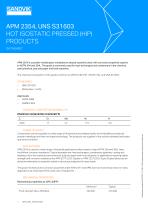
APM 2354 is a powder metallurgical, molybdenum alloyed austenitic steel, with corrosion properties superior to ASTM 304 and 304L. The grade is commonly used for heat-exchangers and condensers in the chemical, petrochemical, pulp and paper and food industries. The chemical composition of the grade conforms to ASTM A182-F61, ASTM 316L, and UNS S31603. STANDARDS - UNS: S31603 - EN Number: 1.4435 Approvals - ASTM A988 - ASME N-834 CHEMICAL COMPOSITION (NOMINAL) % Chemical composition (nominal) % C Cr Mo Ni N FORMS OF SUPPLY Components can be supplied in a wide range of dimensions and shapes thanks to the flexibility provided by powder metallurgy and near net shape technology. The products are supplied in the solution annealed and water quenched condition. APPLICATIONS APM 2354 is used for a wide range of industrial applications where steels of type ASTM 304 and 304L have insufficient corrosion resistance. Typical examples are: heat exchangers, condensers, pipelines, cooling and heating coils in the chemical, petrochemical, pulp and paper and food industries. In applications requiring higher strength and corrosion resistance the APM 2377 (22Cr Duplex) or APM 2327 (25Cr Super Duplex) alloys are an attractive alternative to austenitic steels in structures subjected to heavy loads. The good mechanical and corrosion properties make APM 2377 and APM 2327 an economical choice in many applications by reducing the life cycle cost of equipment. MECHANICAL PROPERTIES Mechanical properties at 20°C (68°F) Minimum* Typical Datasheet updated 5/23/2017 2:48:16 PM (supersedes all previous editions)
Open the catalog to page 1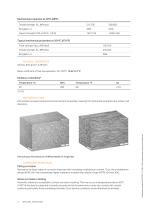
Typical mechanical properties at 354°C (670°F) Proof strength, Rp0.2, MPa (ksi) Tensile strength, Rm, MPa (ksi) Elongation, A PHYSICAL PROPERTIES Density: 8.03 g/cm3, 0.29 lb/in3 Mean coefficient of thermal expansion, 30-100°C: 16.5x10⁻⁶/°C Modulus of elasticity* Temperature, °C MPa Temperature, °F ksi * (x103) MICROSTRUCTURE Hot isostatic pressed components have isotropic properties, meaning the mechanical properties are similar in all directions. CORROSION RESISTANCE Pitting corrosion Resistance to these types of corrosion improves with increasing molybdenum content. Thus, the molybdenum-alloyed...
Open the catalog to page 2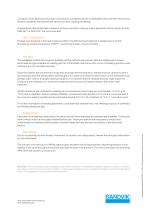
Conditions when plants are shut down must also be considered, as the condensates which are then formed can develop conditions that lead to both stress corrosion cracking and pitting. In applications demanding high resistance to stress corrosion cracking, duplex (austenitic-ferritic) steels, such as APM 2377 or APM 2327 are recommended. HEAT TREATMENT Products are delivered in the heat-treated condition. If additional heat treatment is needed due to further processing, solution annealing at 1060ºC + quenching in water is recommended. WELDING The weldability of APM 2354 is good. Suitable welding...
Open the catalog to page 3All SANDVIK MATERIALS TECHNOLOGY catalogs and technical brochures
 SAF™ 2205
14 Pages
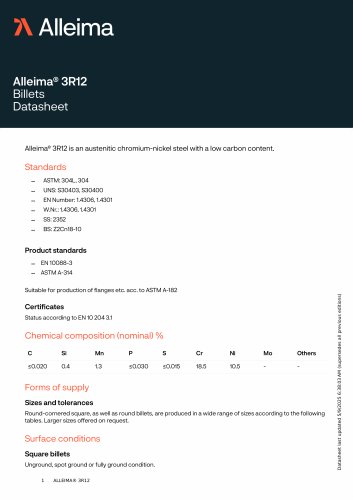 Alleima® 3R12
4 Pages
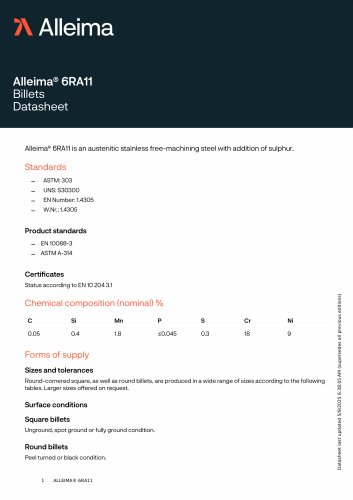 Alleima® 6RA11
3 Pages
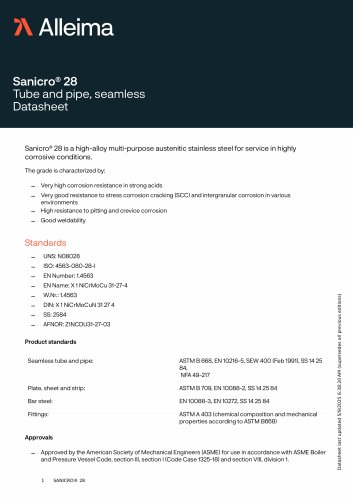 Sanicro® 28
19 Pages
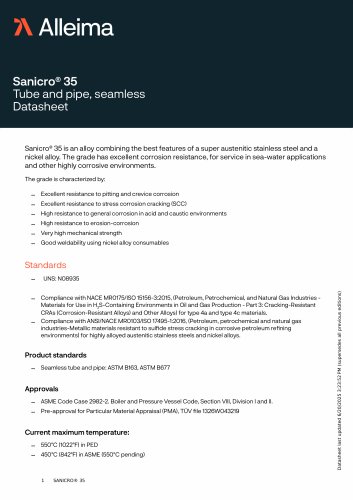 Sanicro® 35
11 Pages
Archived catalogs
 SANMAC 4571
10 Pages
 ROUND BAR SIZES AND GRADES
4 Pages
 SANDVIK ROCK DRILL STEEL
4 Pages
 STAINLESS STEELS FOR MACHINING
29 Pages
 AquaSan Ni50
2 Pages
 Sanmac®329
2 Pages
 APM 9980
4 Pages
 APM 2723
5 Pages
 APM 2377, UNS S31803
4 Pages
 Sandvik billets and blooms
10 Pages
 Sandvik precision strip steel
16 Pages
 APM 2327, UNS S32505
4 Pages


