


REMOS GX

REMOS GX
The REMOS GX is a Light Sport Aircraft (LSA) produced by REMOS Aircraft GmbH, adhering to LSA standards but not standard category airworthiness requirements. The handbook provides crucial information for safe operation and maintenance.
The REMOS GX is a composite carbon fiber aircraft with a high wing design, featuring a front-mounted engine and propeller. It includes electrically operated flaps and a three-wheel landing gear with hydraulic disc brakes. It is powered by a Bombardier-Rotax 912 UL-S engine with a maximum power take-off of 100 HP, a wingspan of 30.6 ft, and a maximum take-off weight (MTOW) of 1,320 lb.
Key airspeed limitations include a never exceed speed (VNE) of 155 mph, a maximum speed in turbulence (VNO) of 123 mph, and a maneuvering speed (VA) of 108 mph. The service ceiling is 15,000 ft, with load factors of +4.0 g / -2.0 g. Aerobatics and spins are prohibited.
The handbook details emergency procedures for various scenarios and normal operating procedures to ensure safe flight operations.
Performance data includes stalling speeds, flap extended speed ranges, and maximum maneuvering speeds, optimized for safe and efficient flight.
The center of gravity range is specified, with a front limit of 9.6 in and a rear limit of 16.3 in. The maximum baggage weight is 66 lb.
Detailed descriptions of the engine, propeller, and avionics are provided. Required equipment for Day-VFR and Night-VFR conditions is specified.
Guidelines for ground handling and servicing are provided to maintain airworthiness and operational readiness.
Detailed instructions for handling emergencies such as door jettison, spin recovery, engine stoppage, and emergency landings are provided.
Standard operating procedures for various flight phases, including fuel draining, preflight checks, engine start, and after start-up, are outlined.
Avionics, intercom, and radios should be on with frequency set. The electric fuel pump is turned off after starting the engine, with a warm-up speed of 2,500 rpm.
Oil temperature should be at least 50°C/120°F, engine speed at 4,000 rpm, with a maximum 300 rpm drop on magneto check.
Landing light recommended, release parking brake, control via pedals, maintain appropriate taxi speed.
For short field take-off, set oil cooler flap as required, carburetor heat off, electric fuel pump on, rotate at 56 mph (49 kts).
Maintain 56 mph (49 kts) for best angle of climb (VX) and 75 mph (65 kts) for best rate of climb (VY).
Maintain clean flaps, appropriate engine speed, monitor temperatures, with fuel consumption around 4.8 US gallons at 4,800 rpm.
Visibility is limited, performance reduced, ensure electric fuel pump and carburetor heat are on.
Approach at 65 mph (57 kts) for short field landing with full flaps, normal landing speed varies with weight.
Take-off and landing distances vary by propeller type and flap settings, with detailed stall speeds for various configurations.
Stall speeds are provided for various flap positions, with emphasis on accurate weight and balance calculations for safe flight.
The cockpit features instruments like the DYNON SV-D700 and Garmin SL30. Engine controls include carburetor heating and dual throttle control.
Powered by an alternator, with recommendations for regular battery maintenance, especially in cold weather.
Use a minimum 16Ah battery and install a TANIS heater system for cold conditions.
Includes controls for engine fuel shut-off valve, brake lever, and parking brake valve, with a start-up checklist provided.
Features an LED panel lighting system suitable for Night-VFR use.
Must be installed according to approved procedures, with maintenance following the manufacturer's handbook.
Guidance on servicing and handling the aircraft on the ground, including coolant and oil checks, fuelling, towing, and cleaning.
Guidance on flight performance and characteristics, intended as a supplementary guide.
For grass runways, set flaps to 5°, take-off directly into the wind, apply full throttle smoothly.
Best angle of climb at 56 mph (49 kts), best rate of climb at 75 mph (65 kts).
Normal cruise at 4,400 to 4,800 RPM, high-speed cruise at 5,000 to 5,400 RPM.
Aircraft is controllable at a wide range of airspeeds, with stable stall characteristics.
Best glide ratio at 75 mph (65 kts), monitor engine temperatures during descent.
Normal approach speed at MTOW is 75 mph (65 kts), with full flaps for landing.
Equipped with a TOST E85 tow release clutch, with specific procedures for towing operations.
Modern gliders require faster towing speeds, typically at 75 mph (65 kts) or higher.
Ensure flaps are clean, engine speed as required, electric fuel pump on.
Approach airspeed set at 75 mph (65 kts), with full flaps for landing.
Take-off roll and air distances vary by propeller type and conditions.
Several glider models tested for towing, with a maximum permissible weight of 1,580 lb.
Standard calculations apply to towing operations, with additional equipment required.
Tow release handle requires regular checks, with a general overhaul every four years or 4,000 operations.
Equipped with specific equipment for banner towing, with procedures for emergency situations.
Temperature impacts aircraft performance, particularly in banner towing operations.
Standard calculations apply, with additional equipment required for banner towing.
Tow release handle installed inside the cabin, with specific maintenance requirements.
Regular maintenance of the tow release clutch is necessary.
Requirements for maintaining aircraft safety, including maintenance and documentation updates.
Owners/operators must provide current contact information and comply with maintenance manuals.
Three levels of public notices: Safety Alerts, Service Bulletins, and Notifications.
Updates released on the REMOS website, with mandatory updates communicated via Safety Alerts or Service Bulletins.
Specified intervals, with only qualified individuals performing maintenance and inspections.
Only certified equipment may be installed without notifying REMOS.
Repairs must be signed off by qualified personnel to release the aircraft back to service.
Annual condition inspection mandatory after repairs affecting flight safety.
Notify REMOS before repairs, with a Repair Approval (LOA) required post-repair.
Engineering department charges by the hour, adhering to ASTM F2483 regulations.
Contact REMOS Aircraft GmbH for continued airworthiness.
Operating without current documentation and approvals is illegal and unsafe.
Catalog excerpts

Pilot Operating Handbook for LSA Edition for GXNXT
Open the catalog to page 1
REMS5 GX Introduction_ Light Sport Aircraft REMOS GX The REMOS GX was manufactured in accordance with the Light Sport Aircraft airworthiness standards and does not conform to standard category airworthiness requirements. Serial No.: Built: Call Sign: Engine-Type: Serial No. Engine: Propeller-Type: Manufacturer: REMOS Aircraft GmbH Flugzeugbau Internet: www.remos.de
Open the catalog to page 2
REMS5 GX Introduction_ List of Content and List of Effective Pages This POH consists of the following listed pages and sections. You will find a marking indicating the revision and date of issue at the top border of each page. Insert the latest changed pages.
Open the catalog to page 3
REMS5 GX Introduction_List of Revisions sect.
Open the catalog to page 4
REMS5 GX Introduction_Remarks and Alterations Please make a notation below if any changes have been made to this manual or to the plane. This manual is an important document for the pilot in command to ensure safe operation of the aircraft. Therefore it is recommended to keep this Operating Handbook updated with the newest information available. You can get the latest updates of this manual from your dealer or directly from the manufacturer’s homepage.
Open the catalog to page 5
Introduction Views
Open the catalog to page 6
REMS5 EX 1 General Information Table of Contents_ sect. General Information
Open the catalog to page 7
General Information This Operating Handbook is designed to help enable a safe and successful completion of each flight with the REMOS GX. It provides you with all necessary information for regular maintenance and operation of the aircraft. Therefore we recommend that the pilot keep this Operating Handbook updated with the newest information available. You can get the latest version of this Handbook from your nqecn"fgcngt"qt"fktgevn{"htqo"vjg"ocpwhcevwtgtÓu"jqogrcig0 The REMOS GX was manufactured in accordance with the Light Sport Aircraft airworthiness standards and does not conform to standard...
Open the catalog to page 8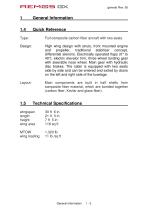
Type: Full composite carbon fiber aircraft with two seats. Design: High wing design with struts, front mounted engine and propeller, traditional stabilizer concept, differential ailerons. Electrically operated flaps (0° to 40°), electric elevator trim, three-wheel landing gear with steerable nose wheel. Main gear with hydraulic disc brakes. The cabin is equipped with two seats side by side and can be entered and exited by doors on the left and right side of the fuselage. Layout: Main components are built in half shells from composite fiber material, which are bonded together (carbon...
Open the catalog to page 9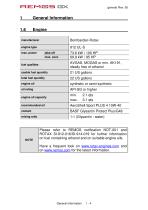
Please refer to REMOS notification NOT-001 and ROTAX SI-912-016/SI-914-019 for further information on fuel containing ethanol and on suitable engine oils. Have a frequent look on www.rotax-engines.com and on www.remos.com for the latest information. General Information
Open the catalog to page 10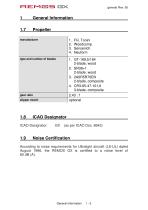
ICAO Designator: GX (as per ICAO Doc. 8643) 1.9 Noise Certification According to noise requirements for Ultralight aircraft (LS-UL) dated August 1996, the REMOS GX is certified to a noise level of 60 dB (A).
Open the catalog to page 11
REMS5 GX 2 Operating Limitations Table of Contents_ sect.
Open the catalog to page 12
REMS5 GX 2 Operating Limitations 2.1 Reference Airspeeds speed
Open the catalog to page 13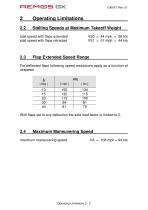
stall speed with flaps extended VS0 = 44 mph = 38 kts stall speed with flaps retracted VS1 = 51 mph = 44 kts 2.3 Flap Extended Speed Range For deflected flaps following speed restrictions apply as a function of airspeed: With flaps set to any deflection the safe load factor is limited to 2. maximum maneuvering speed VA = 108 mph = 94 kts
Open the catalog to page 14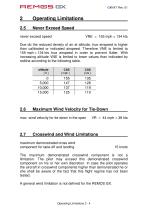
2.5 Never Exceed Speed never exceed speed VNE = 155 mph = 134 kts Due do the reduced density of air at altitude, true airspeed is higher than calibrated or indicated airspeed. Therefore VNE is limited to 155 mph = 134 kts true airspeed in order to prevent flutter. With increasing altitude VNE is limited to lower values than indicated by redline according to the following table. 2.6 Maximum Wind Velocity for Tie-Down max. wind velocity for tie-down in the open VR = 44 mph = 38 kts 2.7 Crosswind and Wind Limitations maximum demonstrated cross wind component for take-off and landing 15...
Open the catalog to page 15
2.8 Maximum Parachute Deploy Airspeed maximum parachute deploy airspeed 138 mph = 120 kts safe load factors +4.0 g / -2.0 g With flaps set to any deflection the safe load factor is limited to 2. 2.11 Maximum Structure Temperature max. certified structure temperature 130°F = 54°C Flight maneuvers not permitted • aerobatics • spins • flight in icing conditions 2.13 Permissible Flight Maneuvers The following maneuvers are permitted • all non-aerobatic maneuvers, including stalls and departure stalls • flight with the doors off
Open the catalog to page 16
D-VFR minimum equipment list • engine ROTAX 912 UL-S • silencer • airbox • propeller as defined in chapter 2 • carburetor heating system • compass with compass card • altimeter • airspeed indicator • safety belts • ELT • electrical system including circuit breakers • master, avionics and engine kill (ignition) switch • engine instruments (one DYNON SV-700 screen and the EMS module DYNON SV-EMS-220) • AeroLEDs SUNTAIL taillight with integrated ACL • AeroLEDs NS90 position lights with integrated ACL N-VFR Minimum equipment list • as per D-VFR minimum equipment list, plus • electrical artificial...
Open the catalog to page 18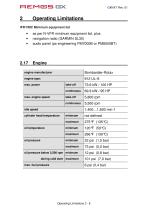
IFR/VMC Minimum equipment list • as per N-VFR minimum equipment list, plus • navigation radio (GARMIN SL30) • audio panel (ps-engineering PM7000B or PM8000BT)
Open the catalog to page 19
REMS5 GX 2 Operating Limitations 2.19 Placards and Markings The required placards and markings are created with the following color codes. Information white lettering on a black black lettering on a white background - white framed background - black framed Information Safety white lettering on a black red lettering on a white background - red framed background - red framed Safety Warning white lettering on a red red lettering on a white background - white framed background - red framed
Open the catalog to page 21All REMOS AG catalogs and technical brochures
 POH Remos
129 Pages
 REMOS Pricelist LSA GXnXES
2 Pages
 REMOS Pricelist RoW GXíS
1 Page
 REMOS Pricelist UL GXíS
1 Page
 REMOS Pricelist UL GXNXT EUR
2 Pages
