
- Catalogs
- MOTOTOK INTERNATIONAL GMBH
- Mototok Brochure


- Company
- Products
- Catalogs
- News & Trends
- Exhibitions
Mototok Brochure

Mototok Brochure
Mototok offers a revolutionary towbarless tug system designed for efficient and safe aircraft maneuvering. The system is fully electric, remotely controlled, and requires only one operator, enhancing flexibility and reducing costs.
Mototok tugs are equipped with high-performance electric motors and maintenance-free batteries. They feature a hydraulic and sensor-controlled nosegear platform for automatic loading and unloading, allowing precise maneuvering in minimal space, ideal for hangar and pushback operations.
Key benefits include low personnel and maintenance costs, ease of use, and enhanced safety. The system eliminates the need for straps, winches, and multiple operators, allowing a single person to control the tug via remote control. The design ensures no damage to the aircraft's nosegear and provides a full circumferential view for the operator.
Unlike conventional tow tractors, Mototok tugs offer independent nosegear turning and aircraft movement, reducing space requirements and accident risks. The compact design and remote control capabilities allow for more efficient use of hangar space.
Mototok tugs are suitable for various aircraft types, including wide- and narrow-body jets, regional jets, business jets, and helicopters. They are also adaptable for military use.
Mototok provides an innovative solution for aircraft towing, offering significant improvements in efficiency, safety, and cost-effectiveness. The system's flexibility and ease of use make it a superior choice for modern aviation operations.
The document provides a comprehensive overview of Mototok's pushback tugs, highlighting their features, benefits, and applications in airport operations. It emphasizes the efficiency, cost-effectiveness, and safety features of these electric tugs, designed to streamline ground handling operations.
Mototok tugs are fully electric, remotely controlled, and require only one operator. They can tow aircraft with a maximum takeoff weight (MTOW) of up to 105 tonnes. The tugs feature a one-click loading system, require no driving license, and have a short operational training time of 2-4 hours.
The tugs can manage up to five boarding bridges and perform up to 30 pushback operations on a single battery charge. They have a recharging time of about 6 hours and offer low maintenance and no fuel costs.
The Intelligent Nosegear Protection System (i-NPS) with auto counter-steering prevents damage to the nosegear by actively measuring torque and initiating counter-steering when necessary. The system provides intuitive handling and real-time information to operators and technicians.
The tugs are equipped with a central processing unit (CPU) for managing towing and braking forces, oversteering protection, and diagnostics. They can be connected to mobile devices for adjustments and real-time monitoring via the Mototok cloud.
Various models are available, including the SPACER 8600 NG for narrow-body and regional aircraft, and the SPACER 200 for wide-body aircraft. The tugs are suitable for use in maintenance, repair, and overhaul (MRO) and fixed-base operator (FBO) environments.
The tugs offer autonomous driving capabilities, turning on the spot for maximum maneuverability, and optional accessories like additional weights for increased traction and trailer coupling adaptors.
Mototok tugs provide a powerful, flexible, and eco-friendly solution for airport ground operations, reducing pushback delays and operational costs while enhancing safety and efficiency.
The document provides detailed specifications and features of various aircraft towing equipment models, focusing on their capabilities, optional accessories, and technical data. It includes information on models like the LB 7500 NG, LB 6600 NG, and the Mototok M Series, among others.
Each model is described with its maximum towing capacity, applicable aircraft types, and optional features such as electronic torque control and shear pins. The document highlights the adaptability of these models for military and civilian aircraft, including helicopters and special tugs for specific aircraft like the Lockheed C-130 Hercules.
The document lists optional accessories available for the LB-Series, such as active steering for ship operations, magnetic emergency systems, and oversteering protection systems. These accessories enhance the functionality and safety of the towing equipment.
Detailed technical data is provided for each model, including dimensions, weight, speed, battery specifications, and terrain compatibility. The document also includes information on the hydraulic systems and ground power capabilities of the equipment.
The document suggests using specific models for particular aircraft types and operational environments, emphasizing the importance of selecting the right equipment based on towing capacity and aircraft compatibility.
Notable features include the patented automatic nosegear clamping system, advanced radio remote control with safety features, and the ability to operate on various terrains. The document also highlights the importance of technical support and customization options for special demands.
The document provides detailed specifications for various aircraft towing equipment. Key parameters include maximum nosewheel weight capacity, dimensions (width, length, height), platform height, ground clearance, and nosewheel diameter. The equipment is designed to handle different weights and dimensions, ensuring compatibility with various aircraft models.
The towing equipment features maintenance-free, deep cycle gel batteries with varying capacities, microprocessor-controlled electric motors, and a range of 2 to 4 days depending on workload. The equipment is suitable for use on concrete and stone terrains and includes puncture-proof tyres. Advanced safety features include electronic torque control and optional hydraulic nosewheel securing.
The equipment complies with several directives and standards, including the Machinery Directive (2006/42/EC), Low Voltage Directive (2014/35/EU), and Electromagnetic Compatibility Directive (2014/30/EU). It also adheres to specific safety and design standards for aircraft ground support equipment.
The document lists numerous airports and aviation service providers worldwide that utilize this equipment, highlighting its global reach and reliability. Notable clients include major airports in the USA, Europe, and Asia, as well as aircraft manufacturers like Airbus, Boeing, and Embraer.
Optional equipment includes hydraulic full hands-free wheel opening doors, ground power cables, and advanced radio remote controls. The equipment is designed for durability and minimal maintenance, suitable for harsh conditions like exposure to wind and saltwater.
The document emphasizes the equipment's robust engineering, compliance with international standards, and widespread use in the aviation industry, underscoring its reliability and efficiency in aircraft towing operations.
Mototok International GmbH, founded in 2003 by Kersten Eckert and Thilo Wiers-Keiser, specializes in the production of compact, towbarless, remote-controlled, and battery-powered aircraft tugs. The company has achieved market leadership through its commitment to quality, ease of use, and high safety standards.
The development of Mototok tugs was driven by Kersten Eckert's personal experience and desire to improve the efficiency of aircraft ground maneuvering. The tugs are designed to reduce the need for multiple personnel and enhance operational efficiency.
Mototok has deployed over 1,500 units worldwide, with significant usage at major airports such as Heathrow Airport, where British Airways has reported a reduction in delays by up to 70% due to the use of Mototok tugs. The company’s products are trusted by various aircraft manufacturers and are used in multiple locations globally, including the US, Canada, Singapore, and Europe.
Mototok tugs are equipped with hydraulic control, a multitude of sensors, and connectivity to the Mototok Cloud, allowing for remote maintenance and monitoring. These features make them unique in the market.
Mototok continues to expand its influence in the aviation industry by providing innovative solutions for aircraft ground handling, supported by a strong commitment to technological advancement and customer satisfaction.
Catalog excerpts
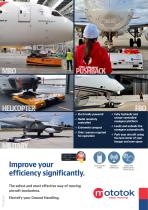
→ Electrically powered → Radio remotely controlled → Extremely compact → Only 1 person required for operation → Fully hydraulic and sensor-controlled nosegear platform → Loads and unloads the nosegear automatically → Park your aircraft using the last corner of your hangar and save space Engineered and Made in Germany with Passion. Improve your efficiency significantly. 7772 / 02-2025 The safest and most effective way of moving aircraft towbarless. Electrify your Ground Handling. FULLY ELECTRIC DRIVE REMOTELY CONTROLLED HANDS FREE LOADING WITH A TA
Open the catalog to page 1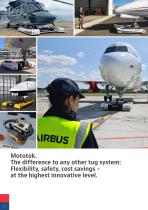
Mototok. The difference to any other tug system: Flexibility, safety, cost savings – at the highest innovative level.
Open the catalog to page 2
Take a look inside 4 Turning on the spot with no wingtip movement: Fixing the Nosegear without stress 7 The top advantages of using a Mototok tug 8 A Comparison between Towing Principles 10 Mototok for Hangar Operations 14 Mototok for Pushback Operations 16 i-NPS - Intelligent Nosegear Protection System 20 A Smart System with Built-in Intelligence 22 Your Tug. Our Experts. Connected in Real-Time. 23 Mototok Spacer 200 - for Wide- and Narrow-Bodies 24 Mototok Spacer 8600 Pushback - for Narrow-Bodies and Regional Jets 26 Mototok Spacer 8600 MRO/FBO - for Narrow-Bodies and Regional Jets 28 Mototok...
Open the catalog to page 3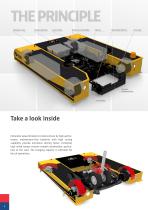
THE PRINCIPLE Emergency Stop Castor Wheel Wheel Securing Paddles Nose Wheel Platform Hydraulic Automatic Door Head Lights Take a look inside Extremely powerful electric motors driven by high-performance, maintenance-free batteries with high cycling capability provide enormous driving forces. Extremely high initial torque ensures smooth acceleration, particularly at the start. The charging capacity is sufficient for lots of operations. Drive Gear
Open the catalog to page 4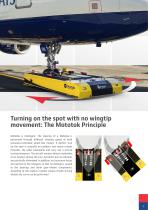
Turning on the spot with no wingtip movement: The Mototok Principle Mototok is intelligent. The steering of a Mototok is performed through different rotating speed of both processor-controlled wheel-hub motors. A perfect turn on the spot is naturally no problem: one motor rotates forwards, the other backwards and carry out a precise turning manoevre. The aircraft remains almost motionless at its location during the turn. Accidents due to collisions are practically eliminated. In addition, no transverse forces are exerted on the nosegear, so that no damage is caused to the bearings and other gear-related...
Open the catalog to page 5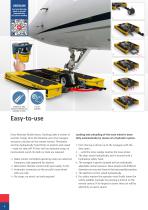
VIDEOLINK See how Mototok loads an aircraft automatically: bit.ly/twin-loading HYDRAULIC AND SENSOR CONTROLLED LOADING SYSTEM Easy-to-use Every Mototok Model shows: Docking takes a matter of seconds. Simply drive the Mototok up to the nosegear and press a button on the remote control. Thewheels are then hydraulically fixed firmly in position and raised – ready for take off! All this with no awkward strap, no inconvenient winch. No bolts or tools are required. → Radio remote controlled operating under an industrial frequency code approved for airports → Alternative: Remote control with spiral...
Open the catalog to page 6
VIDEOLINK See how Mototok compensates the rearing up: bit.ly/mototokpaddles The saftey paddles of the models TWIN and M hydropneumatically balances the heights of the individual nose wheels, fixing them securely in place. No rigid straps are used, which can damage the nosegear. The model SPACER is equipped with a gimbal mount to compensate for the trail of the nosegear. STRESS FREE NOSEGEAR FIXING SYSTEM Fixing the Nosegear without Stress Due to the aircrafts design, the nose landing gear is mounted at an specific angle. Manoeuvring an aircraft with a double nose wheel with the Mototok therefore...
Open the catalog to page 7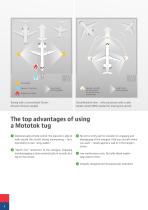
Wing Walker Operator / Tug-Driver Visual field of the Wing Walker Towing with a conventional Tractor: At least 4 Persons needed Operator with RRC, can walk around the aircraft during maneuvering Visual field of the Wing Walker Circumferential view – only one person with a radio remote control (RRC) needed for moving the aircraft The top advantages of using a Mototok tug Industrial radio remote control. The operator is able to walk around the aircraft during maneuvering – he is essentially his own “wing-walker“ “Hands free“ connection to the nosegear. Engaging and disengaging is done automatically...
Open the catalog to page 8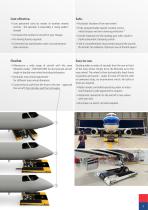
Cost effective. → Low personnel costs by means of wireless remote control – the operator is essentially a “wing walker” himself → Hydraulic fixation of the nose wheel → Increases the number of aircraft in your Hangar → No driving licence required → Gentle treatment of the landing gear with a built in hydro-pneumatic clamping system → Extremely low maintenance costs, no maintenance plan necessary → 100 % circumferential visual control around the aircraft. No knocks. No collisions. Optimum use of limited space! → Manoeuvre a wide range of aircraft with the same Mototok-model – ONE MACHINE for all...
Open the catalog to page 9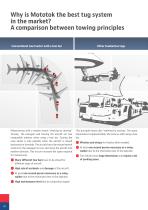
Why is Mototok the best tug system in the market? A comparison between towing principles Conventional tow tractor with a tow bar Maneuvering with a towbar means “steering by moving“. Turning the nosegear and moving the aircraft are two inseparable motions when using a tow bar. Turning the nose wheel is only possible when the aircraft is moved backwards or forwards. The aircraft has to be moved several meters for the nosegear to turn and move the aircraft into another direction. This in turn increases the space required for manoeuvres. Many different tow bars have to be stored for different types...
Open the catalog to page 10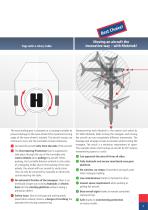
ice! o h C Best Tugs with a rotary table The nose landing gear is clamped on a rotating turntable to prevent damage to the nose wheel if the maximum turning angle of the nose wheel is reached. The aircraft tractor can continue to turn, but the turntable remains stationary. Can load the aircraft only from the side of the aircraft. The Oversteering Protection that is supposed to take place through the use of the turntable only works reliably when pulling the aircraft. When pushing, the turntable behaves similarly to the caster of a shopping trolley due to the tracking of the nose wheels: the wheel...
Open the catalog to page 11All MOTOTOK INTERNATIONAL GMBH catalogs and technical brochures
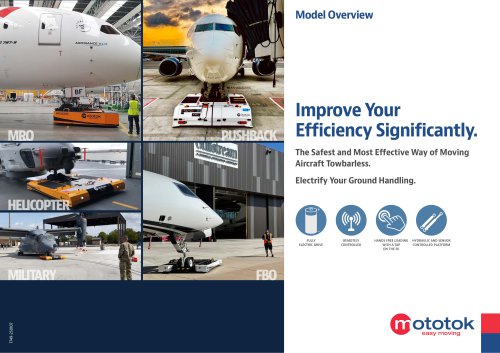 Model Overview
6 Pages