

SmartHeat SLT™ Thin-film Heaters

SmartHeat SLT™ Thin-film Heaters
SmartHeat SLT™ thin-film heaters offer a plug-and-play heating solution that operates at a specific temperature and power based on its unique design. The heaters modulate power across the entire surface to maintain the desired temperature, ensuring safety and efficiency.
SmartHeat heaters are designed to maintain a specific temperature without the need for external sensors or controllers. Each point on the heater acts as a sensor, controller, and heater, simplifying assembly and increasing reliability.
SmartHeat provides maximum power from a cold start to quickly reach operating temperature, then reduces power to maintain thermal equilibrium. This prevents temperature overshoot and ensures uniform temperature across the surface.
The self-limiting nature of SmartHeat prevents it from exceeding the designed safety temperature, avoiding damage from overheating. In case of physical damage, the heater continues to function in undamaged areas, reducing the risk of complete failure.
SmartHeat's multilayer construction includes a carbon-silicone matrix (CSM) that adjusts power draw to equalize heating. The CSM and copper material are encased in polyimide for electrical insulation.
SmartHeat consists of a silicone matrix with conductive carbon particles. As the silicone warms, thermal expansion increases resistance, reducing power flow. This self-limiting technology maintains a specific temperature set point without external controls.
SmartHeat offers custom design, compact form, point-sensitive control, and high reliability, reducing costs and maintenance needs.
SmartHeat is suitable for various applications, including battery warming, respiratory equipment humidification, reagent storage, display defrosting, LED defrosting, infrared lens deicing, sensor anti-icing, valve warming, and aircraft wing deicing.
Traditional heaters require external sensors and controllers, increasing cost, weight, and complexity. They do not respond to local temperature changes and can overheat due to faults.
Catalog excerpts

SmartHeat SLT™ Thin-film Heaters Thermostatic Control at the Molecular Level
Open the catalog to page 1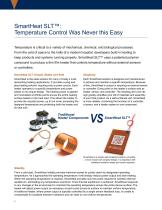
SmartHeat SLT™: Temperature Control Was Never this Easy Temperature is critical to a variety of mechanical, chemical, and biological processes. From the cold of space to the halls of a modern hospital, developers build in heating to keep products and systems running properly. SmartHeat SLT™ uses a patented polymer compound to produce a thin film heater that controls temperature without external sensors or controllers. SmartHeat SLT: Simple, Stable and Safe SmartHeat is the ideal solution for many of today’s most demanding heating applications. It provides a plug-andplay heating solution requiring...
Open the catalog to page 2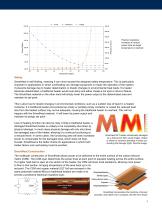
Polymer resistance increases to reduce power draw as target temperature is reached. Safety SmartHeat is self-limiting, meaning it can never exceed the designed safety temperature. This is particularly important in applications in which overheating can damage equipment or impair the operation of the system. It prevents damage due to heater delamination or drastic changes in environmental heat loads. If a heater becomes delaminated, a traditional heater would over-temp and either create a hot spot or drive to failure. The SmartHeat material on the other hand will simply lower the power output to...
Open the catalog to page 3
How it Works SmartHeat SLT consists of a thin silicone matrix loaded with conductive carbon particles. Electrical current moves between the carbon particles via quantum tunneling of electrons through the non-conductive silicone material. The electrical resistance of the material and the current it can carry at any point is determined by the spacing between the carbon particles, and that the spacing changes with temperature. As the silicone warms, thermal expansion drives the carbon particles farther apart and increases resistance point-by-point over the surface of the heater. At the designed...
Open the catalog to page 4All Minco catalogs and technical brochures
 Minco Integrated Solutions
2 Pages

