
- Catalogs
- micro-epsilon
- Inductive sensors based on eddy currents


Inductive sensors based on eddy currents

Inductive sensors based on eddy currents
Micro-Epsilon's eddyNCDT sensors are designed for high precision, non-contact measurement of displacement, distance, position, oscillation, and vibrations using eddy current technology. These sensors are robust and suitable for industrial environments, offering advantages such as wear-free operation, high precision, temperature stability, and compatibility with both ferromagnetic and non-ferromagnetic materials. They are capable of fast measurements up to 100 kHz.
The eddy current principle involves energy extraction from an oscillating circuit to induce eddy currents in conductive materials. A coil supplied with alternating current creates a magnetic field, and when a conductive object enters this field, eddy currents are induced, altering the coil's impedance. This change is used to calculate displacement.
The eddyNCDT series includes various models with different specifications:
- eddyNCDT 3001: Measuring ranges of 2-8 mm, resolution ≥ 3 µm, frequency response 5 kHz.
- eddyNCDT 3005: Measuring ranges of 1-6 mm, resolution ≥ 0.5 µm, frequency response 5 kHz.
- eddyNCDT 3060: Measuring ranges of 1-8 mm, resolution ≥ 0.02 µm, frequency response up to 20 kHz.
- eddyNCDT 3070: Measuring ranges < 1 mm, resolution ≥ 0.02 µm, frequency response up to 20 kHz.
- eddyNCDT 3300: Measuring ranges 0.4-80 mm, resolution ≥ 0.02 µm, frequency response up to 100 kHz.
These sensors are used in various applications, including turbocharger speed measurement and spindle growth measurement. They are resistant to harsh conditions such as dirt, pressure, and extreme temperatures, with models offering protection up to IP67 and pressure resistance up to 2000 bar. The sensors are factory-calibrated for specific materials like steel and aluminum, with options for custom calibration.
Standard installation conditions are provided, with options for field linearization to maintain accuracy. Both shielded and unshielded sensor designs are available, each with specific advantages in terms of measurement range and sensitivity to surrounding materials. Custom modifications are possible for OEM applications, including changes in design, calibration, and mounting options.
Each sensor model comes with detailed technical specifications, including measuring range, resolution, frequency response, temperature stability, and protection class. The sensors are designed for easy integration into machinery and offer high measurement accuracy even in fluctuating temperatures.
The systems feature an industrial-grade M12 Ethernet interface for modern fieldbus connections and configurable analog outputs. They support frequency separation for operating multiple sensors without synchronization.
The systems offer high resolution and linearity, with temperature stability and a frequency response of 20 kHz. They are suitable for both ferromagnetic and non-ferromagnetic targets.
The eddyNCDT systems are ideal for manufacturing automation, machine monitoring, and quality control due to their high performance and reliability.
- Resolution: Static (20 Hz) and dynamic (20 kHz) resolutions are provided.
- Linearity: Less than ±0.2% FSO for DT3060 and less than ±0.1% FSO for DT3061.
- Temperature stability: Less than 0.015% FSO/K.
- Supply voltage: 12 to 32 VDC with a power consumption of 2.5 W.
- Protection class: IP67 for the controller and IP68 for sensors.
The systems use triaxial connectors and M12 connectors for sensor and signal connections. They are designed for easy integration into existing systems with mounting through bores.
The eddyNCDT 3060 and 3070 systems set a new benchmark in inductive displacement measurement technology, offering high precision, robust design, and ease of integration into industrial applications.
The document provides detailed specifications for measuring cylindrical objects using eddyNCDT sensors. It emphasizes the importance of the target diameter being at least 10 times the sensor diameter for accurate measurements. Field linearization is required for certain diameter ratios, specifically when the diameter is less than 10 times the sensor diameter or when the target diameter is 3x or 1.5x the sensor diameter.
For optimal accuracy, sensors should be installed vertically. Deviations occur with tilt angles, and factory calibration is recommended for angles greater than 6°. A 3-point calibration can store the tilt angle in the controller to compensate for signal influences.
The document lists recommended minimum thicknesses for various materials to ensure stable measurement results. For example, aluminum requires a minimum thickness of 0.504 mm, while graphite requires 8.100 mm.
New frequency separation (LF/HF) allows multi-channel operation without interference, eliminating the need for synchronization cables. Field linearization is recommended for non-standard installation conditions to achieve optimal measurement accuracy.
Micro-Epsilon sensors and controllers are actively temperature-compensated, ensuring stable measurement signals. The document compares the thermal drift of Micro-Epsilon sensors with competitors, showing superior stability.
Micro-Epsilon offers a range of sensors and systems for displacement, distance, and position measurement, non-contact temperature measurement, 3D measurement technology, optical micrometers, color recognition sensors, and inspection systems for various materials.
Catalog excerpts

More Precision eddyNCDT // Inductive sensors based on eddy currents
Open the catalog to page 1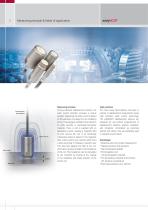
Measuring principle & fields of application eddyNCDT Electromagnetic alternating field Sensor with coil Eddy currents Metal plate Measuring principle Among inductive displacement sensors, the eddy current principle occupies a unique position. Measuring via eddy current is based on the extraction of energy from an oscillating circuit. This energy is needed for the induction of eddy currents in electrically-conductive materials. Here, a coil is supplied with an alternating current, causing a magnetic field to form around the coil. If an electrically conducting object is placed in this magnetic...
Open the catalog to page 2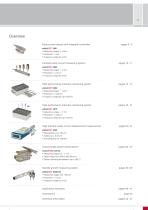
Overview Eddy current sensor with integrated controller eddyNCDT 3001 Measuring ranges 2 - 8 mm Resolution ≥ 3 µm Frequency response 5 kHz Compact eddy current measuring system eddyNCDT 3005 Measuring ranges 1 - 6 mm Resolution ≥ 0.5 µm requency response 5 kHz F High-performance inductive measuring system eddyNCDT 3060 Measuring ranges 1 - 8 mm Resolution ≥ 0.02 μm requency response up to 20 kHz F High-performance inductive measuring system eddyNCDT 3070 Measuring ranges < 1 mm Resolution ≥ 0.02 μm requency response up to 20 kHz F High precision eddy current displacement measurement eddyNCDT...
Open the catalog to page 3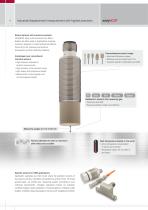
Robust sensors with maximum precision eddyNCDT eddy current sensors from MicroEpsilon are often used in applications requiring maximum precision in harsh ambient conditions. Immunity to dirt, pressure and extreme temperature are their distinctive features. Advantages over conventional inductive sensors ■ High frequency response for dynamic measurements ■ High resolution in the submicron range ■ High linearity and temperature stability ■ Measurement on ferromagnetic and non-ferromagnetic targets Resistant to media in the measuring gap 1Protection class IP67 1Pressure-resistant models up to 2000...
Open the catalog to page 4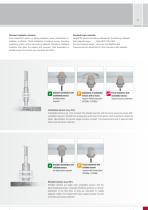
Standard installation situation Each eddyNCDT sensor is factory-calibrated under standardized installation conditions. These installation conditions involve mounting, positioning of the nut and surrounding materials. Deviations installation situations may affect the linearity and accuracy. Field linearization or special tuning in the factory may counteract this effect. Standard target materials eddyNCDT sensors are factory-calibrated for the following materials: Ferromagnetic target: Steel (St37) DIN1.0037 Non-ferromagnetic target: Aluminum AlCuMgPb3.1645 Customer-specific adjustment for other...
Open the catalog to page 5
Robust M12 miniature eddy current sensor The two eddyNCDT 3001 U2 and U4 models are powerful eddy current sensors whose compact dimensions have to date only been reserved for inductive sensors and proximity sensors. These compact sensors come with integrated controller including temperature compensation while offering an excellent price/performance ratio, as well as easy operation. Therefore, the sensors are ideally suited to OEM integration and machine building applications. The temperature-compensated design provides high stability even in fluctuating ambient temperatures. The sensors are factory-calibrated...
Open the catalog to page 6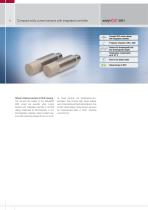
Robust miniature sensors in M18 housing The U6 and U8 models of the eddyNCDT 3001 series are powerful eddy current sensors with integrated controller in an M18 design. Calibrated for ferromagnetic or nonferromagnetic materials, these compact sensors offer measuring ranges of 6 mm or 8 mm. As these sensors are temperature-compensated, they provide high signal stability even in fluctuating ambient temperatures. Due to their robust design, these sensors are used for measurement tasks in harsh, industrial environments.
Open the catalog to page 8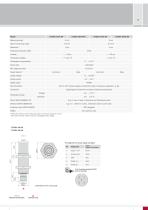
Measurement direction Connector side
Open the catalog to page 9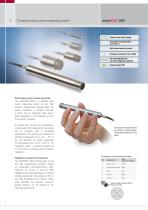
Robust eddy current measuring system The eddyNCDT 3005 is a powerful eddy current measuring system for fast, high precision displacement measurements. The system comprises a compact controller, a sensor and an integrated cable and is factory-calibrated for ferromagnetic or nonferromagnetic materials. As sensor and controller are temperature-compensated, high measurement accuracies can be achieved even in fluctuating temperatures. The sensors are designed for ambient temperatures up to max. +125 °C but can optionally be custom engineered for temperatures from -30 °C to 180 °C. The measuring system...
Open the catalog to page 10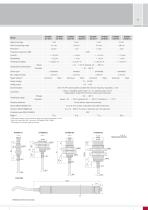
Model Measuring range Start of measuring range Temperature stability Temperature compensation Sensor type Min. target size (flat) Supply voltage Analog output with LF & HF variants (please consider the notes for frequency separation, p. 46) Sensor: integrated cable, length 1 m, min. bending radius 18 mm Supply/signal: 5-pole M12 connector (cable see accessories) Connection Storage Temperature range Sensor: -20 … +125 °C (optional -20 … +180 °C), Controller: 0 … +70 °C Pressure resistance 10 bar (sensor, cable and controller) 15 g / 6 ms in 3 axes, 2 directions and 1000 shocks each 5 g / 10 ......
Open the catalog to page 11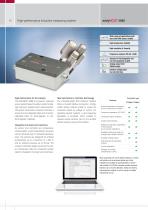
High performance for the industry The eddyNCDT 3060 is a powerful, inductive sensor system based on eddy currents for fast, high precision displacement measurements. The system comprises a compact controller, a sensor and an integrated cable and is factory-calibrated either for ferromagnetic or nonferromagnetic materials. Integration into plant and machinery As sensor and controller are temperature-compensated, a high measurement accuracy can be achieved even in fluctuating temperatures. The sensors are designed for ambient temperatures up to a maximum of +200 °C and an ambient pressure up to...
Open the catalog to page 12
11 Valid for operation with DT306x controller, referred to nominal measuring range 2 Relates to mid of measuring range 31 RMS value of the signal noise, static (20 Hz) 4) Only with DT3061 controller and 5-point linearization 5 Length tolerance cable: nominal value +30 % 6) Weight only sensor without nuts without cable
Open the catalog to page 14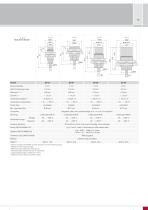
11 Valid for operation with DT306x controller, referred to nominal measuring range 2 Relates to mid of measuring range 35 RMS value of the signal noise, static (20 Hz) 4) Only with DT3061 controller and 5-point linearization 5 Length tolerance cable: nominal value +30 % 65 Weight only sensor without nuts without cable
Open the catalog to page 15All Micro-epsilon catalogs and technical brochures
 wireSENSOR
60 Pages
 NCDT 3001
7 Pages
 eddyNCDT 3005
5 Pages
 NCDT 3070
7 Pages
 NCDT 3060
9 Pages
 Non-contact sensors
1 Page
 Eddy current sensors
1 Page
 P60 analog
19 Pages
 wire SENSOR MPM analog
9 Pages
 wire SENSOR MT
8 Pages
 WDS-2500-P85
2 Pages
 Wire SENSOR
18 Pages
 wireSENSOR WPS-K100
2 Pages
 SurfaceCONTROL
12 Pages
 scanCONTROL
32 Pages
 optoNCDT
40 Pages




- Airport camera
- Laser scanner
- Measuring instrument for the aerospace industry
- Measuring instrument
- Aeronautic laser scanner
- Non-contact laser scanner
- Infrared camera
- Measurement laser scanner
- Aircraft displacement sensor
- Displacement sensor for the aerospace industry
- Non-contact displacement sensor
- Non-contact measuring instrument
- Angular displacement sensor
- Inductive displacement sensor
- Precision displacement sensor
- Profile laser scanner
- Pressure-resistant displacement sensor