
- Catalogs
- micro-epsilon
- eddyNCDT // Inductive sensors based on eddy currents


eddyNCDT // Inductive sensors based on eddy currents

eddyNCDT // Inductive sensors based on eddy currents
Micro-Epsilon's eddyNCDT sensors are designed for high precision, non-contact measurement of displacement, distance, position, oscillation, and vibrations using eddy current technology. These sensors are robust and suitable for industrial environments, offering advantages such as wear-free operation, high precision, temperature stability, and compatibility with both ferromagnetic and non-ferromagnetic materials.
The eddy current principle involves energy extraction from an oscillating circuit to induce eddy currents in conductive materials. A coil supplied with alternating current creates a magnetic field, and when a conductive object enters this field, eddy currents are induced, altering the coil's impedance. This change is used to measure displacement.
- eddyNCDT 3001: Compact sensors with measuring ranges of 2-8 mm, resolution ≥ 3 µm, and frequency response of 5 kHz.
- eddyNCDT 3005: Offers measuring ranges of 1-6 mm, resolution ≥ 0.5 µm, and frequency response of 5 kHz.
- eddyNCDT 3060: High-performance system with measuring ranges of 1-4 mm, resolution ≥ 0.02 µm, and frequency response up to 20 kHz.
- eddyNCDT 3300: High precision with measuring ranges of 0.4-80 mm, resolution ≥ 0.02 µm, and frequency response up to 100 kHz.
- turboSPEED DZ140: For turbocharger speed measurement with ranges of 0.5-1 mm and speed range from 200 to 400,000 rpm.
- eddyNCDT SGS4701: For spindle growth measurement with ranges of 250-500 µm and resolution ≥ 0.5 µm.
Sensors are factory-calibrated for standard installation conditions. Deviations may affect accuracy, requiring field linearization or special tuning. Unshielded sensors offer a larger measurement spot, while shielded sensors provide a narrower field line distribution, reducing sensitivity to adjacent metals.
These sensors are used in demanding environments, resistant to dirt, pressure, and extreme temperatures. Custom modifications are available for specific OEM applications, including design changes, target calibration, and custom cable lengths.
All sensors are designed to withstand harsh conditions, with protection class IP67 and pressure resistance up to 2000 bar. They offer high frequency response, high resolution, and temperature stability, making them suitable for dynamic measurements on various materials.
The sensors and controllers are temperature-compensated, allowing for high measurement accuracy even in fluctuating temperatures. They are designed to withstand ambient temperatures up to +200°C and pressures up to 20 bar, making them ideal for integration into plant and machinery.
The systems feature an industrial-grade M12 Ethernet interface for modern fieldbus connections and configurable analog outputs for voltage or current. They support frequency separation for operating multiple sensors simultaneously without synchronization issues.
Both DT3060 and DT3061 models offer active temperature compensation, frequency separation, industrial Ethernet interface, intuitive web interface, multipoint calibration, scalable measuring range, and analog output. The DT3061 model additionally provides switching and temperature outputs, 5-point calibration, and storage of multiple characteristic curves.
The eddyNCDT 3060 and 3300 systems are suitable for a wide range of applications, including manufacturing automation, machine monitoring, and quality control. They offer high-speed measurements with high resolution and linearity, making them ideal for dynamic processes.
The document lists various sensor models with their respective measuring ranges, resolutions, linearity, temperature stability, and connection types. It also provides information on the materials used and the protection class for each model.
- Sensors: The document describes several shielded and unshielded sensors with varying measuring ranges (0.4 mm to 1 mm), temperature stability (≤±0.025% FSO/°C), and pressure resistance (up to 2000 bar). The sensors are made from materials like stainless steel, ceramic, and epoxy, and are designed to operate at temperatures up to 180°C.
- Cables: Various cable types are detailed, including miniature coaxial cables and special coaxial cables with Viton sheathing. These cables have specific temperature resistances (up to 200°C) and are available in different lengths (1 m, 3 m, 6 m).
- Connectors: The document lists different types of plugs and sockets, such as 5-pole sockets and triaxial plugs, with temperature resistances up to 200°C.
- Installation: The sensors and cables are designed for easy integration into engine compartments and other high-pressure environments. The document highlights the use of push-pull connections and BNC connectors for reliable installation.
- Measurement Principle: The sensors operate on the eddy current measuring principle, which is non-contact and wear-free, making it resistant to disturbances like heat, dust, and oil.
- Turbocharger Speed Measurement: The turboSPEED DZ140 system is used for measuring the speed of turbocharger blades, capable of handling speeds from 200 to 400,000 rpm. It is suitable for both aluminum and titanium blades and can operate at distances up to 2.2 mm.
- Spindle Growth System (SGS4701): This system is used in high-speed milling machines to measure and compensate for the thermal and centrifugal force expansion of spindles, ensuring precision in machining operations.
- Ensure proper installation using the specified connectors and cables to maintain measurement accuracy and system reliability.
- Consider the environmental conditions, such as temperature and pressure, when selecting sensors and cables for specific applications.
The sensor cable should not be shortened to avoid functionality loss. The system can be installed on the spindle housing via a flange or directly in the spindle. Proper installation distances are crucial for optimal performance, with specific distances recommended for different models.
The document discusses the influence of target size and material on measurement accuracy. It emphasizes the importance of correct sensor installation and provides guidelines for compensating distance measurements on curved surfaces.
Various supply and signal cables are available, with different lengths and connector types to suit specific installation needs.
Field calibration and linearization are recommended for non-standard installation conditions to ensure measurement accuracy. The document outlines procedures for frequency separation and multi-channel operation.
The system is actively temperature-compensated, ensuring stable measurement signals across a range of temperatures. A comparison graph illustrates the superior thermal drift performance of Micro-Epsilon sensors compared to competitors.
The eddyNCDT SGS4701 system offers high measurement accuracy and robustness, making it suitable for demanding industrial applications. Proper installation and calibration are essential for optimal performance.
Catalog excerpts

More Precision eddyNCDT // Inductive sensors based on eddy currents
Open the catalog to page 1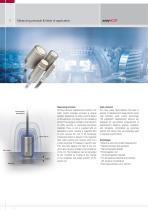
Measuring principle & fields of application Measuring principle Among inductive displacement sensors, the eddy current principle occupies a unique position. Measuring via eddy current is based on the extraction of energy from an oscillating circuit. This energy is needed for the induction of eddy currents in electrically-conductive materials. Here, a coil is supplied with an alternating current, causing a magnetic field to form around the coil. If an electrically conducting object is placed in this magnetic field, eddy currents are induced which form a field according to Faraday’s induction law....
Open the catalog to page 2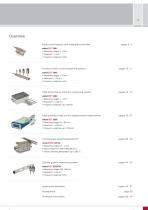
Overview Eddy current sensor with integrated controller eddyNCDT 3001 Measuring ranges 2 - 8 mm Resolution ≥ 3 µm Frequency response 5 kHz Compact eddy current measuring system eddyNCDT 3005 Measuring ranges 1 - 6 mm Resolution ≥ 0.5 µm requency response 5 kHz F High-performance inductive measuring system eddyNCDT 3060 Measuring ranges 1 - 4 mm Resolution ≥ 0.02 μm requency response up to 20 kHz F High precision eddy current displacement measurement eddyNCDT 3300 Measuring ranges 0.4 - 80 mm Resolution ≥ 0.02 μm requency response up to 100 kHz F Turbocharger speed measurement turboSPEED DZ140...
Open the catalog to page 3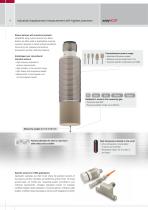
Resistant to media in the measuring gap 1Protection class IP67 1Pressure-resistant models up to 2000 bar Robust sensors with maximum precision eddyNCDT eddy current sensors from MicroEpsilon are often used in applications requiring maximum precision in harsh ambient conditions. Immunity to dirt, pressure and extreme temperature are their distinctive features. Advantages over conventional inductive sensors ■ High frequency response for dynamic measurements ■ High resolution in the submicron range ■ High linearity and temperature stability ■ Measurement on ferromagnetic and non-ferromagnetic targets...
Open the catalog to page 4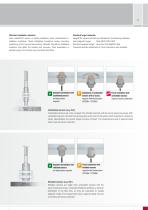
Standard installation situation Each eddyNCDT sensor is factory-calibrated under standardized installation conditions. These installation conditions involve mounting, positioning of the nut and surrounding materials. Deviations installation situations may affect the linearity and accuracy. Field linearization or special tuning in the factory may counteract this effect. Standard target materials eddyNCDT sensors are factory-calibrated for the following materials: Ferromagnetic target: Steel (St37) DIN1.0037 Non-ferromagnetic target: Aluminum AlCuMgPb3.1645 Customer-specific adjustment for other...
Open the catalog to page 5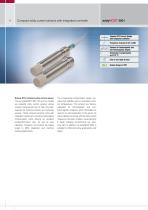
Robust M12 miniature eddy current sensor The two eddyNCDT 3001 U2 and U4 models are powerful eddy current sensors whose compact dimensions have to date only been reserved for inductive sensors and proximity sensors. These compact sensors come with integrated electronics including temperature compensation while offering an excellent price/performance ratio, as well as easy operation. Therefore, the sensors are ideally suited to OEM integration and machine building applications. The temperature-compensated design provides high stability even in fluctuating ambient temperatures. The sensors are...
Open the catalog to page 6
Robust miniature sensors in M18 housing The U6 and U8 models of the eddyNCDT 3001 series are powerful eddy current sensors with integrated controller in an M18 design. Calibrated for ferromagnetic or nonferromagnetic materials, these compact sensors offer measuring ranges of 6 mm or 8 mm. As these sensors are temperature-compensated, they provide high signal stability even in fluctuating ambient temperatures. Due to their robust design, these sensors are used for measurement tasks in harsh, industrial environments.
Open the catalog to page 8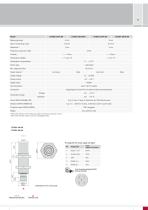
5-pin housing connector M12x1 View on pin side Measurement direction Connector side
Open the catalog to page 9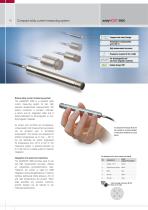
Compact eddy current measuring system eddyNCDT 3005 St 37 ^A! IP67 Compact and robust design High measurement accuracy For ferromagnetic and non-ferro-magnetic materials Robust eddy current measuring system The eddyNCDT 3005 is a powerful eddy current measuring system for fast, high precision displacement measurements. The system comprises a compact controller, a sensor and an integrated cable and is factory-calibrated for ferromagnetic or nonferromagnetic materials. As sensor and controller are temperature-compensated, high measurement accuracies can be achieved even in fluctuating temperatures....
Open the catalog to page 10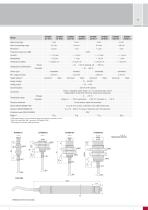
Model Measuring range Start of measuring range Temperature stability Temperature compensation Sensor type Min. target size (flat) Supply voltage Analog output with LF & HF variants Sensor: integrated cable, length 1 m, min. bending radius 18 mm Supply/signal: 5-pole M12 connector (cable see accessories) Connection Storage Temperature range Sensor: 0 … +125 °C (optional 0 … +180 °C), Controller: 0 … +70 °C Pressure resistance 10 bar (sensor, cable and controller) 15 g / 6 ms in 3 axes, 2 directions and 1000 shocks each 5 g / 10 ... 500 Hz in 3 axes, 2 directions and 10 cycles each Protection class...
Open the catalog to page 11
When connecting a PC via the Ethernet interface, a modern web interface can be accessed without any further installation and enables the parameterization of sensor and controller. The DT3061 controller provides enhanced features such as 5-point calibration, setting of switching and temperature outputs, as well as storage of multiple characteristic curves.
Open the catalog to page 12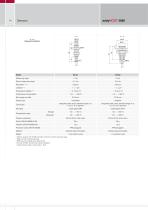
Measurement direction 1) Valid for operation with DT306x controller, referred to nominal measuring range 2) Relates to mid of measuring range 3) RMS value of the signal noise, static (20 Hz) 4) Only with DT3061 controller and 5-point linearization 5 Length tolerance cable: nominal value +30 %
Open the catalog to page 14
Measurement direction 1) Valid for operation with DT306x controller, referred to nominal measuring range 2) Relates to mid of measuring range 3) RMS value of the signal noise, static (20 Hz) 4) Only with DT3061 controller and 5-point linearization 5 Length tolerance cable: nominal value +30 %
Open the catalog to page 15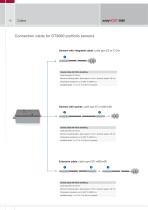
Connection cable for DT3060 portfolio sensorsSensors with integrated cable: cable type ES-xx-C-CAx Coaxial cable with Viton sheathing Cable diameter: 0 3.6 mm Minimum bending radius: static approx. 18 mm / dynamic approx. 36 mm Temperature resistance: up to 200 °C (3000 hrs.) Available length: 1 m / 3 m / 6 m (9 m on request) Coaxial cable with Viton sheathing Cable diameter: 0 3.6 mm Minimum bending radius: static approx. 18 mm / dynamic approx. 36 mm Temperature resistance: up to 200 °C (3000 hrs.) Available length: 1 m / 3 m / 6 m (9 m on request) Coaxial cable with Viton sheathing Cable diameter:...
Open the catalog to page 16All Micro-epsilon catalogs and technical brochures
 wireSENSOR
60 Pages
 NCDT 3001
7 Pages
 eddyNCDT 3005
5 Pages
 NCDT 3070
7 Pages
 NCDT 3060
9 Pages
 Non-contact sensors
1 Page
 Eddy current sensors
1 Page
 P60 analog
19 Pages
 wire SENSOR MPM analog
9 Pages
 wire SENSOR MT
8 Pages
 WDS-2500-P85
2 Pages
 Wire SENSOR
18 Pages
 wireSENSOR WPS-K100
2 Pages
 SurfaceCONTROL
12 Pages
 scanCONTROL
32 Pages
 optoNCDT
40 Pages



- Airport camera
- Laser scanner
- Measuring instrument for the aerospace industry
- Measuring instrument
- Aeronautic laser scanner
- Non-contact laser scanner
- Infrared camera
- Measurement laser scanner
- Aircraft displacement sensor
- Displacement sensor for the aerospace industry
- Non-contact displacement sensor
- Non-contact measuring instrument
- Angular displacement sensor
- Inductive displacement sensor
- Precision displacement sensor
- Profile laser scanner
- Pressure-resistant displacement sensor