


Handbook Calibration

Handbook Calibration
Calibration is crucial for maintaining the accuracy of measuring instruments, which can degrade over time. It involves comparing an instrument's displayed value with a known standard, essential for quality assurance and safety, particularly in industries like chemical manufacturing.
Measurement accuracy requires traceability to national or international standards through a calibration hierarchy, including national metrological institutes, accredited labs, and in-house systems. Documentation and accreditation at each stage are vital for maintaining traceability.
The BIPM coordinates global calibration standards, ensuring primary standards are maintained and comparable. National institutes like Germany's PTB and the USA's NIST maintain national standards and offer calibration services.
Accredited labs provide calibration services and must adhere to international standards. In-house systems ensure reference standards trace back to national standards, with certificates proving compliance.
Standards like ISO 9000 require calibration of equipment affecting product quality. Calibration details must be documented, and instruments labeled with recalibration schedules. ISO 10012:2004 focuses on measurement management systems, emphasizing measurement uncertainty evaluation.
Industries have specific directives, such as the automotive industry's QS 9000. Calibration must follow standards like DIN EN ISO/IEC 17025, with national institutes providing additional directives.
Calibration involves comparing reference and test item values, considering factors like ambient conditions. Procedures must ensure accuracy, with calibration points within the instrument's working range.
Pressure calibration uses standards like DKD-R 6-1, while temperature calibration often involves fixed points like the triple point of water. Reference instruments are crucial for calibration, providing high accuracy.
Portable instruments allow on-site calibration, combining pressure generation and measurement. They achieve high accuracy and can measure ambient conditions, facilitating calibration of various instruments.
Analyzing measured values during calibration helps determine instrument quality. Characteristics like measuring deviation, hysteresis, and repeatability are evaluated to ensure accuracy and reliability.
Measurement uncertainty quantifies the range within which the true value lies, calculated using statistical methods. A measurement uncertainty budget identifies all potential sources of uncertainty during calibration.
WIKA Alexander Wiegand SE & Co. KG is a leader in pressure and temperature measurement, with a global presence and a focus on innovation and quality. The company adheres to ISO 9001 and ISO/TS-16949 standards, emphasizing high product quality and environmental protection.
Catalog excerpts

Calibration Technology verlag moderne industrie Calibration Technology Basics, reference instruments for pressure and temperature, professional calibration
Open the catalog to page 1
verlag moderne industrie Calibration Technology Basics, reference instruments for pressure and temperature, professional calibration Christian Elbert
Open the catalog to page 2
This book was produced with the technical collaboration of WIKA Alexander Wiegand SE & Co. KG. Christian Elbert is head of the Calibration Technology Product Unit at WIKA in Klingenberg, Germany. He is a member of the board of directors of the German Calibration Service (DKD) and chairman of the associated Technical Committee for Pressure. His special thanks go to Danica Schwarzkopf for the expert support in the key topic of temperature and to the marketing team of André Habel Nunes. Translation: RKT Übersetzungs- und Dokumentations-GmbH, Schramberg © 2012 All rights reserved with Süddeutscher...
Open the catalog to page 3
Contents Introduction 4 Traceability and calibration hierarchy Professional calibration Reference instruments Calibration characteristics Measurement uncertainty Trends 66 Technical terms The company behind this book
Open the catalog to page 4
Every measuring instrument is subject to ageing as a result of mechanical, chemical or thermal stress and thus delivers measured values that change over time. This cannot be prevented, but it can be detected in good time by calibration. The Egyptians already knew this almost 5000 years ago. The workers calibrated their yardsticks by comparing them with a “royal cubit” (approx. 52.36 cm) made of stone and thus managed to achieve, for example, side lengths on the Cheops pyramid of 230.33 m which differ from each other by only about 0.05 per cent. In the process of calibration, the displayed value...
Open the catalog to page 5
Introduction 5 Fig. 1: Accredited calibration laboratory for the measurement parameter “temperature” instructions, requirements of a quality assurance standard or in-house and customerspecific regulations. Calibration must also be carried out when the measuring instrument is used for the preparation of products which are subject to official supervision such as drugs or foodstuffs. As part of a survey of 100 management executives of international companies, the Nielsen Research Company established in 2008 that due to faulty calibrations, manufacturing companies were losing more than 1.7 million...
Open the catalog to page 6
Fig. 2: Calibration of pressure measuring instruments with a portable calibrator amount of oxygen during a chemical reaction. The calibration of measuring instruments can sometimes also be relevant to safety: if pressure or temperature sensors (in the chemical industry, for example) do not provide correct values, the incorrect control of chemical processes may even result in a risk of explosion (Fig. 2). At the very least, the importance of calibration can be seen in everyday examples such as in household gas or water meters and in fuel gauges at petrol pumps. In this book, the basics of calibration...
Open the catalog to page 7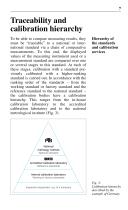
Traceability and calibration hierarchy To be able to compare measuring results, they must be “traceable” to a national or inter national standard via a chain of comparative measurements. To this end, the displayed values of the measuring instrument used or a measurement standard are compared over one or several stages to this standard. At each of these stages, calibration with a standard previously calibrated with a higher-ranking standard is carried out. In accordance with the ranking order of the standards – from the working standard or factory standard and the reference standard to the national...
Open the catalog to page 8
8 Traceability and calibration hierarchy Traceability in practice The German Calibration Service DKD (Deutscher Kalibrierdienst) designates the following as essential elements of traceability: • The chain of comparison must not be interrupted. • In each stage of the calibration chain, the measurement uncertainty must be known so that the total measurement uncertainty can be calculated. As a rule, a higher-ranking measuring instrument should have a measuring accuracy three to four times higher than the instrument calibrated by it. • Each stage of the calibration chain must be documented as must...
Open the catalog to page 9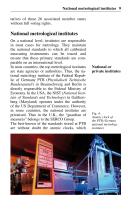
National metrological institutes 9 tatives of those 26 associated member states without full voting rights. National metrological institutes On a national level, institutes are responsible in most cases for metrology. They maintain the national standards to which all calibrated measuring instruments can be traced and ensure that these primary standards are comparable on an international level. In most countries, the top metrological institutes are state agencies or authorities. Thus, the national metrology institute of the Federal Republic of Germany PTB (Physikalisch Technische Bundesanstalt)...
Open the catalog to page 10
10 Traceability and calibration hierarchy serve among other things as the basis for the time signal in radio clocks and watches (Fig. 4). As the national metrological institute, the PTB also has the legislative mandate to offer scientific and technical services in the area of calibration to science and commerce. For this, it uses a network of accredited institutions. Accredited calibration laboratories Accredited calibration laboratories often take on calibration as external service providers for those companies that do not have the required equipment themselves. However, they themselves can...
Open the catalog to page 11
In-house calibration 11 exclusively on specialist grass-roots projects such as the development of standards and directives (Fig. 5). DAkkS carries out a complete evaluation of every accredited calibration laboratory every five years and also pays monitoring visits every 18 months, to ensure that the high demands of measuring processes are met. In addition to the described process monitoring of laboratories, there are also expert committees to ensure technical development and knowledge transfer. Since all European bodies that accredit calibration laboratories collaborate in the EA, the work procedures...
Open the catalog to page 12All Mensor catalogs and technical brochures
 Mensor Sensors
2 Pages
 WIKA Handbook
436 Pages
 Calibration
20 Pages
 Condensed Custom Systems
4 Pages
 Custom Systems
20 Pages
 Calibration Technology
32 Pages
 Model CPB5000
12 Pages
 Model CPB3800hp
9 Pages
 Model CPB3800
15 Pages
 Model CPB3500
9 Pages
 Model CTP5000
6 Pages
 Models CTP2000, CTP9000
4 Pages
 Model WIKA-Cal
6 Pages
 Model CPA8001
8 Pages
 Model CPC8000-H
7 Pages
 Model CPC8000
8 Pages
 MODEL CPC7000
9 Pages
 Model CPC6050
8 Pages
 Model CPC4000
8 Pages
 Model CPC2000
6 Pages
 Model CPG500
6 Pages
 Model CPG-KITH
6 Pages
 Model CPG-KITP
6 Pages
 Model CPG1500
11 Pages
 CPG2300
2 Pages
 CPG2400 Barometer
2 Pages
 CPA8001
8 Pages
 CPA2501
8 Pages
 CPC8000
8 Pages


- Tester
- Aeronautical tester
- Pressure sensor for the aerospace industry
- Aircraft pressure sensor
- Avionics tester
- Aircraft pump
- Absolute pressure sensor
- Pressure tester
- Digital pressure sensor
- OEM pressure sensor
- Booster unit
- Booster unit for the aeronautical industry
- Precision pressure sensor
- Air booster unit
- Air pump
- RS232 pressure sensor
- Nitrogen booster unit