
- Catalogs
- MAROTTA CONTROLS, INC.
- Aerospace America


Aerospace America

Aerospace America
Overview: The document provides a comprehensive review of advancements and operations in the field of electric propulsion for satellites and spacecraft over the past year. It highlights various projects, collaborations, and technological developments in electric propulsion systems.
Key Developments:
- XR-5 Hall Thrusters: Aerojet Rocketdyne announced agreements to supply XR-5 Hall thrusters for Lockheed Martin's A2100 and Orbital ATK's GEOStar 3 satellites. European Space Propulsion is working on qualifying the XR-5E variant.
- NASA's Initiatives: NASA's Glenn Research Center and Jet Propulsion Laboratory are developing a 12.5 kilowatt Hall Effect Rocket with magnetic shielding. NASA awarded contracts for the development of NASA Evolutionary Xenon Thruster systems and power processing units.
- Annular Ion Engine: NASA Glenn, Aerospace Corp., and the University of Michigan are advancing the annular ion engine for high thrust-to-power operations.
- International Efforts: The University of Stuttgart demonstrated a spherical inertial electrostatic confinement system. Japan's Hayabusa-2 completed its first maneuver using microwave discharge ion engines.
- Component Development: Marotta and VACCO Industries are working on multi-function valves and iodine proportional flow control valves, respectively.
- Electrospray Thrusters: MIT, JPL, and Busek Co. received awards to mature 100 micronewton systems. Busek delivered electronics for its BET-1 electrospray thruster system.
- High Power Systems: NASA NextSTEP grants were awarded to demonstrate a 100 kilowatt Hall system and other high power thrusters.
Significant Missions:
- Hayabusa-2: Propelled by ion engines, it aims to collect samples from asteroid 1999JU3.
- Dawn Spacecraft: Achieved orbit around Ceres using its Ion Propulsion System.
- Space Technology 7: Scheduled to test colloid thrusters on ESA's LISA Pathfinder.
Small-Spacecraft Propulsion: George Washington University launched a micro-cathode arc thruster, and Missouri University of Science and Technology is developing a multi-mode propulsion system.
Iodine Technology: The iSat project is progressing towards a critical design review, and Busek's BIT-3 RF ion thruster was selected for the Lunar IceCube mission.
Future Deliveries: Snecma's PPS 5000 Hall effect thruster is set for delivery for Airbus and Eutelsat satellites, and Space Systems Loral awarded flight sets of PPS 1350-E Hall thrusters.
Conclusion: The year has seen diverse research, innovation, and operations in electric propulsion, indicating significant progress and future potential in the field.
Catalog excerpts
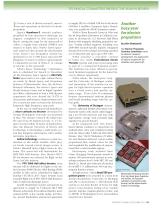
TECHNICAL COMMITTEES PRESENT THE YEAR IN REVIEW t’s been a year of diverse research, innovation and operations in the field of electric propulsion. Japan’s Hayabusa-2 asteroid explorer, propelled by four microwave discharge ion engines, completed its first maneuver in March, setting the stage for the spacecraft to collect a sample from asteroid 1999JU3 and return it to Earth. Also, NASA’s Dawn spacecraft achieved orbit around the dwarf planet Ceres. Dawn’s Ion Propulsion System has operated for over 47,000 hours and used 395 kilograms of xenon to deliver approximately 11 kilometers/second of Delta-V, or change in velocity, to the spacecraft. NASA’s Space Technology 7 demonstration is scheduled for launch in December on the European Space Agency’s LISA Pathfinder Spacecraft to test eight colloid thrusters made by Busek Space and Propulsion Systems of Massachusetts. Also, the Air Force Research Laboratory, the service’s Space and Missile Systems Center and its Rapid Capabilities Office collaborated to host a Hall thruster experiment this year aboard the X-37B to characterize performance improvements relative to previous units on board the Advanced Extremely High Frequency spacecraft. In the area of small-spacecraft propulsion, a micro-cathode arc thruster developed by George Washington University was launched in May. The thruster reduced the initial tumble rates from 30 degrees/second to 1.5 degrees/second within 48 hours of deployment. Also, the Missouri University of Science and Technology is developing a multi-mode system that integrates electrospray with catalytic microtube propulsion. Iodine technology continues to gain momentum as the iodine Satellite (iSat) project heads toward critical design review at NASA’s Marshall Space Flight Center in Alabama. The spacecraft will demonstrate the BHT-200-I Hall thruster. Also, Busek’s BIT-3 RF ion thruster was selected for flight on the Lunar IceCube mission. The PPS 5000 Hall effect thruster from Snecma will be delivered for flight on the Airbus Eurostar E3000 Electric Orbit Raising (EOR) satellite in 2016 and is scheduled for flight on Eutelsat’s E172B in 2017. Space Systems Loral awarded flight sets of PPS 1350-E Hall thrusters, with 2.5 kilowatt discharge power. Aerojet Rocketdyne in June announced an agreement to supply its 5 kilowatt XR-5 Hall thruster subsystems for Lockheed Martin’s modernized A2100. A few months earlier, in February, Aerojet Rocketdyne announced agreement Another busy year for electric propulsion to supply XR-5s to Orbital ATK for its all-electric GEOStar 3 satellites. European Space Propulsion is to qualify the XR-5E European variant. NASA’s Glenn Research Center in Ohio and the Jet Propulsion Laboratory in California continue to develop the 12.5 kilowatt Hall Effect Rocket with magnetic shielding propulsion system. Testing verified magnetic shielding over by John Dankanich 2000-3000 seconds specific impulse. Integrated The Electric Propulsion thruster Power Processing Unit testing operated Technical Committee works at 12.5 kilowatts and up to up to 800 volts. to advance research, NASA awarded a cost-share contract development and application to build two NASA Evolutionary Xenon of electric propulsion for Thruster systems and power processing units satellites and spacecraft. as part of a commercial transition project. The hardware has been offered as government furnished equipment for the latest Discovery Mission opportunity. NASA Glenn, the Aerospace Corp. and the University of Michigan continued maturation of the annular ion engine for high thrust-to-power operation over a broad power and specific impulse range. Tests of the 65 centimeter thruster demonstrated uniform plasma and broad throttling range with flat carbon grids. The University of Stuttgart demonstrated a spherical inertial electrostatic confinement system with anode outlet triggering a jet of both electrons and ions with high kinetic energy with potential high impulse low-power thruster. At the component level, New Jerseybased Marotta continues to characterize its multi-function valve and completed testing with the Sitael (Alta) 5 kilowatt Hall effect thruster. Also, VACCO Industries of California and Alabama delivered custom iodine proportional flow control valves for iSat and completed the qualification of proportional flow control module options. Electrospray work included three Game Changing Development awards to mature 100 micronewton systems to technology readiness level 5 with MIT, JPL and Busek Co. Busek also delivered electronics for its BET-1 (1 millinewton) 100 watt elecBusek/NASA/MIT trospray thruster system. At high power, NASA NextSTEP proMiniaturized electrospray thrusters pulsion grants were awarded to a team from from, top, Busek Space Propulsion Aerojet Rocketdyne, University of Michigan and Systems, Jet Propulsion and JPL to demonstrate a 100 kilowatt Hall Laboratory (3-centimeters-wide thruster) and the Massachusetts system; to Ad Astra Rocket of Texas for high Institute of Technology. power, long duration testing of its variable specific impulse magnetoplasma rocket; and to MSNW of Washington for its electrodeless Lorentz
Open the catalog to page 1