
- Catalogs
- Leonardo – Finmeccanica
- C-27J Spartan


C-27J Spartan

C-27J Spartan
The C-27J Spartan is a highly versatile and effective multi-mission airlifter, renowned for its ability to operate from rudimentary airstrips and perform short take-offs and landings (STOL) under extreme environmental conditions. It is mission-proven in various demanding operational environments, including Afghanistan.
Specifications
- Maximum Take-Off Weight (MTOW): 71,650 lb (32,500 kg)
- Maximum Landing Weight: 71,650 lb (32,500 kg)
- Normal Landing Weight: 66,139 lb (30,000 kg)
- Max Payload: 25,574 lb (11,600 kg)
- Fuel Capacity: 3,255 US Gal (12,320 l)
- Engines: 2 Rolls-Royce AE 2100-D2A, 4,637 SHP each
- Propellers: 2 Dowty R-391 six-blade
Performance
- Take-Off Ground Run: 2,230 ft (680 m)
- Landing Ground Roll: 1,246 ft (380 m)
- Top Cruising Speed: 325 KTAS (602 km/h)
- Max Service Ceiling: 30,000 ft (9,144 m)
- Cruise Altitude: 27,000 ft (8,229 m)
- Range with 10,000 lb Payload: 2,760 nm (5,112 km)
- Ferry Range: 3,160 nm (5,852 km)
Capabilities
The Spartan is designed for ruggedness, reliability, and survivability, with a structural strength that allows for 3 g tactical maneuvers. It features an Auxiliary Power Unit (APU) for independent power, useful for missions at improvised airfields. The aircraft can be equipped with a Defensive Aids Sub-Systems suite, secure communications, and ballistic protection for high-threat environments.
Operational Flexibility
The C-27J can be configured for various missions through easily installable and transportable mission kits, including:
- Troops Transport: 46 to 60 troops
- Paratroops Airdrop: 34 fully equipped, 46 lightly equipped
- Cargo Transport: Bulk loads, vehicles, aircraft engines, light helicopters, 463L standard pallets
- Cargo Airdrop: Up to 6 A22 CDS bundles, up to 9000 kg with two platforms
- Medevac: Up to 36 stretchers and 6 medical attendants
- VIP Transport: Module for 6 VIP and 18 escort passengers
- Fire Fighting: Up to 6 Guardian System boxes
Environmental Adaptability
The Spartan is qualified for extreme temperature conditions, ranging from -55°C to ISA+ 35°C, and can operate effectively in very hot and high conditions, as demonstrated in the Andes.
Catalog excerpts
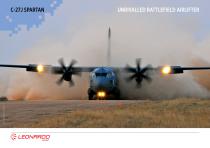
UNRIVALLED BATTLEFIELD AIRLIFTER titnoji - dJe]iniAi eoijneucud y LEONRRDO AIRCRAFT
Open the catalog to page 1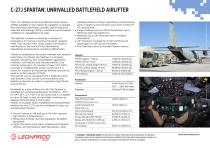
The C-27J Spartan is the most effective multi-mission airlifter available on the market. Its capability to operate from the most rudimentary airstrips, performing short take-offs and landings (STOL) in extreme environmental conditions is unparalleled in its class. The Spartan is mission-proven by a number of prestigious Air Forces in tactical transport, disaster relief, "last tactical mile” troop support and Search and Rescue in the world's most demanding operational environments, including Afghanistan. Thanks to exceptional structural strength and systems redundancy by design the Spartan is...
Open the catalog to page 2All Leonardo – Finmeccanica catalogs and technical brochures
 1090ES RX
4 Pages
 PIRATE
2 Pages
 SEASPRAY 7000E
2 Pages
 PICOSAR
2 Pages
 OSPREY
2 Pages
 GABBIANO ULTRA-LIGHT
2 Pages
 SURVEILLANCE RADAR FAMILY
2 Pages
 AW119Kx
8 Pages
 AW109 TREKKER
8 Pages
 AW609 TiltRotor
5 Pages
 AW009
AW0095 Pages
 AWFamily
5 Pages
 AW189
AW1895 Pages
 AW139
AW1398 Pages
 AW169
AW1695 Pages
Archived catalogs
 body_AW009
8 Pages
 body_GrandNew_EMS
4 Pages
 body_AWFamily
8 Pages
 W-3A Sokół
5 Pages
 FALCO Xplorer - RPAS
2 Pages
 C-27J ISR
20 Pages
 Raven ES-05
2 Pages
 LEOSS S
2 Pages
 CSP-ALS
2 Pages
 VIXEN 1000E
2 Pages


- UAS
- Professional UAS
- Surveillance UAS
- Fixed-wing UAS
- LEONARDO surveillance radar
- Aeronautic camera
- LEONARDO single-rotor helicopter
- Camera for the aerospace industry
- Airport radar
- Aircraft camera
- LEONARDO transport helicopter
- Infrared camera
- LEONARDO turboshaft helicopter
- Land-based radar
- 500 - 1000km helicopter
- ADS-B
- ADS-B receiver
- LEONARDO rescue helicopter
- Aircraft radar