
- Catalogs
- LaVision GmbH
- MTZ 06/2013, Berg et al.

MTZ 06/2013, Berg et al.

MTZ 06/2013, Berg et al.
The document discusses a new optical indication method developed by LaVision GmbH for measuring in-cylinder mixture formation in modern engines. This method supplements traditional pressure indication by providing real-time measurements of fuel density, residual gas content, mixture temperature, and lambda (λ) value, which are crucial for optimizing engine performance and meeting stringent emission standards.
Optical Indication
Optical indication provides direct measurements of mixture quality, including ignitability, residual gas content, and gas temperature, which are not possible with pressure indication alone. The system uses sensors that measure these parameters directly in the combustion chamber, allowing for high temporal resolution and spatial averaging over the cylinder cross-section.
Measurement Principle and Sensor Configurations
The method relies on infrared (IR) absorption to detect hydrocarbons, carbon dioxide, and water in the combustion chamber. Sensor probes can be integrated into spark plugs or glow plugs, or installed in the combustion chamber, to measure gas densities and convert them into concentrations or λ values.
Fuel Density Curve and Local Lambda Value
During cold starts, variations in fuel density and λ value at the spark plug are significant. Crank angle-resolved measurements help optimize injection and ignition strategies by providing insights into mixture ignitability.
Simultaneous Fuel and Residual Gas Measurement
Simultaneous measurement of fuel and residual gas densities allows for better understanding of ignitability, especially in downsized engines with high exhaust gas recirculation (EGR) rates.
CO2, EGR Rates, and Derived Quantities
Uniform EGR distribution and low cyclic fluctuations are essential for efficient combustion. The method allows for the determination of CO2 concentration curves and EGR rates, providing insights into combustion efficiency and emissions.
Curve of Mixture Temperature
The temperature sensor measures the temperature curve during mixture formation and combustion, providing data on the effects of EGR on gas temperature and combustion process.
Summary and Conclusion
The optical indication method enhances traditional pressure indication by providing additional in-cylinder data, enabling faster recognition of engine conditions and reducing optimization steps. This tool is valuable for development engineers in improving engine performance and meeting emission standards.
Catalog excerpts

Offprint from MTZ 06.2013 Springer Vieweg Springer Fachmedien Wiesbaden GmbH MEASUREMENT OF IN-CYLINDER MIXTURE FORMATION BY OPTICAL INDICATION
Open the catalog to page 1
DE VELO PMENT SENS ORS Modern engine concepts are based on complex mixture formation and combustion processes with direct injection, exhaust gas recirculation and downsizing. Their successful optimisation as well as specific conditions such as cold start behaviour requires an extension of pressure indication by the addition of engine-relevant indication quantities. The sensor system presented in the following supplements the established pressure indication system by adding the optically measured in-cylinder characteristic quantities of fuel density, residual gas content and mixture temperature,...
Open the catalog to page 2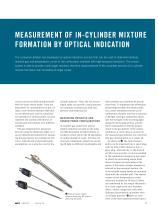
MEASUREMENT OF IN-CYLINDER MIXTURE FORMATION BY OPTICAL INDICATION The company LaVision has developed an optical indication process that can be used to determine lambda, residual gas and temperature curves in the combustion chamber with high temporal resolution. The sensor system is able to provide crank angle-resolved, real-time measurements of the complete process of in-cylinder mixture formation over hundreds of single cycles. curves can be recorded simultaneously with the same sensor probe. From the measured CO2 concentrations in the cylinder, cycle-resolved internal EGR rates can be determined,...
Open the catalog to page 3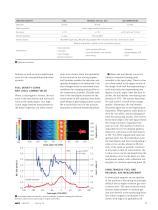
INDICATED QUANTITY Data acquisition Crank angle-resolved multiple cycles Accuracy < 2 % < 2 % ± 20 K at 3 vol. % H2O Derived quantity X value Internal EGR - Sensor probes M12/M14 spark plug, M5 glow plug adapter, M5 indication bore hole, transmission probe Mixture preparation, stability of the combustion process Direct injection Cold start Load changes Ignition behaviour Cycle-resolved EGR rate : Validation Equal distribution over cylinder : Supercharging, EGR Valve timing : HCCI 0 Overview of systems -120 -60 0 Crank angle [°CA aTDC) 0 Non steady-state...
Open the catalog to page 4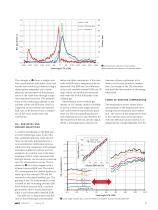
The example in Q shows a single cycle with simultaneous indication of the fuel density and residual gas density using a sensor probe integrated into a spark plug and measurement of the pressure curve at the same time through a separate indication bore hole. The measurement of the residual gas density in the cylinder allows the EGR rate, which is composed of the external and internal EGR rate, to be derived from a comparison of the curve before and after combustion. CO2, EGR RATES AND DERIVED QUANTITIES A uniform distribution of the EGR rate, an even residual gas mass in all cylinders combined...
Open the catalog to page 5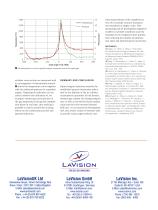
Crank angle [°CA aTDC] ❻ Gas temperature curve of a gasoline engine, measured close to the spark gap cylinder cross-section are measured with an arrangement of transmission sensors. ❻ shows the temperature curve together with the indicated pressure in a gasoline engine. Temperature indication can be used to observe the influences of, for example, exhaust gas recirculation on the gas temperature during the compression phase in real time, thus making it possible to clearly classify the ensuing effects on the combustion process and ignition behaviour. Optical engine indication extends the established...
Open the catalog to page 6All LaVision GmbH catalogs and technical brochures
 Focus on Fluid Dynamics
12 Pages
 Focus on Combustion
16 Pages
 StrainMaster
20 Pages
 FlowMaster
16 Pages
 PIV poster
1 Page
 LIF poster
1 Page
 Tomographic PIV
20 Pages
 StrainMaster Portable
8 Pages
 StrainMaster Micro-DIC
8 Pages
 SprayMaster
16 Pages
 ParticleMaster
4 Pages
 Optical Crack Tracer
4 Pages
 ICOS
ICOS12 Pages
 DaVis
DaVis20 Pages
 Laser Imaging in Fluid Dynamics
12 Pages
 Quantitative Flow Field Analysis
12 Pages
 Fluid-Structure Interaction
2 Pages
 Imager sCMOS
2 Pages
 Imager M-lite 2M
2 Pages


- Aeronautical software
- 3D software
- Airport camera
- Inspection machine
- Inspection machine for the aeronautical industry
- Test software
- Measurement software
- Tracking software
- 2D software
- Aeronautic camera
- Camera for the aerospace industry
- Surface inspection machine
- Data acquisition software
- Spark optical emission camera
- Calculation software
- Automatic inspection machine
- Image analysis software
- Optical inspection machine
- 3D inspection machine
- Laser inspection machine