
- Catalogs
- LaVision GmbH
- Focus on Fluid Dynamics

Focus on Fluid Dynamics

Focus on Fluid Dynamics
Laser imaging is a vital tool in fluid dynamics, offering high-resolution imaging capabilities in 2D, 3D, and 4D. Techniques such as Laser Induced Fluorescence (LIF) and Particle Image Velocimetry (PIV) are crucial for measuring scalar flow parameters and flow fields, applicable to various fluid flows including laminar, turbulent, reactive, and multiphase flows.
LaVision's FlowMaster and FluidMaster systems are designed for flow field and scalar imaging, using similar hardware and software for multi-parameter measurements. Accurate flow seeding is essential, with LaVision providing expertise and equipment.
LIF imaging monitors reactive mixing processes with high spatio-temporal resolution. The ratiometric 2-color LIF method is preferred for scalar flow imaging due to its independence from local variations. Tomographic PIV is used for 3D and 4D flow field imaging, offering insights into turbulent flows.
Dual imaging techniques study interactions between phases, such as bubble-water flows. Micro PIV (µPIV) is applied in microfluidic environments, like fuel cells, to optimize flow field designs.
LIF imaging in gas flows uses gaseous tracers for high-resolution concentration and temperature mapping. Techniques like 1-color and 2-color LIF thermometry are used for temperature measurements.
Thermographic PIV allows simultaneous temperature and flow field imaging using phosphorescent particles, supporting high-speed imaging for thermal flow field analysis.
Time-resolved 3D imaging is crucial for studying turbulent mixing processes, with high-speed light sheet scanners and cameras enabling detailed analysis of 3D flow structures.
Laser imaging provides comprehensive tools for fluid dynamics research, offering detailed insights into flow behaviors and interactions across various applications.
The document discusses advanced techniques for measuring and visualizing flow fields in large volumes using Helium-Filled Soap Bubbles (HFSB) and other imaging technologies, crucial for fluid dynamics and fluid-structure interaction studies.
- Helium-Filled Soap Bubbles (HFSB): Sub-millimeter diameter bubbles that are neutrally buoyant and brighter than standard particles, allowing effective 3D flow field measurements in large volumes. They have a relaxation time of 11 µs, suitable for high-velocity flows.
- Bubble Generation: LaVision’s HFSB generator produces up to 2 million bubbles per second, ensuring high seeding concentration for PIV measurements.
- Shake-the-Box (STB) Particle Tracking: Used for time-resolved 3D convective flow field measurements, providing detailed insights into flow dynamics.
- 4D Mixture Fraction Imaging: Utilizes high-speed scanning planar LIF for detailed flow analysis.
- Background Oriented Schlieren (BOS): A cost-effective method for visualizing gas motion based on refractive index variations without complex laser setups.
- FSI Measurement Systems: LaVision offers integrated systems combining PIV and Digital Image Correlation (DIC) for simultaneous measurement of flow fields and structural responses.
- Applications: Used in studies such as pulsating blood flow in aneurysms and locust flight dynamics.
LaVision provides advanced imaging solutions for both qualitative and quantitative analysis of fluid dynamics and fluid-structure interactions, supporting a wide range of scientific and engineering applications.
Catalog excerpts

Focus on Fluid Dynamics Advanced Laser Imaging Solutions
Open the catalog to page 1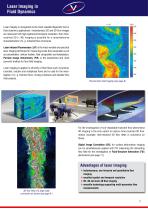
Laser Imaging in Fluid Dynamics Laser imaging is recognized as the most valuable diagnostic tool in fluid dynamics applications. Instantaneous 2D and 3D flow images are measured with high spatial and temporal resolution. Even timeresolved 3D (= 4D) imaging is possible for a comprehensive characterization of e. g. turbulent flow structures. Laser Induced Fluorescence (LIF) is the most versatile and practical laser imaging technique for measuring scalar flow parameters such as concentration, mixture fraction, fluid composition and temperature. Particle Image Velocimetry (PIV) is the established...
Open the catalog to page 2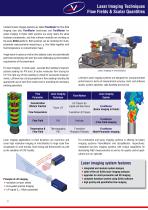
LaVision’s laser imaging systems are called FlowMaster for flow field imaging (see also FlowMaster brochures) and FluidMaster for scalar imaging in fluids. Both systems are using nearly the same hardware components, and their software modules are working on the same DaVis platform. Both systems can be combined for multiparameter measurements measuring e. g. flow fields together with fluid temperature or concentration maps. Image scans in space as well as time (phase) scans are automatically performed complying with even the most challenging synchronization requirements of the experiment. For...
Open the catalog to page 3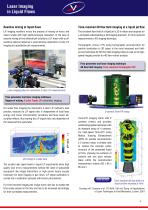
Laser Imaging in Liquid Flows Reactive mixing of liquid flows Time-resolved 3D flow field imaging of a liquid jet flow LIF imaging monitors in-situ the process of mixing on micro and macro scales with high spatio-temporal resolution. In the case of reactive mixing of two different pH-solutions a LIF tracer with a pHsensitive spectral response is used allowing ratiometric 2-color LIF imaging for quantitative pH measurements. The turbulent flow field of a liquid jet is 3D in nature and requires for a complete understanding a 3D imaging approach, for time-resolved measurements a 4D imaging technique....
Open the catalog to page 4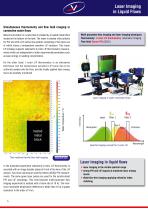
Simultaneous thermometry and flow field imaging in convective water flows Natural convection in a water tank is created by a heated metal block located at the bottom of the tank. The water is seeded with particles for PIV and with a LIF-active dye solution consisting of two dyes one of which shows a temperature sensitive LIF emission. This tracer LIF strategy supports ratiometric 2-color LIF thermometry measurements which are independent of other experimental parameters such as laser energy or seeding concentration. On the other hand, 1-color LIF thermometry is an alternative technique, but the...
Open the catalog to page 5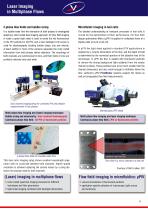
2-phase flow fields and bubble sizing In a bubble-water flow the interaction of both phases is investigated applying a color-coded dual imaging approach: for flow field imaging in water a green light sheet is used to excite the red fluorescence of the PIV particle for 2D-PIV, and a blue backlight LED screen is used for shadowgraphy tracking bubble shape, size and velocity. A beam splitter in front of the cameras separates the color coded information from both phases before detection. The recordings of both channels are synchronized in time, and their fields of view are perfectly matched onto...
Open the catalog to page 6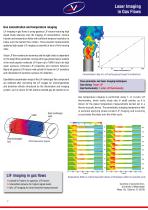
Laser Imaging in Gas Flows Gas concentration and temperature imaging LIF imaging in gas flows is using gaseous LIF tracers featuring high signal levels allowing even 3D imaging of concentration, mixture fraction and temperature fields with sufficient temporal resolution to freeze even the fastest flow motion. Time-resolved measurements applying high-speed LIF imaging is possible at tens of kHz framing rates. Tracer LIF flow markers are numerous and the right choice is dependent on the target flow parameter. Among other gas phase tracers acetone is the most popular molecular LIF tracer up to 1000...
Open the catalog to page 7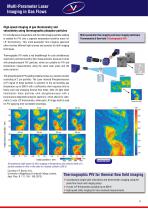
High-speed imaging of gas thermometry and velocimetry using thermographic phosphor particles For simultaneous temperature and flow field imaging particle seeding is needed for PIV, and a separate temperature-sensitive tracer for LIF thermometry. This multi-parameter flow imaging approach often involves different light sources and cameras for both imaging techniques. Thermographic PIV marks a real breakthrough for such simultaneous velocimetry and thermometry flow measurements, because it works with phosphorescent PIV particles, which are suitable for PIV and temperature measurements using the...
Open the catalog to page 8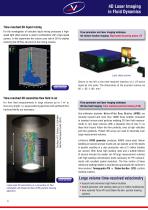
4D Laser Imaging in Fluid Dynamics Time-resolved 3D liquid mixing For the investigation of turbulent liquid mixing processes a highspeed light sheet scanner is used in combination with a high-speed camera. In this experiment the volume scan rate of 30 Hz enables resolving the 3D flow structure of the mixing process. Flow parameter and laser imaging technique 4D mixture fraction imaging: High-speed scanning planar LIF Laser sheet scanner Shown to the left is the time-resolved injection of a LIF-active liquid jet into water. The dimensions of the scanned volume are 60 x 60 x 100 mm3. Time-resolved...
Open the catalog to page 9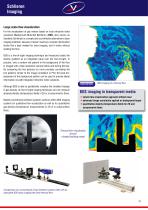
Schlieren Imaging Large scale flow visualization For the visualization of gas motion based on local refractive index variations Background Oriented Schlieren (BOS, also known as Synthetic Schlieren) is a simple and cost-effective alternative to laser imaging methods, because it doesn’t need any complex illumination device like a laser needed for laser imaging, and it works without seeding the flow. BOS is a line-of-sight imaging technique and measures locally the density gradient as an integrated value over the line-of-sight. In practice, only a random dot pattern in the background of the flow...
Open the catalog to page 10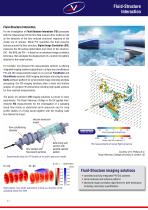
Fluid-Structure Interaction Fluid-Structure Interaction For the investigation of Fluid-Structure Interaction (FSI) processes both the measurement of the flow field around a flow model as well as the detection of the flow induced structural response of the model are of interest. While PIV quantifies the fluid dynamic features around the flow structure, Digital Image Correlation (DIC) measures the 3D surface deformation and strain of the structure. DIC - like BOS and PIV – is based on an advanced image correlation technique, that calculates the displacement of a random dot pattern attached to the...
Open the catalog to page 11All LaVision GmbH catalogs and technical brochures
 Focus on Combustion
16 Pages
 StrainMaster
20 Pages
 FlowMaster
16 Pages
 PIV poster
1 Page
 LIF poster
1 Page
 Tomographic PIV
20 Pages
 StrainMaster Portable
8 Pages
 StrainMaster Micro-DIC
8 Pages
 SprayMaster
16 Pages
 ParticleMaster
4 Pages
 Optical Crack Tracer
4 Pages
 MTZ 06/2013, Berg et al.
6 Pages
 ICOS
ICOS12 Pages
 DaVis
DaVis20 Pages
 Laser Imaging in Fluid Dynamics
12 Pages
 Quantitative Flow Field Analysis
12 Pages
 Fluid-Structure Interaction
2 Pages
 Imager sCMOS
2 Pages
 Imager M-lite 2M
2 Pages


- Aeronautical software
- 3D software
- Airport camera
- Inspection machine
- Inspection machine for the aeronautical industry
- Test software
- Measurement software
- Tracking software
- 2D software
- Aeronautic camera
- Camera for the aerospace industry
- Surface inspection machine
- Data acquisition software
- Spark optical emission camera
- Calculation software
- Automatic inspection machine
- Image analysis software
- Optical inspection machine
- 3D inspection machine
- Laser inspection machine