

Kaydon bearing solutions
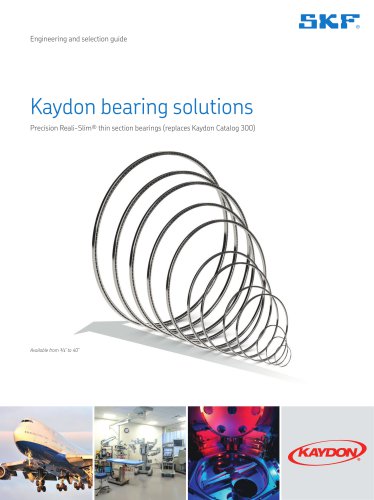
Kaydon bearing solutions
Kaydon's Reali-Slim bearings are designed for compact and lightweight applications, offering significant space and weight savings. These bearings maintain a constant cross-section regardless of bore size, leading to potential system cost reductions of up to 40%. They are suitable for various industries, including industrial machinery, aerospace, defense, oil & gas, medical, semiconductor machinery, and renewable energy.
The document provides a comprehensive guide to selecting Reali-Slim bearings, including open and sealed types, precision tolerances, and recommended fits. It covers various materials such as AISI 52100 steel and AISI 440C stainless steel, and offers options with Endurakote plating for enhanced durability.
This section includes recommendations for bearing selection, capacity, life, and load analysis. It emphasizes the importance of understanding load scenarios to optimize bearing performance.
Different separator types are discussed, including non-metallic, phenolic, brass, and nylon options. The section also covers limiting speeds, torque, and axis deviation, providing insights into performance optimization.
Guidelines for mounting, inspection, installation, lubrication, and maintenance of Reali-Slim bearings are provided to ensure longevity and reliability.
The document mentions other Kaydon products like KT series tapered roller bearings and offers resources such as CAD downloads, interactive bearing selectors, and Reali-Design software for design assistance.
Includes terms, definitions, warranty information, design aids, and distributor contacts. It also provides a request form for bearing proposal data and conversion factors.
This document provides an overview of Reali-Slim thin section bearings, highlighting their design efficiency, load scenarios, and product availability. The Reali-Slim product line includes seven open series and five sealed series, with bore diameters ranging from 1 inch to 40 inches. These bearings are available in three configurations: radial contact (Type C), angular contact (Type A), and four-point contact (Type X).
The Reali-Slim bearings are designed to maintain a constant cross-section as the bore diameter increases, which is beneficial for standardizing components across different product sizes. The document also introduces additional product variants such as Ultra-Slim, Reali-Slim TT series, and KT thin section taper bearings.
Standard Reali-Slim bearings are manufactured to Kaydon Precision Class 1 specifications. They can be customized with various options including changes in diametral clearance, preloading, and special materials. The document emphasizes the importance of specification control drawings for product traceability.
Reali-Slim bearings are designed to handle radial, axial, and moment loads. The document provides equations and diagrams to explain how these loads interact with the bearings. Type C bearings are primarily for radial loads, Type A for greater thrust capacity, and Type X for handling multiple load types simultaneously.
The document details the material analysis, heat treatment, precision, and quality control standards for Reali-Slim bearings. It also outlines the design of separators and the importance of proper cleaning and packaging.
Reali-Slim bearings offer a compact and efficient design solution for various applications, with the flexibility to meet specific requirements through customization. The document provides a comprehensive guide to selecting and specifying these bearings for optimal performance.
This section provides an overview of the Metric Series Ball Bearings, highlighting their specifications and applications. These bearings are designed for various industrial uses, offering durability and precision.
Details the types of ultra-slim thin section bearings, focusing on their design and suitability for applications requiring minimal space and weight. Types A, C, and X are discussed, each with unique characteristics for specific engineering needs.
This section outlines the precision tolerances and recommended fits for ultra-slim bearings, ensuring optimal performance and longevity. It provides guidelines for selecting the appropriate fit based on application requirements.
Describes the Reali-Slim TT Series, emphasizing their compact design and efficiency in turntable applications. These bearings are ideal for systems where space is limited but performance cannot be compromised.
Includes detailed selection tables for standard Reali-Slim bearings, providing dimensions, capacities, and weights. These tables assist in choosing the right bearing for specific load and size requirements.
Focuses on Type A – Angular Contact bearings, explaining their design features such as deep groove and reduced shoulder. These bearings are suitable for radial and single-direction thrust loads and can be used in conjunction with similar bearings for enhanced performance.
The tables provide comprehensive data on various bearing series (KA, KAA, KB, KC, KD, KF, KG), including dimensions, dynamic and static capacities, and approximate weights. This information is crucial for engineers to select bearings that meet specific mechanical and load requirements.
The document serves as a technical guide for selecting and understanding the specifications of various bearing types offered by Kaydon. It emphasizes the importance of precision and fit in bearing selection to ensure optimal performance in industrial applications.
The document provides detailed specifications for Reali-Slim bearings, including dimensions in inches and precision tolerances. It highlights that diametral clearance can vary widely based on bearing, housing, and shaft tolerances. The document specifies total width tolerance for Duplexed Type A Bearings and race width tolerance for Single Type C, X, A Bearings.
The document advises contacting Kaydon for design assistance when non-standard diametral clearances or specific performance characteristics are required. It also outlines the application of Endurakote plating for corrosion resistance and wear improvement.
The bearings are classified under Precision Class 4 and 6, referencing ABEC 5F and 7F standards, respectively. The document provides recommended shaft and housing diameters for steel supports with standard bearing diametral clearance.
Endurakote plating is recommended for bearings to enhance corrosion resistance and wear resistance. It is particularly beneficial for larger diameter bearings or when quick delivery is critical. The document suggests that Endurakote plating can be applied to any type of bearing and most bearing materials.
The tables provide detailed measurements for bearing sizes, including bearing diameters, radial and axial runout, and diametral clearance before installation. The tables also list the dynamic and static capacities of bearings in pounds.
The document describes Endurakote plating as having a hardness exceeding 70 Rockwell "C" and a low coefficient of friction. It adheres well to base materials and enhances corrosion resistance, withstanding temperatures from -65°F to 250°F.
Endurakote plating is used in food processing equipment and provides significant advantages in terms of corrosion resistance and wear resistance. It is compatible with most ferrous and nonferrous metals and does not affect the load capacity of bearings.
- Dimensions: The document lists the bore, outside diameter, and land diameters for each bearing type, measured in millimeters.
- Capacities: Dynamic and static capacities are provided in Newtons, with notes on their application and limitations. Dynamic capacities are based on 1 million revolutions of L10 life, while static capacities are non-brinell limits.
- Weight: Approximate weights are given in kilograms for each bearing type.
- Load Analysis: The document advises on bearing selection and load analysis, noting that capacities listed are not simultaneous and require further discussion for combined loading.
- ISO Ratings: ISO radial ratings are calculated per ISO 281:1990 and are included for comparison purposes.
- For hybrid series bearings (P, X, and Y), contact Kaydon product engineering for specific capacity values.
- Consider the maximum shaft or housing fillet radius (F) that the bearing corners will clear.
- The tables provide a comprehensive list of bearing numbers, dimensions, capacities, and weights for each series.
- Popular items are marked with a special symbol for easy identification.
- Angular contact and Conrad assembly types are mentioned, with specific details on ball sizes and separator types.
- Torque figures and limiting speeds are provided for double-sealed bearings.
The document discusses the specifications of four-point contact (Type X) bearings, highlighting an increase in radial capacity compared to radial (Type C) bearings. This is due to the distribution of ball loads over two lines of contact, resulting in lower contact stress and longer life.
The dynamic capacity values are based on 1,000,000 revolutions L10 fatigue life, which is the industry standard. It is noted that applying loads equal to dynamic capacities in actual applications is not advisable as it may not yield acceptable life. The L10 life is the life that 90% of bearings can achieve before material fatigue appears, while L50 or median life is approximately five times the L10 life.
Previous methods of load analysis had limitations, such as assuming zero for one reaction and not accounting for internal bearing fitup. Modern methods use computers to determine individual ball loads, allowing for more accurate life and safety factor calculations.
For radial loading, larger clearances result in fewer balls carrying the load, reducing dynamic life. For axial and moment loading, larger clearances allow a higher contact angle, but may cause issues if the contact area spills over the race edge.
The document outlines various separator types used in Reali-Slim bearings, each with specific design features and material considerations. The primary function of a separator is to space rolling elements uniformly to prevent contact and abrasion, which affects life and torque characteristics.
1. Phenolic laminate is used for lightweight and lubricant absorption applications.
2. The 'snap-over' non-metallic separator is ideal for high-speed applications and small cross-section bearings.
3. Correct bearing orientation is crucial, especially when the bearing axis is within 45° of vertical.
1. Continuous Ring Circular Separators: Used in Type A bearings, allowing more balls than Conrad bearing Types C and X.
2. Riveted Ring Circular Pocket: Suitable for non-standard bearings of Type C or X, recommended for high speeds.
3. Segmental Separators: Useful for high-temperature applications and variable loading conditions.
4. Formed Wire Separator: Maximizes ball capacity, suitable for Type A bearings.
5. Toroid Separators, PTFE Spacer Slugs, Spacer Balls, Helical Spring Separators: Used for critical positioning applications with low speeds and light loads.
1. Factors affecting speed include bearing diameter, type, internal configuration, and lubrication.
2. Maximum safe operating speeds are empirical and depend on various factors.
3. Special attention to lubrication and heat is necessary for speeds near or over limits.
1. Torque is the moment required to turn the rotating race relative to the stationary race.
2. Factors affecting torque include separator drag, lubricant viscosity, and bearing geometry.
3. Cleanliness is crucial for maintaining uniform torque levels.
1. Races and balls are made from AISI 52100.
2. Cage materials include PTFE, Vespel®, and slugs for different separator types.
1. Figures 4-7 to 4-13 provide data on slimness symbols, derating factors, and torque curves.
2. Charts show approximate torque levels and limiting speeds for various bearing types and conditions.
Reali-Slim bearings are crucial in applications where the position of a rotating part relative to a stationary structure is critical. The document discusses the displacement of the axis of rotation, which can occur radially, axially, and angularly, and the factors contributing to these deviations, such as bearing diametral clearance and elastic deflection.
The document provides equations to determine displacement, involving variables like radial translation (RT), axial translation (AT), and angular rotation (AR). These calculations are essential for applications where radial, axial, or moment loads are applied.
The Reali-Design software aids in selecting the appropriate Reali-Slim bearing. It allows users to input key parameters and provides performance graphs for factors like starting torque, radial deflection, and axial deflection. The software is user-friendly and available for free download.
Proper mounting of Reali-Slim bearings is essential due to their thin cross-section. The document outlines procedures for mounting different types of bearings, such as radial (Type C), four-point contact (Type X), and angular contact (Type A) bearings. It emphasizes the importance of correct fits and preload settings to ensure optimal performance.
The document includes figures illustrating the relationship between axial and diametral clearance and the recommended mounting configurations for different bearing types. These visual aids help in understanding the installation and performance characteristics of the bearings.
Reali-Slim bearings require careful consideration of mounting, clearance, and load conditions to function effectively. The Reali-Design software simplifies the selection process, providing engineers with the necessary tools to optimize bearing performance.
Angular contact bearings in a duplex set should have their 'V' marks aligned during installation to minimize runout. The flatness and roundness tolerances of the shaft and housing are crucial for the performance of Reali-Slim thin section ball bearings. Proper chamfering and interference fitting techniques are recommended to ensure ease of assembly and avoid damage.
The preload of bearings affects deflection, stiffness, and friction torque. Kaydon's software can help calculate the optimal preload. Face clamps are recommended for securing bearings, and a 'star' pattern should be used for tightening fasteners to ensure even distribution of clamping force.
Bearings should be cleaned and lubricated with suitable oil or grease before installation. The choice of lubricant depends on operating conditions such as speed, load, and temperature. Excessive lubrication can lead to higher operating temperatures and early fatigue.
Reali-Slim bearings require special inspection techniques due to their unique proportions. Proper installation in a clean environment is essential for optimal performance. Bearings should not be used as gauges during machining to prevent damage.
Different lubricants are recommended based on temperature ranges and application requirements. Factory-lubricated bearings have a shelf life of two years, and maintenance schedules should ensure protection against contamination and adequate lubrication.
Kaydon offers Reali-Slim bearings with features for extreme environments, including stainless steel options for high precision and corrosion resistance, and hybrid bearings for applications with marginal lubrication.
Catalog excerpts
Engineering and selection guide Kaydon bearing solutions Precision Reali-Slim® thin section bearings (replaces Kaydon Catalog 300)
Open the catalog to page 1
Many years ago, Kaydon engineers trying to help designers fit assemblies into smaller spaces had an idea: what if the bearing cross-section didn't increase as the bore size got bigger? This led them to develop new bearings with a cross-section that remained constant: Reali-Slim thin section bearings. 85 percent. Such savings typically have a ripple effect, and have been known to eliminate enough material and/or components to reduce system cost by 40 percent. Despite their slim profile, Reali-Slim bearings have enough load capacity to handle a wide range of applications. A few appear here; for...
Open the catalog to page 2
Table of contents Introduction Reali-Slim part number identification . . . . . . . . . . . . . . . . . . . . . . . . . . . . . . . . . . . . . . . . . . . . . . . 2 Section 1 – An introduction to Reali-Slim thin section bearings . . . . . . . . . . . . . . . . . . . . 7 Product line overview . . . . . . . . . . . . . . . . . . . . . . . . . . . . . . . . . . . . . . . . . . . . . . . . . . . . . . . . . . . . 8 Examples of design efficiency . . . . . . . . . . . . . . . . . . . . . . . . . . . . . . . . . . . . . . . . . . . . . . . . . . . . . . 9 Bearing load scenarios . . . . . . . . . . ....
Open the catalog to page 3
Position 2 - Series standard cross section Races/Balls D AISI 52100 Steel L AISI 52100 Steel, AISI 440C stainless steel balls N AISI 52100 Steel, AISI 440C stainless steel balls P AISI 17-4PH Steel Ceramic Balls (see section 6) Q AISI 52100 Steel (see section 6) Seals, Shields One shield Two seals and Endurakote® plating Endurakote plating and No seals Open bearings W AISI 440C Stainless Steel X AISI 52100 Steel Ceramic Balls (see section 6) Y AISI440C Stainless Steel Ceramic Balls (see section 6) Extended width Extra-extended width * Smaller section applies when position 3 is alphabetic—see...
Open the catalog to page 4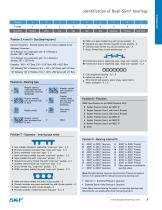
Position 3, 4 and 5 - Size (bearing bore) Numeric Characters - Nominal bearing bore in inches multiplied by ten Alphabetic Characters - “A” In Position 3 in combination with “A” in Position 2 denotes .187 x .187 Series “A” In Position 3 in combination with “H” in Position 2 denotes .187 x .250 Series Examples - 040 = 4.0" Bore, 120 = 12.0" Bore, 400 = 40.0" Bore “10” following “AA” in Positions 2 & 3 = .187 x .187 Series with 1.0" Bore “15” following “HA” in Positions 2 & 3 = .187 x .250 Series with 1.5" Bore Position 6 - Bearing type Q PEEK, one-piece molded ring with circular pockets - A R...
Open the catalog to page 5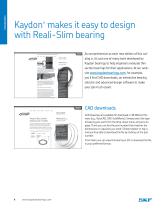
Kaydon makes it easy to design with Reali-Slim bearing ® As comprehensive as each new edition of this catalog is, it’s just one of many tools developed by Kaydon bearings to help engineers evaluate thin section bearings for their applications. At our website www.kaydonbearings.com, for example, you’ll find CAD downloads, an interactive bearing selector and advanced design software to make your job much easier. CAD downloads CAD drawings are available for download in 38 different formats (e.g., AutoCAD, DXF, SolidWorks). Simply select the type of bearing you want from the drop-down menu and go...
Open the catalog to page 6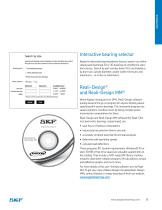
Search by size specify inch bearings, metric bearings, or both, then fill in one or all of the spaces to search by minimum and/or maximum dimensions. Bearing series O inch bearings (inches) ® Both inch and metric bearings Show results in ® inches O mm Interactive bearing selector Kaydon's interactive bearing selector lets you search our online catalog and download 2D or 3D drawings to simplify the selection process . Search by part number (even if it's incomplete) or by bore size, outside diameter, and/or width minimums and maximums... in inches or millimeters . Reali-Design® and Reali-Design...
Open the catalog to page 7
The design and application information contained in this catalog is for illustration only. Responsibility for the application of the products contained in this catalog rests solely with the equipment designer or user. In spite of our best efforts, the material contained in this catalog may contain inaccuracies and typographical errors.
Open the catalog to page 8
Section 1 An introduction to Reali-Slim thin section bearings Product line overview . . . . . . . . . . . . . . . . . . . . . . . . . . . . . . . . . . . . . . . . . . . . . . . . . . . . . . . . . . . . 8 Examples of design efficiency . . . . . . . . . . . . . . . . . . . . . . . . . . . . . . . . . . . . . . . . . . . . . . . . . . . . . . 9 Bearing load scenarios . . . . . . . . . . . . . . . . . . . . . . . . . . . . . . . . . . . . . . . . . . . . . . . . . . . . . . . . . . 10 Product availability chart . . . . . . . . . . . . . . . . . . . . . . . . . . . . . . . . . . . . . . . . . ....
Open the catalog to page 9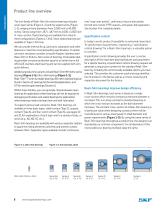
Product line overview The inch family of Reali-Slim thin section bearings includes seven open series (Figure 1-2) and five sealed series (Figure 1-3), ranging in bore diameters from 1.000 inch to 40.000 inches. Series range from .187 x .187 inch to 1.000 x 1.000 inch in cross-section. Open bearings are available from stock in three configurations (Types A, C & X). Stock sealed bearings are available in Types C & X only. We can provide internal fit up, lubricants, separators and other features to meet the most demanding specifications. To obtain corrosion resistance consider using the Kaydon stainless...
Open the catalog to page 10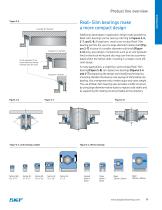
Product line overview For all diameters of this rotary table your bearing envelope stays the same. Additional advantages in application design made possible by Reali-Slim bearings can be seen by referring to Figures 1-6, 1-7, and 1-8. A large bore, small cross-section Reali-Slim bearing permits the use of a large diameter hollow shaft (Figure 1-7) in place of a smaller diameter solid shaft (Figure 1-6), king-post design. Components such as air and hydraulic lines or electrical wiring and slip rings can then be accommodated within the hollow shaft, resulting in a neater, more efficient design....
Open the catalog to page 11Archived catalogs
 Bearing applications guide
8 Pages


