
- Catalogs
- Kappa optronics GmbH
- Lightweight f light data & cockpit recording


Lightweight f light data & cockpit recording

Lightweight f light data & cockpit recording
The document emphasizes the importance of implementing ED-155 crash-protected recording solutions in lightweight aircraft to enhance aviation safety. It underscores the need for lightweight flight data and cockpit recorders, driven by recent regulations and notable accidents.
Aviation safety is paramount, with strict regulations due to the high risk of human injury. The ED-155 regulation requires the installation of lightweight crash-protected recorders in light aircraft by September 5, 2022, applicable to newly built aircraft and those under commercial air transport rules.
Cameras are vital in ED-155 recording solutions, providing redundant information and visual data from the cockpit. They capture pilot actions and external views, crucial for analog-based cockpits.
Advanced solutions like the Kappa "Flight Eye Cockpit" camera offer high-performance recording capabilities. These solutions are lightweight, easy to install, and cost-effective, suitable for light aircraft.
ED-155 recording solutions benefit flight schools, maintenance organizations, and insurance companies by providing valuable data for training, maintenance, and asset protection. They support dual streaming for various use cases.
The ED-155 regulation is part of a broader effort to enhance aviation safety by ensuring the recording of vital information on small aircraft. It sets minimum operational performance specifications for recording systems, focusing on crash protection and data retention.
ED-155 offers reduced crash protection compared to ED-112A to meet cost and weight goals for lightweight aircraft. It specifies requirements for cockpit audio, aircraft data, and airborne image recording systems.
The implementation of ED-155 recording solutions is a significant step towards enhancing safety in light aircraft aviation. These solutions provide comprehensive data to help prevent future accidents and improve overall aviation safety.
The European Aviation Safety Agency (EASA) is amending EU Regulation Nr. 965/2012 to mandate crash recorders in aircraft where none are currently required, affecting commercial and specialized operations, as well as small VTOL aircraft. The goal is to harmonize with ICAO Annex 6 rules and improve safety by recording flight data.
Flight recorders first appeared in 1939, evolving from photographic devices to solid-state memory systems by the 1980s, enhancing recording capacity and reliability.
The Federal Aviation Agency (FAA) is urged by the National Transportation Safety Board (NTSB) to require visual and audio data recorders on commercial turbine-powered helicopters. Recent accidents have prompted a move towards mandatory installation.
In Canada, regulations for FDR and CVR are outlined in section 605.33 of the Canadian Aviation Regulations. Transport Canada plans to align with ICAO standards and recommend retrofitting existing aircraft.
Known as CVFDR, these devices must survive severe accident conditions. An alternate power supply is recommended to ensure continuous recording.
The SferiRec© FE 320 LCR with camera was developed to meet new European regulations, effective for aircraft certified after September 2022.
The NTSB emphasizes the installation of crash-resistant recorders and flight data monitoring programs, particularly for light aircraft used in commercial operations and certain turbine-engined aircraft.
Catalog excerpts
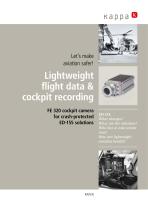
Let’s make aviation safer! Lightweight flight data & cockpit recording FE 320 cockpit camera for crash-protected ED-155 solutions ED-155: What changes? What are the solutions? Who has to take action now? How can lightweight aviation benefit?
Open the catalog to page 1
In this paper: 03 How Lightweight crash-protected recorders with certified cameras can boost safety in Light Aircraft Aviation A quick overview of the current situation 05 Why cameras are so important for crash-protected ED-155 recording solutions Fully compliant all-in-one solutions 07 ED-155 Crash-protected Recording for lightweight aircraft What is in the Regulation? 08 History and regulations Dive in deeper into the topic! 02 Let’s make aviation safer! “Not learning from the past is a brutally expensive and dangerous way to run a flight operation. Through the analysis of past flights, flight...
Open the catalog to page 2
How lightweight crash-protected ED-155 recorders can boost safety in light aircraft aviation A quick overview of the current situation Safety is one of the most important topics in aviation. The regulations are very tight in this segment because a small error could trigger a big catastrophe and the risk of human injury is way higher than in other type of transports. Even if there is no human harm, every incident damages the whole industry. For a long time, the Light Aircraft industry was somehow under the radar and far less strict rules applied in this area. This is now changing, and it’s changing...
Open the catalog to page 3
ED-155: The public opinion is already one step ahead. Light aircraft operators have to act now. In common passenger aircrafts, Flight Data Recorders and Cockpit Voice Recorders have been mandatory for a long time. People generally think all aircrafts, no matter which type, have installed a black box, with which all the information about a journey is collected and can be investigated after incidents. It is rarely known that this does not yet apply to light aircraft and light helicopters. Why is there still reluctance among some operators and pilots? The technology is still assumed to be costly...
Open the catalog to page 4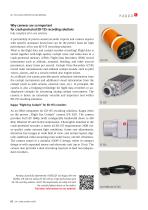
Why cameras are so important for crash-protected ED-155 recording solutions Fully compliant all-in-one solutions A partnership of proven sensor/recorder experts and camera experts with specific aerospace know-how can be the perfect basis for high performance all-in-one ED-155 recording solutions. What is the flight data and cockpit recorder recording? Flight-data is stored together with high quality cockpit voice and video data in a crash-protected memory (CPM). Flight Data Recorders (FDR) record information such as altitude, airspeed, heading, and other aircraft parameters, many times per second....
Open the catalog to page 5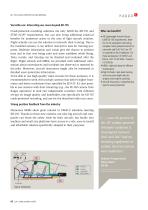
Versatile use: interesting use cases beyond ED-155 Crash-protected recording solutions not only fulfill the ED-155 and ETSO–2C197 requirements, but can also bring additional practical benefits for numerous actors in the area of light aircraft aviation. Flight schools can use the solution to intensify their training. Due to the installed sensors, it can deliver instructive data for training purposes. Realtime information and vision give the chance to perform tests and in that way being safer and more confident while flying. Tests, results, and training can be checked and evaluated after the flight....
Open the catalog to page 6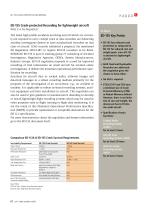
ED-155 CRASH-PROTECTED RECORDING Kappa 0 The latest high profile accidents involving aircraft which are currently not required to carry cockpit voice or data recorders are bolstering accident investigators desires to have standardized recorders on that class of aircraft. ICAO recently submitted a proposal, the mentioned EU Regulation 2019/1387, to require ED-155 recorders to be fitted. EUROCAE ED-155 is part of working group 77 consisting of Accident Investigators, Regulatory Agencies, OEM’s, System Manufacturers, Industry Groups. ED-155 regulation responds to a need for improved recording of...
Open the catalog to page 7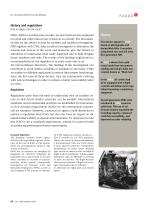
History and regulations Dive in deeper into the topic? FDRs, ADR for accident data recorder, are electronic devices employed to record and collect data of any system on an aircraft. The documented data by this device is used for accident and incident investigation. FDR together with CVR, help accident investigators to determine the reasons and sources of the event and moreover, give the chance to authorities to understand what really happened and to help mitigate future incidents and risks. The results of the findings might lead to a recommendation by the regulator or in some cases also to an...
Open the catalog to page 8
US Regulation Federal Aviation Agency (FAA) is responsible for the US regulation. The National Transportation Safety Board has asked helicopter manufacturers to require visual and audio data recorders on commercial turbine-powered helicopters. NTSB declare three urgent recommendations and led the FAA to issue an emergency airworthiness directive affecting an entire fleet of helicopters. H. R. 7274 regulation. The NTSB formally recommended in 2004 that passenger helicopters be equipped with a Terrain Awareness and Warning System (TAWS) and two years later they also recommended that helicopters...
Open the catalog to page 9