
- Catalogs
- Joloda Hydraroll
- four-ways-to-improve-safety-in-the-loading-bay-with-automation.pdf


four-ways-to-improve-safety-in-the-loading-bay-with-automation.pdf
four-ways-to-improve-safety-in-the-loading-bay-with-automation.pdf
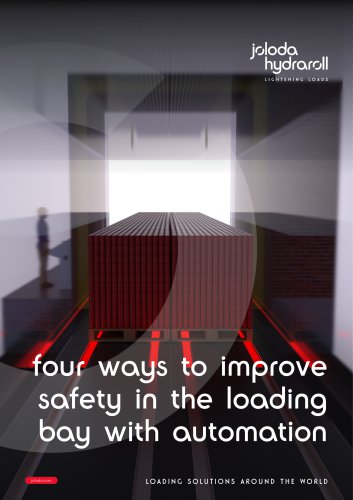
The logistics industry faces significant safety challenges, with numerous workplace accidents and injuries occurring annually. These incidents result in substantial financial costs and impact employee morale and productivity. The document emphasizes the importance of going beyond regulatory compliance to protect employees and maintain profitability.
Identifying Areas of Risk
Loading bays are identified as high-risk areas due to factors like manual handling, vehicle-pedestrian interactions, and space constraints. The document highlights the need for businesses to proactively identify and mitigate these risks through improved practices and automation.
Step 1: Avoid Manual Handling
Automation in loading bays can significantly reduce physical strain on employees, minimizing musculoskeletal disorders. Automated systems can complete tasks faster and safer, reducing the need for manual intervention and optimizing space and resources.
Step 2: Minimise Opportunities for Human Error
Human errors in loading bays can lead to severe accidents. Automated systems with fail-safe mechanisms ensure correct procedures are followed, preventing incidents like trailer tipping and premature vehicle drive-aways.
Step 3: Avoid Collisions Between Vehicles and People
Automated loading systems eliminate the need for forklifts, reducing collision risks. Safety features like emergency stops and sensors protect workers from entering danger zones during operations.
Step 4: Improve Staff Morale and Retention
Automation not only enhances safety but also improves the working environment, attracting and retaining employees. Embracing technology can appeal to younger workers and reduce procedural errors and accidents.
A Checklist for Successful Automation
The document provides a checklist for implementing automation, starting with a risk assessment to identify specific threats. Setting automation priorities based on risk assessment results helps businesses determine the most suitable solutions for their needs.
Overview
The document discusses the challenges and solutions in the logistics sector, particularly focusing on the automation of loading and unloading processes to enhance efficiency and safety. It highlights the importance of understanding current operations and the benefits of automation.
Key Specifications
- Details on materials, weights, and sizes of pallets.
- Operational hours, employee involvement, and shift patterns.
- Volume of pallet flow and business scaling forecasts.
- Current equipment used, such as forklifts and stackers.
- Loading processes and trailer specifications.
- Business issues from manual processes, including accidents, time inefficiencies, and space limitations.
Procedures and Recommendations
- Automating loading processes can significantly improve safety and efficiency.
- Automation reduces the need for forklifts, optimizes space, and creates a low-stress environment.
- Fewer personnel are required, alleviating recruitment pressures and enhancing workplace satisfaction.
Industry Impact
The transportation and storage sector loses around 2 million working days annually due to workplace injuries and illnesses. Automation can mitigate these losses by improving safety and operational reliability.
Conclusion
The logistics industry is experiencing growth, with a projected annual growth rate of 17.1% from 2023 to 2030. Automation is crucial to meet escalating demands and improve logistics efficiency.
Contact Information
The document provides contact details for Joloda Hydraroll's offices worldwide, including locations in the UK, Netherlands, France, USA, Japan, Finland, and Brazil.
Catalog excerpts
Sustainably Lightening Loads four ways to improve safety in the loading bay with automation joloda.com
Open the catalog to page 1
Improving Loading Bay Safety Identifying Areas of Risk 4 Step 1: Avoid Human Intervention 5 Step 2: Minimise Opportunities for Human Error 6 Step 3: Avoid Collisions Between Vehicles and People 7 Step 4: Improve Staff Morale and Retention 8 A Checklist for Successful Automation 9
Open the catalog to page 2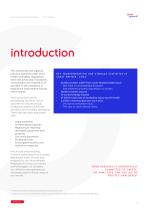
Improving Loading Bay Safety Introduction introduction The warehouse and logistics industry operates under strict health and safety regulations. Even still, every year, thousands of employees are involved in an accident in the workplace or experience work-related injuries and ill health. The human cost can be devastating. And even if your business isn’t found at fault, workplace-related injuries and accidents are incredibly damaging. There are high costs associated with: KEY TRANSPORTATION AND STORAGE STATISTICS IN GREAT BRITAIN, 20231 • 55,000 workers suffer from work-related health issue: •...
Open the catalog to page 3
Improving Loading Bay Safety Indentifying Areas of Risk need to segregate vehicles from pedestrians and the loading dock should be a priority area for any logistics business. In the following pages, we look at the factors that could be undermining your safety standards in the loading area right now and outline four ways that automation can be transformational. With so many factors influencing the warehouse environment right now which are out of their control, it’s just too dangerous for businesses to assume that regulatory compliance is enough to protect their employees and their profitability....
Open the catalog to page 4
Improving Loading Bay Safety Step 1: Avoid Manual Handling step 1:avoid manual handling AUTOMATING TO ERADICATE MANUAL • Automation removes the need for forklift trucks, immediately reducing the risk to employees. • Connecting automated loading and unloading systems with other automated end-of-line solutions, such as conveyors or Automated Guided Vehicles (AGVs), further reduces the need for manual intervention. • Automation reduces the risk of damage to goods or assets, such as forklift trucks, trailers, or the warehouse floor, which require manual repairs and downtime. • Fewer workers and vehicles...
Open the catalog to page 5
Improving Loading Bay Safety Step 2: Minimise Opportunities for Human Error People make mistakes - and stressed workers under high pressure deadlines are at even more risk of slipping up. Within the loading area, however, mistakes can be devastating. Just consider the implications when heavy loads are incorrectly handled or dangerous items mismanaged, when pallets are not correctly secured in a trailer, when vehicle chocks are placed incorrectly, or a vehicle or trailer is moved away from the loading bay too early. From breakages to spillages, slipped loads to vehicle creep, mistakes due to inexperience,...
Open the catalog to page 6
Improving Loading Bay Safety Step 3: Avoid Collisions Between Vehicles and People Pedestrians operating side by side with forklift trucks is a dangerous mix. Plus, of course, there are always trucks and trailers regularly arriving and departing outside. The average annual number of workplace injury fatalities in the UK is 1244. Between 2018 and 2022, 37% of deaths in the transportation and storage environment were classified as struck by moving vehicle5. Businesses can immediately cut the risk of collisions between forklifts and employees by adopting automated loading and unloading procedures,...
Open the catalog to page 7
Improving Loading Bay Safety Step 4: Improve Staff Moral and Retention As labour shortages intensify, staff may feel they have to cut corners or rush, increasing falls or incidences with vehicles. Recruitment is tough everywhere, but the issue is now urgent within logistics. One recent survey found that 64% of businesses across materials handling, distribution or fulfilment had forgone business worth more than 25% of their revenue in 2022 because of staffing issues. That’s despite 49% of respondents saying their businesses offered flexible schedules to attract or retain staff, and more than one-third...
Open the catalog to page 8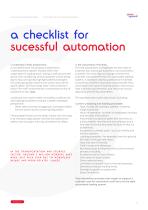
Improving Loading Bay Safety A Checklist for Successful Automation A comprehensive risk analysis is essential to understand the specific threats within the organisation’s loading dock. Taking a walk around the space and considering what employees will be doing day-to-day can quickly highlight potential dangers. Do walkways guide workers and visitors around the space safely? Are floors kept clear? Are handrails in place? The HSE recommends a comprehensive list of questions to ask, here. Looking at any recent health and safety incidents will also highlight problems and get a better employee perspective....
Open the catalog to page 9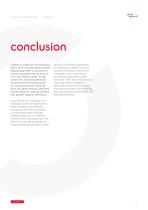
Improving Loading Bay Safety Conclusion Logistics companies are enjoying a boom time, with the global market expecting growth to continue at an annual growth rate of around 17.1% from 2023 to 2030. At the same time, escalating demand has placed enormous pressure on warehouse space, while the drive for higher velocity fulfilment across sectors is creating need for ever greater logistics efficiency. Automating the unloading and loading process will significantly enhance safety and reliability throughout the entire operation. Goods move quickly through loading areas, with no need for forklift trucks....
Open the catalog to page 10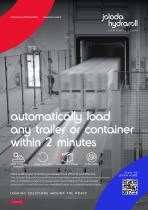
Improving Loading Bay Safety Automated Loading jo oda hydraroll LIGHTENING LOADS reduce loading time reduce product damage SCAN TO LEARN MORE Make loading and unloading processes more efficient and effective The Joloda Hydraroll Group are a one-stop-shop loading solutions manufacturer with a complete range of manual, semi-automated, or fully automated solutions for modified and non-modified trailer or container applications.
Open the catalog to page 11
Sustainably Joloda Hydraroll Lightening Loads INSERT Let’s Chat if you have any questions, please get in touch! Joloda Hydraroll Ltd (Head Office) 1 De Havilland Drive, Liverpool L24 8RN, United Kingdom +44 151 427 8954 [email protected] Joloda BV De Hulst 13, 5807 EW, Oostrum Venray, The Netherlands +31 478 501 059 [email protected] Joloda Loading Automation PO Box 4820, Wilmington North Carolina, 28406, USA +01 910 791 2125 [email protected] Joloda Hydraroll SAS 1 Cour Du Harve, CS50101 75008 Paris, France +33 7 81 41 99 00 [email protected] Joloda Japan K.K. 606 Eiwa Oike Building,...
Open the catalog to page 12All Joloda Hydraroll catalogs and technical brochures


- Airport barrier
- Roller deck
- Airport lift table
- Scissor lift table
- Airport roller deck
- Cargo roller deck
- Air cargo roller deck
- ULD slave pallet
- Slave pallet
- Air cargo slave pallet
- Pallet ULD storage rack
- Airport pallet truck
- Caster deck
- Electric pallet truck
- Low-profile pallet truck
- Truck loading dock
- Airport loading dock