
- Catalogs
- Granta Design
- GRANTA MI:Restricted Substances Package


GRANTA MI:Restricted Substances Package

GRANTA MI:Restricted Substances Package
Overview
The GRANTA MI: Restricted Substances Package is designed to help manufacturing enterprises manage the challenges associated with restricted substances. It provides tools for analytics, reporting, and decision-making to minimize substance risk and ensure compliance with regulations such as REACH.
Key Benefits
- Avoid business risks related to restricted substance regulations, preventing costly delays and reputational damage.
- Make informed decisions based on robust data about materials and specifications.
- Analyze both legacy products and new designs to ensure compliance.
- Incorporate compliance considerations early in the design process to minimize costs and maximize impact.
Case Studies
Case studies from Boeing and Rolls-Royce highlight the effectiveness of the GRANTA MI system in managing restricted substance risks by consolidating complex information in one place.
Challenges Addressed
- Filling knowledge gaps due to evolving regulations and supplier data collection.
- Managing widely-distributed and dynamic internal information.
- Handling diverse formats of Bills of Materials (BoMs) for effective risk analysis.
Solution Features
- Material & Restricted Substance Reference Data: Comprehensive and regularly updated knowledge-base covering thousands of substances and over 100 international regulations.
- De-risk Materials and Processes: Build a database of company materials and specifications, linking them to reference data for effective management and risk mitigation.
- Fast Product Compliance Analytics: Transform and analyze legacy BoMs using the MI:BoM Analyzer web app for quick compliance reporting.
- Design for Compliance: Use the MI:Materials Gateway app within CAD systems to assign materials and run interactive reports, ensuring compliance early in the design process.
Collaboration and Support
The package is developed in collaboration with the EMIT Consortium, including major companies like Airbus Helicopters and Honeywell. It supports various CAD and PLM systems, ensuring broad applicability and ease of integration.
Catalog excerpts
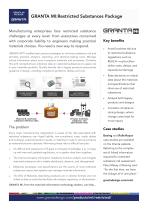
GRANTA MI:Restricted Substances Package Manufacturing enterprises face restricted substance challenges at every level: from executives concerned with corporate liability to engineers making practical materials choices. You need a new way to respond. GRANTA MI™ enables best practice strategies to minimize substance risk and provides practical analytics, reporting, and decision-making tools. Manage critical information about your company's materials and processes. Combine this with comprehensive reference data on restricted substances to assess risk in your materials portfolio. Quickly identify risk in legacy products and provide guidance in design, avoiding compliance problems, delays, and cost. de-risk materials & processes The problem Every major manufacturing organization is aware of the risks associated with restricted substance use—legal liability, non-compliance costs, costly delays and re-design, potential product recalls, or inability to make or service products as materials become obsolete. Minimizing these risks is difficult because: • It's difficult and expensive to fill gaps in company knowledge, e.g., to keep up with new and updated regulations, or to gather data from suppliers. • The internal company information needed to monitor, analyze, and mitigate restricted substance risk is widely-distributed, dynamic, and disorganized. • Materials, processes, and specifications are the source of most restricted substances issues; few systems can manage materials information. • The Bills of Materials describing products are in diverse formats and not linked to data or tools that facilitate risk analysis, reporting, or declarations. GRANTA MI, from the materials information technology leaders, can help... GRRNTR Mi Key benefits • Avoid business risk due to restricted substance regulations such as REACH—multi-million dollar costs, delays, and reputational damage • Base decisions on robust data about the materials and specifications that drive use of restricted substances • Analyze both legacy products and designs • Consider compliance during design, where change costs least for most impact Case studies Boeing and Rolls-Royce case studies are available on the Granta website. Referring to the complex set of linked information required for restricted substance risk assessment, Peter Mezey of Boeing said: "for the first time, we have the linkage all in one place." grantadesign.com/emit
Open the catalog to page 1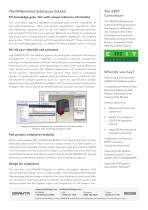
The MI:Restricted Substances Solution Fill knowledge gaps, fast, with unique reference information Our unrivalled, regularly-updated knowledge-base covers: thousands of restricted substances; 100+ international legislations, regulations, lists, and Standards; property data on the full range of engineering materials; and specialist information on coatings. Materials are linked to substances that they contain. Substances are linked to related legislation. This enables queries like: “Which materials will this regulation impact?” Keep up-to-date and fill knowledge gaps, e.g., to assess risk where...
Open the catalog to page 2All Granta Design catalogs and technical brochures
 Data Products 2019
2 Pages
 GRANTA MI:Composites Package
2 Pages
 GRANTA MI
2 Pages
