
- Catalogs
- FLARM Technology AG
- PowerFLARM Product


PowerFLARM Product

PowerFLARM Product
FLARM technology, introduced over a decade ago, has been instrumental in enhancing the safety of glider pilots by preventing mid-air collisions. Due to its success and the increasing congestion in airspace, FLARM has been adopted by various aviation sectors, including powered airplanes, helicopters, and low-flying jets. PowerFLARM was developed to meet the evolving technical requirements for collision avoidance in crowded airspace.
Enhanced Detection Capabilities
PowerFLARM significantly improves upon the original Classic FLARM by increasing the detection range from approximately 3 km to over 10 km. This enhancement is crucial for timely warnings, especially when approaching fast-moving aircraft at speeds of 250 kt (463 km/h).
Dual Antenna Diversity
To overcome signal shielding by metal or carbon fiber materials, PowerFLARM employs two radio transceivers with separate antennas, ensuring comprehensive coverage and detection of aircraft approaching from various directions.
Interference Protection
PowerFLARM includes built-in interference protection to filter out unwanted signals from mobile phones and other electronic devices, ensuring reliable reception of FLARM signals.
Integration with Transponder and ADS-B
PowerFLARM integrates with transponder and ADS-B 1090ES receivers, allowing it to detect aircraft not equipped with FLARM. This integration enhances safety by including these aircraft in trajectory prediction and collision warning algorithms.
Obstacle Warning System
PowerFLARM provides intuitive warnings for known obstacles such as powerlines and cable cars. It uses lateral buffers for line objects and dynamic trajectory forecasting to minimize unnecessary warnings.
Technical Specifications
PowerFLARM is available in both core (installed) and portable versions, with specific dimensions, power supply requirements, and data port configurations. It is approved by EASA for fixed installation in certified aircraft, with a Minor Change Approval available.
Legal Notice
FLARM Technology Ltd reserves all rights to the document and information provided, with no liability assumed for its use. The document may be revised at any time.
Catalog excerpts
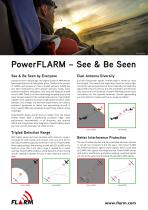
PowerFLARM – See & Be Seen See & Be Seen by Everyone Dual Antenna Diversity Introduced over a decade ago, the original Classic FLARM devices have saved the lives of many glider pilots. Thanks to the success of FLARM, and because of more crowded airspace, FLARM has also been embraced by other aviation domains. Today, many powered airplanes, helicopters, and even low flying jet aircraft carry FLARM. There is no other technology as widely used in the lower airspace below FL100, outside large airports, than FLARM. Together with a general increase in high speed aircraft at lower altitudes, this changes the technical requirements for collision avoidance equipment to detect fast approaching aircraft in time. PowerFLARM was developed to specifically address these challenges. Just like transponder signals, FLARM range is limited by radio line-of-sight. This means that especially a metal or carbon fiber aircraft (as well as equipment of these materials) will shield the signal. With only one antenna, the view is limited to one direction only, away from such materials. PowerFLARM features two radio transceivers for two separate antennas. Aircraft approaching you from behind or below will thus no longer be hidden. PowerFLARM makes aircraft that are hidden from old Classic FLARM visible. With a significantly increased range, radio performance improvements in all directions, and optional ADS-B and transponder data integration, PowerFLARM protects you from aircraft otherwise not visible in time. Classic FLARM Tripled Detection Range With higher power and more sensitive radio receivers, range is increased for both sender and receiver, from around 3 km for old Classic FLARM to typically more than 10 km for PowerFLARM. When approaching a fast-moving aircraft with 250 kt (463 km/h) head-on, more than 5 km radio range is needed for a useful warning. PowerFLARM enables a timely detection of fast moving aircraft, making it possible for you to take resolutive action in time. Classic FLARM Better Interference Protection The use of mobile phones and other portable electronic devices in aircraft has increased in the last years. Old Classic FLARM has limited protection against these signals, which could lead to FLARM radio signals not being received. PowerFLARM comes with built-in interference protection, keeping unwanted signals out and at the same time boosting the desired FLARM signals. Classic FLARM
Open the catalog to page 1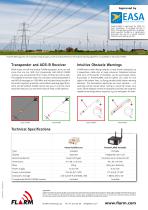
PowerFLARM is approved by EASA for fixed installation in certified aircraft. A Minor Change Approval (MCA) is available. EASA supports FLARM as it significantly decreases the risk of a mid-air collision between participating aircraft. PowerFLARM supports more complex obstacle types, as well as improvements to the obstacle warning algorithm, not available in old Classic FLARM Transponder and ADS-B Receiver Intuitive Obstacle Warnings While many aircraft are already FLARM-equipped, there are still some that are not. With the transponder and ADS-B 1090ES receiver, you are protected from many of...
Open the catalog to page 2All FLARM Technology AG catalogs and technical brochures
 See the Threats
1 Page
 PowerFLARM Fusion
2 Pages

