


TF100 35D

TF100 35D
A seal is a device that prevents the passage of gas or fluid. Seals are categorized into static seals, which operate between surfaces with little or no movement, and dynamic seals, which operate between surfaces with relative movement. Semi-static or resilient seals accommodate limited movement due to pressure or thermal cycling.
Seal performance is influenced by factors such as seal geometry, contact force, cavity surface finish, sealing medium, pressure differentials, and operating temperatures. Static seals aim for zero leakage, while semi-static seals are designed for reusability and accommodate cavity fluctuations.
Cavities are crucial in seal design, determining the physical envelope for seal dimensions. Standard cavity types include Standard Closed, Standard Open, Corner, and Segmented cavities, each with specific design constraints.
Metallic seals are optimal for high temperatures, high pressure, long life, cavity fluctuations, and sealing corrosive or hard-to-handle gases or liquids. Eaton's seals are made from strong, resilient materials like Inconel 718, suitable for a wide temperature range.
Seal materials like Inconel X-750 and Inconel 718 have specific temperature limits, with Eaton developing methods for high-temperature superalloys for applications above +1350°F (+732°C).
Eaton's seals are designed for high-pressure use, with C-Seals operating above 200,000 psi. The seals are also designed for infinite operational life, except under extreme conditions.
Eaton's semi-static seals accommodate axial and radial cycling of cavities, with material and cross-section selection affecting the seal's resiliency.
Eaton has a long history of designing and manufacturing metallic seals, including the C- and E-Seals, with in-house manufacturing capabilities. The quality system meets stringent specifications, evidenced by NADCAP certifications in various processes.
- C-Seal: Suitable for rigid connections with minimal axial deflection, offering low leakage rates and high-pressure capabilities.
- Boss-type C-Seal: Designed for specific fittings, reusable, and does not transmit load through the seal.
- Standard E-Seal: Flexible, suitable for cyclic axial deflection, with good springback and reusability.
- Special 8 E-Seals: Accommodate a wide range of cavity sizes and movements.
- U-Plex Seal: Extremely flexible with lower compression loads.
To choose the appropriate seal, consider whether the application is static or semi-static, the required sealing tightness, and the axial or radial load capabilities.
- Performance Capabilities: Excellent for rigid connections, low leakage rates, and suitable for ultra-high vacuum to high-pressure applications.
- Typical Applications: Used in water injection valves, cryogenic fittings, fuel injector seals, and more.
- High-Pressure Capability: Designed to handle high pressures without increasing hoop stress.
- Very Tight Leakage Control: Features a curved sealing surface for effective deformation and sealing.
- Deflection Capability: Designed to deform plastically with some springback, suitable for reuse under certain conditions.
Selection involves choosing the seal type, axial free height, material thickness, heat treatment, material type, plating, and diameter dash number. Inconel 718 is the preferred material for strength and load characteristics.
- Material and Treatment: Seals are made from standard thickness material and are un-plated. Heat treatment options affect the force to compress (FTC) values.
- Scaling Factors: These are used to adjust seal performance based on application conditions. The FTC is calculated by multiplying the load from graphs (FTC0) by specific multipliers.
- Material Thickness: Different thicknesses are provided with corresponding FTC multipliers.
Graphs illustrate the relationship between load (FTC0) and deflection for various free heights (FH). Deflection data is provided for different free heights ranging from 1/16" to 1/4".
Different plating materials (Indium, Lead, Tin, Silver, Gold, Nickel) are compared based on leakage and deflection data. Maximum operating temperatures and melting points are specified for each plating type.
Leakage rates are provided for different surface finishes (32, 63, 125 RMS) and pressures (psi). Data is presented for bare and plated seals (Silver, Nickel, Lead).
Tables provide detailed dimensions for cavity and seal diameters across various dash numbers. Tolerances for free heights and diameters are specified.
Consult Eaton for radial-type C-Seal load and deflection characteristics. Use scaling factors to customize seal performance for specific applications.
Designed for AS5202 type fittings and AND 10050 type bosses. Features include foolproof installation, self-aligning, easy reuse, and pressure-energized sealing. Material: Inconel X-750 is recommended to minimize compression loads.
Suitable for applications with cyclic axial deflection and low leakage rates. Operates primarily in the elastic range with excellent springback and reusability. Designed for high-pressure pulsations and large cavity deflections.
E-Seals are flexible and cost-effective, suitable for high-pressure and high-temperature applications. Pressure capability depends on cross-section, material type, and diameter. Leakage rates are typically around .010 SCFM per inch of diameter.
Selection based on seal type, orientation, axial free height, material type, and diameter dash number. Standard E-Seals and U-Plex Seals have specific part number selection criteria.
Load vs. Deflection graphs illustrate force-to-compress values and deflection capabilities. Scaling factors provided for customizing seal performance to specific application conditions.
Specifications include dimensions for E-Seals, including cavity and seal inner and outer diameters. Procedures describe the configuration of seals in both open and closed cavity setups.
Tolerances for free height and diameter are specified, with variations depending on the free height category (3/32", 1/8", 3/16").
Specifications outline dimensions and operational capabilities of eight popular E-Seal designs. Performance data includes graphs showing load versus deflection and leakage versus deflection for seals made of Inconel 718.
Force to compress (FTC) is adjusted based on the seal material. Leakage is adjusted based on operating temperature, pressure differential across the seal, and cavity surface finish.
The U-Plex seal is highly flexible, designed to operate in the elastic range, and offers significant deflection capability.
The U-Plex seal is suitable for locations requiring high axial deflection capability and local compliance ability.
- TIG Welding: Permitted prior to forming as per PS 85613, class C.
- Dimension Measurement: Average dimension determined by 360° circumferential measurement.
- Packaging: Each item must be individually packaged using standard internal methods.
- Marking: Packages should be marked as specified on the sales order.
- Sealing Surfaces: Must conform to QCS 85345.
- Plating Requirements: Required over specified areas per PS 85681, optional and may be incomplete in other areas.
Includes fields for company information, contact details, and application specifics. Requests details on fluid media, pressure conditions, temperature cycles, and seal cavity details.
Eaton Aerospace Group, Irvine, California and Beltsville, Maryland locations provided with phone and fax numbers.
Catalog excerpts

Resilient Metallic Seals • Many Cross-Sectional Variations • Weld Integrity • High Qual
Open the catalog to page 1
Eaton’s Aerospace Group offers an extensive variety of standard catalogs featuring metal seals with numerous cross-sections, sizes and shapes adapted for various customer applications. We are able to offer short lead times on a number of products, all made to order. Our sales, applications and design engineers are all available to work with you to solve your particular leakage problems in a timely, cost-effective manner, often using existing designs adapted to your needs. As a preferred supplier, partnering supplier or longterm agreement holder with leading original equipment manufacturers worldwide,...
Open the catalog to page 2
EATON Aerospace Group TF100-35D October 2013
Open the catalog to page 3
Introduction to Seals and Seal Types A seal is a device that prevents the passage, flow or leakage of a gas or fluid. Seals can be divided into two major categories: 1. Static Seals. Sealing takes place between surfaces that have little or no movement relative to one another. 2. Dynamic Seals. Sealing takes place between surfaces that have relative movement, i.e. the movement of a shaft relative to a housing. There are also seals that fall between these two categories and do not exactly fit into these basic definitions of static or dynamic seals. Some static seals are designed to accommodate...
Open the catalog to page 4
FIGURE 1-2 Standard Closed FIGURE 1-3 Standard Open FIGURE 1-4 Corner Cavity Cavity Segments Typical Cavities Cavity Type There are several cavity types that are considered standard. The cavity is a primary design constraint since it determines the physical envelope for the seal's dimensions. The typical standard cavity types are briefly described below and depicted in Figures 1-2 through 1-5. 1. Standard Closed Cavity. This type of cavity is characterized by a fully enclosed seal area. This type is sometimes referred to as a "U" type cavity. (Figure 1-2) 2. Standard Open Cavity. This type of...
Open the catalog to page 5
variables, including alloy chemistry, processing history, and final heat treatment." (This definition is courtesy of an Inco Alloys International Ins. Paper by D.F. Smith entitled Testing Sensitivity in Low CTE Superalloys dated 3/16/91.) For semi-static seal applications above +1300°F (+704°C), Eaton is researching and developing manufacturing methods for several new high-temperature superalloys. At this time, Eaton successfully utilizes alloys such as Haynes 188® in operating cycles with a maximum temperature of +1600°F (+871°C). Consult Eaton for any applications with operating temperatures...
Open the catalog to page 6
welding, metal forming, heat treatment, electroplating and electropolishing. In addition, Eaton performs endurance, proof, burst and other qualification and development tests. D. Many Cross-Sectional Variations to Fit your Needs B. High Quality The PressureScience quality system is capable of meeting the most stringent customer specifications. This is evidenced by the National Aerospace and Defense Contractors Accreditation Program (NADCAP) certifications. NADCAP certification in Chemical Processing, Welding, Heat Treatment and Liquid Penetrant operations assures continued conformance to even...
Open the catalog to page 7
Overview of Seals Covered in This Catalog TYPE OF SEAL GENERAL COMMENTS AND BASIC FEATURES Standard C-Seal C-Seal and Boss-type C-Seal • Good for “rigid” connections where little or no axial deflection occurs • Low leakage rates—can be enhanced by plating • Ultra high vacuum (10-10 Torr) to high pressure (200,000 psi) applications • Intended to deform plastically; little or no springback • Compression load in the range of 100 to 1000 pounds per circumferential inch of seal (PCI) • See page 9 for more information Boss-type C-Seal • Designed for AS5205 (AS54395) type fittings & A.N.D. 10050 type...
Open the catalog to page 8
GENERAL COMMENTS AND BASIC FEATURES Microplex Seal • Flexible, suitable for applications with cyclic axial deflection • Low leakage, similar to E-seal • Good springback and reusability characteristics • Compression in the range of 5 to 50 pci • Designed for application where the full capabilities of the E-seal are not required • See page 45 for more information Radial Type Seals: Wave-Seal • Offers an interference fit on diameter • Can serve as a piston ring replacement • Can accommodate large axial movement by sliding • Used where no sealing face is available due to cavity geometric and/or load...
Open the catalog to page 9
C-Seal Sketch and Description Eaton's C-Seal Performance Capabilities: • Excellent for "rigid" connections where minimal or no axial deflection occurs • Low Leakage rates (10-11 scc/ sec of Helium) • Ultra high vacuum (10-10 Torr) to high pressure (200,000 psi) applications • Intended to deform plastically; little or no springback • Compression load in the range of 100 to 1000 PCI An improvement on the classic metal "O" ring, the C-Seal provides a more flexible, lower load sealing solution which is also pressure energized. Available in three basic orientations (Internal Pressure Face Type, External...
Open the catalog to page 10
Typical load, deflection, or spring-back capabilities are shown in the Load vs. Deflection graph on page 11. It is not suggested, however, that the C-Seal be utilized in a cavity exhibiting this amount of continuous cavity cycling during operation. As a rule, a C-Seal will springback 2% of its free height. Repeated reinstallations or continuous cavity fluctuations in excess of this amount could result in failure of the seal through cyclic fatigue and cracking. Standard C-Seal Part Number Selection The following pages support a simple part number selection process. Make your selection based on...
Open the catalog to page 11
After selecting the part number, expedite your order by filling out a copy of the appropriate drawing form in the Appendix, and faxing to the number on the form. Instructions on filling out the drawing form can be found in the Appendix. CATALOG CODE Only option is -C. -► DIAMETER DASH NUMBERS See Tables on pages 12-18 for four-digit diameter designation code. -► PLATING _Plating Thickness, in._P/N Code_Knoop_ Plating_Thin_Thick_Thin_Thick Hardness_ None_||_0 - (only option)_(Reference Only) Special Silver, per .0015 - .0025, Silver (per AMS 2410) Eaton spec 0900_PLUS .0003 - .0008, gold (per...
Open the catalog to page 12All EATON SAS catalogs and technical brochures
 AE246
AE24626 Pages
 666/667
32 Pages
 601/AE701
2 Pages
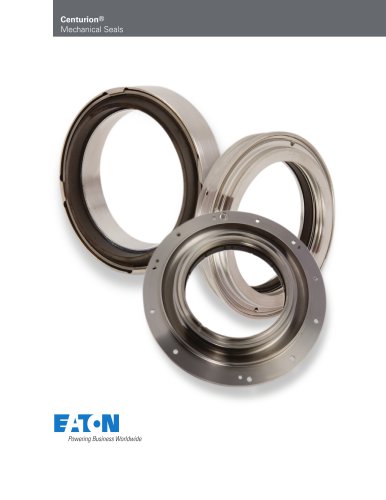 Centurion 800 - TF100 34E
8 Pages
 AS7510
2 Pages
 Engine solutions
4 Pages
Archived catalogs
 Aerospace
8 Pages
 AE645 PTFE Reinforced
8 Pages
 Vickers ® AC Motorpump
4 Pages
 Sikorsky UH-60 Black Hawk
8 Pages
 Bell/Boeing V-22 Osprey
8 Pages
 Carter ® Nozzle Ball Valve
4 Pages
 Boeing C-17 Transport
8 Pages
 Eurofighter Typhoon
8 Pages
 Carter® Ball Valve
4 Pages
 Boeing CH-47
8 Pages
 7202
72022 Pages
 7100
71002 Pages
 39-0001-1100
2 Pages
 9121
91212 Pages
 20026
200262 Pages


