
- Catalogs
- Collins Aerospace - Rockwell Collins
- TPR-901-205/225 transponders


TPR-901-205/225 transponders

TPR-901-205/225 transponders
The TPR-901-205/225 transponders by Rockwell Collins are designed to meet stringent ADS-B mandates globally. These transponders are compliant with Mode S requirements and DO-260 standards, ensuring reliable performance for Boeing and Airbus platforms.
Specifications
The TPR-901 transponders are compliant with TSO-C112e and TSO-C166b, qualified to DO-160E, and support DO-178 levels B and D. They feature a 24-bit ICAO aircraft address, transponder capability report, altitude reporting, automatic aircraft identification, and flight status reporting.
Procedures and Integration
The TPR-901 can replace non-compliant transponders without altering the antenna or aircraft wiring. It integrates with various TCAS and GNSS sources, supporting advanced ADS-B features like ADS-B In, CDTI, VSA, and ITP.
Norms and Compliance
These transponders comply with international mandates, including DO-260B requirements in the US and EU. They are certified for all Boeing and Airbus platforms, ensuring readiness for emerging airspace requirements.
Recommedations and Benefits
ADS-B In offers advantages such as enhanced situational awareness, operational efficiency, fuel savings, and improved surface operations. Rockwell Collins provides award-winning customer service to support these systems.
Conclusion
Rockwell Collins' TPR-901 transponders are a reliable choice for meeting global surveillance requirements, backed by comprehensive customer support and integration capabilities.
Catalog excerpts

TPR-901-205/225 transponders: Meeting the most stringent ADS-B mandates. Many regions around the world have mandated the operation of Mode S transponders that are compliant to DO-260, DO-260A or DO-260B to meet the needs of ADS-B Out in their airspace. The Rockwell Collins TPR-901-205/225 transponders (for Boeing and Airbus platforms, respectively) are the most reliable and capable available. Rockwell Collins has a long history with transponder development. The TPR-901 was created in 2007 to satisfy the new Mode S Elementary Surveillance functionality required for operation in Europe. With the emergence of DO-260B, Rockwell Collins has created a software-only upgrade to the TPR-901. It provides a quick and affordable way to comply with mandates in Europe and the United States. The TPR-901 also can be used as a drop-in replacement to other federated transponders that don’t comply with DO-260B, without changing the antenna or aircraft wiring. KEY FEATURES > TSO-C112e and TSO-C166b compliant > DO-178, levels B and D > Qualified to DO-160E > 24-bit ICAO aircraft address > Transponder capability report, including SI code capability > Altitude reporting > Automatic reporting of aircraft identification (flight ID) > Flight status (airborne/ground) The TPR-901 is certified on all Boeing and Airbus platforms and is available to meet your surveillance needs. Rockwell Collins Building trust every day
Open the catalog to page 1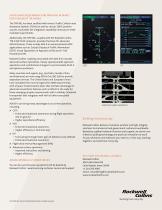
SURVEILLANCE REQUIREMENTS ARE EMERGING IN NEARLY EVERY REGION OF THE WORLD The TPR-901 has been certified with various Traffic Collision and Avoidance Systems (TCASs) as well as various GNSS position sources. It provides the integration capability necessary to meet mandate requirements. Additionally, the TPR-901, coupled with the Rockwell Collins TTR-2100 TCAS computer, provides the basis for advanced ADS-B features. These include ADS-B In and associated traffic applications such as Cockpit Display of Traffic Information (CDTI), Visual Separation on Approach (VSA) and In-Trail Procedures (ITP). Rockwell...
Open the catalog to page 2All Collins Aerospace - Rockwell Collins catalogs and technical brochures
 CIIS RF Coaxial Cables
5 Pages
 Sweep-On® 2000™
2 Pages
 Airshow® 500
4 Pages
 Airshow® 4000
8 Pages

Archived catalogs
 Broadband connectivity
2 Pages
 Cabin connectivity
4 Pages
 ePhone Data sheet
2 Pages
 H-SVS bROCHURE
4 Pages
 DF-500 Brochure
4 Pages
 H-TAWS brochure
4 Pages
 VeriPax
2 Pages
 ExpressCheck
2 Pages
 TPR-901
2 Pages
 HGS-3500
12 Pages
 ARINC Direct
4 Pages
 CabinConnect™
4 Pages
 ARINC AirVue™
8 Pages
 ARINC SELFDROP™
2 Pages
 ACAS-900 DATA SHEET
2 Pages
 PFLX140-500 RF coaxial cable
2 Pages
 CMU-900
4 Pages
 AN-ARN-149V data sheet
2 Pages


- Color light
- Aircraft lighting system
- Cable
- Airplane cable
- Aircraft seat
- Aircraft lighting
- Landing beacon
- Position beacon
- Audio panel
- Mounting lighting
- Aircraft cabin lighting
- Data cable
- Seat with integrated screen
- Crew seat
- Aircraft audio panel
- Economy class seat
- USB charging station
- Coaxial cable
- Inflight entertainment
- Aircraft inflight entertainment