

BLASTWALL AIRPORT JET BLAST PROTECTION SYSTEM

BLASTWALL AIRPORT JET BLAST PROTECTION SYSTEM
BlastWall is an innovative blast fence solution made entirely of fiberglass or steel, designed to withstand the force of jet takeoff blasts while remaining invisible to radar and radio transmissions. This document outlines the advantages, specifications, and notable installations of BlastWall.
Advantages of BlastWall
- No Runway Closures: Installation can be completed by work crews without cranes, ensuring no disruption to landing paths.
- No Corrosion: The all-fiberglass structure, including plating, girders, and bolts, offers an indefinite operational lifetime with minimal maintenance.
- Zero Radar Footprint: The absence of steel components ensures no interference with ground radar and radio beacons.
- Minimum Site Preparation: Only requires leveling and placement of concrete mounting points with steel bolts at ground level.
Specifications
- BlastWall is engineered to deflect blasts of up to 160 km/h with a safety factor of 1.5:1.
- It is designed to collapse upon impact to minimize damage to aircraft and the structure itself.
- All components, including nuts and bolts, are made from pultruded or molded fiberglass, ensuring a lightweight and durable structure.
- Pigment and UV stabilizers are incorporated into the fiberglass resin for corrosion resistance and maintenance-free operation.
Testing and Compliance
- Extensively tested by NAV Canada for non-interference with electronic signal emissions.
- Engineered to meet or exceed NAV Canada airside installation requirements.
- Approved for installation in airports across Canada.
Notable Installations
- Queenstown Airport, New Zealand
- Chattrapati Shivaji Airport, Mumbai
- Pearson Airport, Toronto
- Midway Airport, Chicago
- Fort Dix U.S. Army Base, New Jersey
- O’Hare Airport, Chicago
- Abbotsford Airport, British Columbia
Contact Information
For more information, contact Peter Roston, President, at +1 416 409 7009 or via email at [email protected]. Visit the website at www.BlastWall.com.
Catalog excerpts

BlastWall is all-fiberglass or steel blast fence with the structural strength to withstand jet takeoff blast and remain invisible to radar and radio transmissions. Blastwall fiberglass provides many advantages over traditional airport wall structures made of steel: NO RUNWAY CLOSURES — Installation is by work crews without need for cranes that will block access to landing paths. NO CORROSION — The all-fiberglass structure, plating, girders and bolts offer virtually an indefinite operational lifetime with almost zero maintenance over years. ZERO RADAR FOOTPRINT — The performance of ground radar and radio beacons is not affected since Blastwall's frame and plating contain no steel components. MINIMUM SITE PREPARATION — Leveling and placement of concrete mounting points with steel bolts at ground level is the only site preparation required. COPYRIGHT © 2013 BLASTWALL LTD. BLASTWALL IS A TRADE MARK OF BLASTWALL LTD., TORONTO, CANADA
Open the catalog to page 1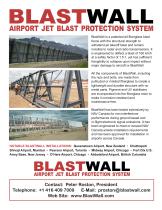
BlastWall is a patented all-fiberglass blast fence with the structural strength to withstand jet takeoff blast and remain invisible to radar and radio transmissions. It is engineered to deflect a blast of 160 km/h at a safety factor of 1.5:1, yet has sufficient frangibility to collapse upon impact without major damage to aircraft or BlastWall. All the components of BlastWall, including the nuts and bolts, are made from pultruded or molded fiberglass to create a lightweight and durable structure with no metal parts. Pigment and UV stabilizers are incorporated into the fiberglass resin to make...
Open the catalog to page 2