

Titanium Ti6Al4V ELI

Titanium Ti6Al4V ELI
The Ti6Al4V ELI titanium alloy is renowned for its high strength-to-weight ratio and excellent corrosion resistance, making it suitable for diverse applications in industries such as aerospace, automotive, medical, and more. It often replaces heavier and less efficient materials, offering reliable and cost-effective solutions.
Special Characteristics
Ti6Al4V ELI (Grade 23) is an enhanced version of Ti6Al4V (Grade 5) with reduced levels of oxygen, nitrogen, carbon, and iron, leading to improved ductility and fracture toughness. It is ideal for biomedical implants, aerospace components, cryogenic applications, and offshore equipment due to its high resistance to stress corrosion cracking in seawater.
Powder Specification
The Arcam Titanium Ti6Al4V ELI is a gas-atomized powder with particle sizes between 45 and 100 microns, ensuring safe handling. Refer to the Arcam MSDS for detailed safety information.
Post Processing
Heat Treatment: Hot Isostatic Pressing (HIP) is recommended for fatigue-loaded components with parameters of 920°C, 1000 bar, and 120 minutes.
Machining: The alloy offers good machinability with low cutting speeds, high feed rates, ample cutting fluid, sharp tools, and a rigid setup.
Welding: Ti6Al4V ELI can be welded using conventional processes, though special measures are required due to its chemical reactivity.
Chemical Specification
The alloy's composition includes 6% Aluminium, 4% Vanadium, and trace amounts of Carbon, Iron, Oxygen, Nitrogen, and Hydrogen, with Titanium as the balance. These specifications align with ASTM F136 standards.
Mechanical Properties
The mechanical properties of Ti6Al4V ELI produced via the EBM process are comparable to wrought annealed materials and superior to cast materials. Key properties include a yield strength of 930 MPa, ultimate tensile strength of 970 MPa, and a fatigue strength of over 10,000,000 cycles at 600 MPa.
Microstructure
The EBM process results in a microstructure with a lamellar α-phase and larger β-grains, offering higher density and finer grain due to rapid cooling. The material is naturally aged during the build process.
Arcam AB provides Free Form Fabrication machines for direct manufacturing of metal parts, offering geometric freedom and excellent material properties.
Catalog excerpts

Ti6Al4V ELI Titanium Alloy MECHANICAL PROPERTIES Arcam Ti6Al4V ELI1 Ti6Al4V ELI Required** Yield Strength (Rp 0,2) 930 MPa 795 MPa Ultimate Tensile Strength (Rm) 970 MPa 860 MPa Fatigue strength @ 600 MPa >10,000,000 cycles >1,000,000 cycles Modulus of Elasticity 120 GPa 114 GPa * Typical ** ASTM F136 The mechanical properties of materials produced in the EBM process are comparable to wrought annealed materials and are better than cast materials. General characteristics The high strength, low weight ratio and outstanding corrosion resistance inherent to titanium and its alloys...
Open the catalog to page 2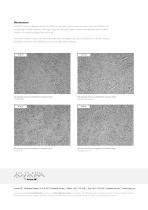
Ti6Al4V ELI parts manufactured in the EBM process have a microstructure better than cast Ti6Al4V ELI containing a lamellar α-phase with larger β-grains, and with a higher density and significantly finer grain, thanks to the rapid cooling of the melt pool. The build chamber is kept at an elevated temperature throughout the entire build process, and the material therefore comes out of the EBM process in a naturally aged condition. Micrograph of Arcam Ti6Al4V ELI material, 500x. Longitudinal Micrograph of Arcam Ti6Al4V ELI material, 500x. Hipped, longitudinal Micrograph of Arcam Ti6Al4V ELI material,...
Open the catalog to page 3All Arcam AB catalogs and technical brochures
 2017 Arcam Brochure
20 Pages
 Arcam ASTM F75 Cobalt-Chrome
4 Pages
 Titanium Ti6Al4V
3 Pages
 Titanium Grade 2
3 Pages
Archived catalogs
 Arcam Brochure
20 Pages