
- Catalogs
- ARC (Airport Research Center) - CAST
- Airport Consulting Planning and Simulation Services


- Company
- Products
- Catalogs
- News & Trends
- Exhibitions
Airport Consulting Planning and Simulation Services

Airport Consulting Planning and Simulation Services
The Airport Research Center (ARC) specializes in optimizing airport operations and infrastructure through advanced simulation tools and expert knowledge. Their services encompass airport master planning, airside and terminal planning, market analysis, aeronautical studies, and level of service assessments.
ARC develops and optimizes airport master plans, ensuring compliance with ICAO standards. Their services include aeronautical studies, environmental impact assessments, and layout development for runways, taxiways, and terminals, along with capacity calculations and functional planning.
ARC focuses on validating and optimizing airside infrastructure, accelerating planning processes, and conducting capacity studies. Their goal is to enhance resource utilization and operational strategies to improve capacity and reduce costs.
Using the CAST Terminal simulation system, ARC evaluates and improves terminal facilities by analyzing capacity, optimizing passenger flow, and enhancing architectural design. This approach aims to improve terminal functionality and prevent unnecessary investments.
ARC conducts market potential analysis and traffic forecasting, considering economic and demographic factors. They provide detailed forecasts for peak hours and design day flight schedules to support strategic infrastructure and business planning.
ARC performs hazard identification and mitigation planning, ensuring compliance with international standards. They offer detailed planning for airside facilities and obstacle assessments using advanced CAD tools for visualization.
ARC uses simulation tools to assess and improve terminal service levels, identifying bottlenecks and testing mitigation measures. They provide realistic visualizations to support decision-making processes and enhance passenger experience.
ARC designs modular and expandable terminals that balance cost-effectiveness with high functionality, aided by CAST simulation for efficient construction.
ARC employs CAST Terminal simulation software to validate and optimize terminal designs, covering architecture, operating characteristics, functional requirements, cost optimization, and interior design. A notable project includes the modular terminal extension at Kharkiv International Airport in Ukraine.
ARC assists in determining declared capacities for slot coordination by analyzing flight schedules and simulating traffic loads. Their approach, recognized by major airports like Frankfurt, Hamburg, and Doha, optimizes traffic volumes and reduces delays.
ARC enhances airport security processes by optimizing lane layouts, staffing, and operational concepts. Their simulations identify bottlenecks and improve throughput, adapting to regulatory changes and integrating new screening technologies, with references including airports in Cologne, Hamburg, and Düsseldorf.
Catalog excerpts
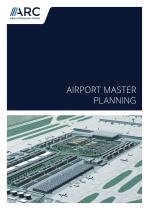
Airport Research Center AIRPORT MASTER PLANNING
Open the catalog to page 1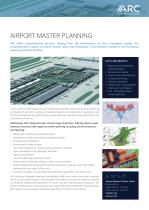
Airport Research Center AIRPORT MASTER PLANNING ARC offers comprehensive services, ranging from the development of early conceptual studies, the comprehensive creation of airport master plans and conduction of aeronautical studies to the functional planning of airport facilities. FACTS AND BENEFITS Master plan development and optimization Aeronautical studies Airport layout development Functional planning Capacity calculation ICAO Annex 14 compatibility checks and optimization OLS - Obstacle limitation surface planning In the context of international airport master planning, ARC’s services include...
Open the catalog to page 2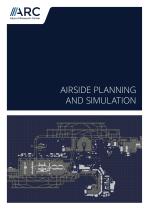
Airport Research Center AIRSIDE PLANNING AND SIMULATION
Open the catalog to page 3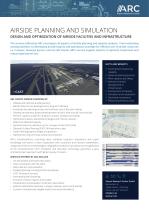
Airport Research Center AIRSIDE PLANNING AND SIMULATION DESIGN AND OPTIMIZATION OF AIRSIDE FACILITIES AND INFRASTRUCTURE The services offered by ARC encompass all aspects of airside planning and capacity analysis. From evaluating existing facilities, to developing airside layouts and operational concepts for efficient use of airside resources i.e. runways, taxiways aprons, and aircraft stands, ARC’s service support airports to optimize investment and reduce operational cost. ARC ASSISTS AIRSIDE PLANNING BY: » » » » » » » » » » » Validate and optimize airside planning Match infrastructure development...
Open the catalog to page 4
Airport Research Center ^ TERMINAL PLANNING AND SIMULATION
Open the catalog to page 5
Airport Research Center TERMINAL PLANNING AND SIMULATION The services offered by ARC encompass all aspects of terminal planning. From evaluating existing facilities, to developing terminal layouts and operational concepts for a more efficient use of resources within the terminal (i.e. check-in, security checkpoints, baggage reclaim). Our goal is to enhance the function of terminal buildings, guaranteeing long-term utilization and preventing unnecessary investment costs. Apart from planning new terminal buildings, the evaluation and improvement of existing terminal buildings and their facilities...
Open the catalog to page 6
Airport Research Center A MARKET ANALYSIS, FORECAST & FLIGHT SCHEDULES DEVELOPMENT
Open the catalog to page 7
Airport Research Center MARKET ANALYSIS, FORECAST & FLIGHT SCHEDULE DEVELOPMENT Business planning requires extensive knowledge of the anticipated volume of traffic. Accurate forecasting of this data is essential for the approval process and the planning of investments and infrastructure. Besides a wide range of consulting services, ARC has a proven record in assisting international and national airports and airlines with expert reports on market analysis and aviation demand forecasts. Germany North FACTS AND BENEFITS Market potential analysis Traffic forecast Design day flight schedules Analysis and...
Open the catalog to page 8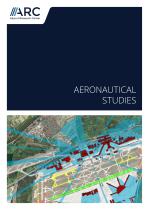
Airport Research Center AERONAUTICAL STUDIES
Open the catalog to page 9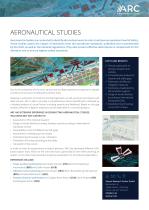
Airport Research Center AERONAUTICAL STUDIES Aeronautical studies are conducted to identify alternative means in order to achieve an equivalent level of safety. These studies assess the impact of deviations from the aerodrome standards, published and recommended by the ICAO, as well as the national regulations. They also present effective alternatives to compensate for the deviation and to ensure highest safety standards. Due to the complexity of this issue, aerodrome and flight operational expertize is needed as well as the provision of adequate software tools. Applying a systematic and well documented...
Open the catalog to page 10
Airport Research Center LEVEL OF SERVICE ASSESSMENT
Open the catalog to page 11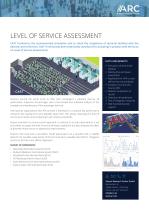
LEVEL OF SERVICE ASSESSMENT CAST Terminal is the recommended simulation tool to check the compliance of terminal facilities with the desired Level of Service. CAST Terminal has been extensively used by IATA Consulting in projects with the focus on Level of Service Assessments. Airports around the world strive to offer their passengers a pleasant journey. All optimization measures should begin with a fair-minded and unbiased analysis of the strengths and weaknesses of the passenger terminal. International organizations like IATA provide a framework to compare key performance indicators like waiting...
Open the catalog to page 12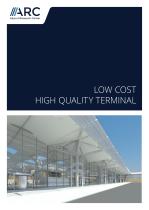
Airport Research Center LOW COST HIGH QUALITY TERMINAL
Open the catalog to page 13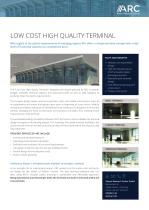
Airport Research Center LOW COST HIGH QUALITY TERMINAL With regard to the special requirements of emerging regions ARC offers a unique terminal concept with a high level of functional capacity at a competitive price. The “Low Cost High Quality Terminal”, designed and master-planned by ARC, combines budget, intended terminal capacity and expected traffic as well as IATA category to perfectly meet the client’s requirements. The modular design allows reduced investment costs and reliable construction times as all components are known and agreed upon prior to beginning of construction. Module architecture...
Open the catalog to page 14
Airport Research Center DECLARED CAPACITY DETERMINATION
Open the catalog to page 15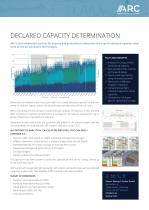
Airport Research Center DECLARED CAPACITY DETERMINATION ARC is the independent partner for airports and authorities to determine the airport’s declared capacity using state-of-the-art simulation technologies. Every slot-coordinated airport has to provide the so-called ‘declared capacity’ for the next winter or summer season, before the slot allocation process with airlines can start. Analysis of runway, airfield and terminal capacity Best possible traffic volumes and reduced delays Future proof approach by using simulation software Elaboration of effective mitigation measures Comprehensive flight...
Open the catalog to page 16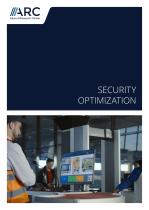
Airport Research Center SECURITY OPTIMIZATION
Open the catalog to page 17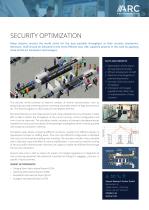
Airport Research Center SECURITY OPTIMIZATION Many airports around the world strive for the best possible throughput at their security checkpoint. Moreover, staff should be allocated in the most efficient way. ARC supports airports in this task by applying state-of-the-art simulation technologies. FACTS AND BENEFITS Optimization of lane layout and operational concept Efficient employment of staff Detection and mitigation of potential bottlenecks Increase of security control throughput Anticipation of changed regulations like LAGs rules or implementation of body scanners The security control process...
Open the catalog to page 18All ARC (Airport Research Center) - CAST catalogs and technical brochures


- Airport aeronautic software
- Real-time software
- Airport airport software
- Process software
- 3D software
- Cloud-based software
- Navigation software
- Test software
- 2D software
- Web-based software
- Automated software
- Data acquisition software
- Passenger management software
- Smartphone software
- Flight planning software
- Tablet computer software
- Airport Windows software
- AODB software
- SaaS software
- GSE software