
- Catalogs
- ANSYS FRANCE SAS
- ADVANTAGE ISSUE 3/2022

ADVANTAGE ISSUE 3/2022

ADVANTAGE ISSUE 3/2022
Ansys Advantage Issue 3 of 2022 highlights the integration of Ansys products, services, and partner ecosystems to tackle complex engineering challenges. It underscores the role of simulation in advancing product design and development, emphasizing Ansys' contribution to innovation across various industries.
MBSE replaces traditional documents with digital models encapsulating system requirements, architecture, and interfaces, enhancing communication and decision-making throughout the product lifecycle. Ansys ModelCenter connects engineering analysis software to systems architecture, supporting this approach.
MBSE improves the safety and cybersecurity of autonomous vehicles. A case study on Hitachi Industry & Control Solutions Ltd. illustrates the establishment of an MBSE Design Lab to balance functional safety and cybersecurity.
Digital modeling, simulation, and analysis are used to incorporate operational environments and evaluate mission outcomes, crucial for informed engineering and planning decisions early in the product lifecycle.
PyAnsys integrates Ansys simulations into Python-based products, expanding the accessibility and application of Ansys technologies.
Ansys Gateway powered by AWS offers customizable cloud configurations to enhance collaboration among engineers, providing scalable access to Ansys simulation tools.
Digital twins, facilitated by AWS IoT TwinMaker and Ansys Twin Builder, enable the creation of predictive and "living" models that drive greater industrial autonomy.
Microsoft's use of machine teaching with digital twins showcases how AI can advise human operators on decision-making processes.
Professor Bert Blocken's team uses CFD to model Covid-19 aerosol flow in stadiums, demonstrating the application of cloud-based simulation in public health.
Ansys optiSLang optimizes design efforts by factoring in uncertainties and tolerance variations, ensuring optimal configurations for designs.
Ansys' ecosystem of over 350 technology partners and global channel partners is crucial for delivering simulation solutions and fostering innovation.
Combitech's use of Ansys Additive Suite to verify selective laser melting in manufacturing small cooling channels illustrates the role of simulation in sustainable practices.
The issue underscores the transformative power of simulation in engineering, emphasizing its role in digital transformation and innovation across industries.
MBSE is a methodology that replaces traditional document-based systems engineering with digital models, ensuring consistency and coordination throughout a system's lifecycle. It addresses issues such as document upkeep, human interpretation errors, and verifiability of system requirements.
1. System Architect Model (SAM): Represents the system's architecture and requirements using connected block diagrams.
2. Engineering Simulation Software: Used to verify if the system meets its requirements through various simulations.
3. Centralized Computation Center: Stores and executes all MBSE processes and results.
Ansys software supports MBSE by providing simulation tools that connect with the SAM. Ansys ModelCenter integrates these simulations, allowing for virtual verification of designs.
MBSE facilitates early problem identification, reducing costs and improving decision-making throughout the design lifecycle.
MBSE has been adopted in various sectors, notably by the U.S. Department of Defense and the automotive industry.
Hitachi has transitioned to MBSE to manage the development of complex automotive systems, utilizing Ansys tools to integrate safety and cybersecurity analyses.
MBSE represents a significant shift in systems engineering, offering a structured approach to managing complex systems across various industries.
MBSE is introduced as a method to manage complex systems by creating a system model that expresses the relationship between multifaceted requirements and functions.
Hitachi Industry & Control Solutions has developed an MBSE framework based on three axes: How to Proceed, How to Model, and How to Think.
MBSE facilitates frequent analysis and simulation in early product development stages, allowing for requirement confirmation and design alternative reviews before prototype investments.
Digital mission engineering involves using digital modeling, physics-based simulation, and analysis to evaluate mission outcomes and effectiveness throughout the lifecycle.
Digital mission engineering increases efficiency and reduces costs from product design through operations.
Digital mission engineering involves using simulations to gain insights without performing real-world tasks.
Simulation tasks are becoming more automated with tools like PyAnsys, which integrates Ansys-based simulations into Python projects.
Python's popularity and extensive libraries make it ideal for integrating with Ansys products.
Companies like Bewind GmbH use PyAnsys to automate workflows, improving accuracy and efficiency.
Ansys Gateway, powered by AWS, offers a scalable cloud solution for deploying Ansys applications.
PyAnsys and Ansys Gateway powered by AWS represent significant advancements in simulation technology.
Ansys Gateway powered by AWS is designed to enhance customer experience by providing a secure, reliable, and customizable remote simulation processing environment.
The performance of Ansys Gateway powered by AWS has been validated by demanding customers like Emirates Team New Zealand.
Ansys and AWS are collaborating to advance digital twin technology, which is crucial for industrial autonomy.
Ansys Twin Builder allows engineers to create physics-based digital twins with hybrid analytics.
By integrating Ansys Twin Builder with AWS IoT TwinMaker, organizations can maximize their simulation investments.
This document discusses the integration of AI and digital twins in industrial automation, focusing on the collaboration between Microsoft and Ansys Twin Builder.
Machine learning traditionally relies on large datasets for pattern recognition, while machine teaching mimics human learning by breaking down processes into smaller tasks.
Digital twins simulate physical processes, generating data for AI training more efficiently than physical machines.
Engineers use Ansys Twin Builder to create system-level models combining various modeling techniques.
The document illustrates the use of digital twins in a cabin pressure control system (CPCS) for aircraft.
The document also covers the use of computational fluid dynamics (CFD) simulations to study COVID-19 aerosol flow in stadiums.
The integration of digital twins and AI represents a significant advancement in industrial automation.
Professor Bert Blocken and his team used CFD simulations to study aerosol dispersion in the Johan Cruijff ArenA.
Ansys optiSLang is a PIDO solution that integrates robust design optimization algorithms into Ansys Workbench and AEDT.
Ansys emphasizes an open ecosystem through its Technology Partner Program, which includes over 350 partners.
Electromagnetic interference (EMI) is a significant challenge in the electronics industry.
Ansys and NVIDIA have partnered to optimize simulation performance using NVIDIA's GPUs.
In collaboration with Microsoft, Ansys Cloud Direct allows IC designers to perform high-fidelity simulations of RFIC designs.
Ansys and NI have partnered to enhance design accuracy through joint solutions.
STK provides a comprehensive simulation platform for mission planning.
NI's validation solutions, combined with Ansys' simulation tools, enable the exploration of unprecedented scenarios.
Channel partners play a crucial role in ensuring customer success and sustainable growth for Ansys.
Channel partners significantly bolster Ansys's presence globally.
As Ansys's product portfolio grows, some channel partners have specialized in high-demand products.
Ansys has a long history of working with channel partners, some relationships spanning over 30 years.
The integration of digital technologies in vehicles is transforming the driving experience.
High-speed signals in infotainment systems pose measurement challenges.
Looking ahead, the integration of in-vehicle functionalities is expected to deepen.
Signal integrity (SI) is crucial in automotive cockpits.
Additive manufacturing (AM) is a key trend in sustainable manufacturing.
Combitech uses Ansys software to simulate production processes.
Vinnova's SIP Production2030 program supports projects like Combitech's to enhance sustainability in manufacturing.
Nature Architects uses metamaterials to incorporate advanced physical functions into products.
The document discusses the innovative use of integrated plastic honeycomb structures in product design.
Nature Architects utilizes DFM (Design for Manufacturing) technology and advanced simulations through the Ansys Startup Program.
The engineering plastic plate features a perforated structure that conforms to the human body.
DFM technology enhances traditional functional modeling by generating metamaterial structures.
Nature Architects provides metamaterials and DFM solutions to manufacturers.
Metamaterials are crucial to DFM solutions, offering properties tailored to specific applications.
Nature Architects leverages conventional manufacturing methods and Ansys simulations to innovate product designs.
Catalog excerpts

EXCELLENCE IN ENGINEERING SIMULATION 6 Model-Based Systems Engineering Explained PyAnsys: Tap into Ansys Simulation with Python Introducing Ansys Gateway Powered by AWS Ansys Advantage
Open the catalog to page 1
COMPLETE SIMULATION’S NEW MISSION MBSE ENHANCES THE SAFETY AND CYBERSECURITY OF AUTONOMOUS VEHICLES ACCESS THE POWER OF ANSYS WITH PYTHON Discover how Ansys’ integrated products, services, and partner ecosystem make it easier to connect your digital thread to meet the complex engineering challenges that will advance society as a whole. SYSTEMS ENGINEERING MODEL-BASED SYSTEMS ENGINEERING EXPLAINED Learn how MBSE enables you to replace static documents with “intelligent” digital models that contain everything important about the system — the requirements, architecture, and interfaces between system...
Open the catalog to page 2
TEACHING ‘BRAINS’ USING DIGITAL TWINS A LINK AROUND THE WORLD ARTIFICIAL INTELLIGENCE See how Microsoft is using machine teaching, not machine learning, to train “brains” that can be used to advise a human operator on the best decision to make. SIMULATION PREDICTS COVID-19 AEROSOL FLOW IN STADIUMS Follow Professor Bert Blocken’s team as they use CFD to understand how Covidcontaining aerosols travel throughout crowded stadiums, leading to a predictive model that could minimize future stadium closures. ROBUST DESIGN OPTIMIZATION OPTIMIZE DESIGN OPTIMIZATION EFFORTS Learn how Ansys optiSLang factors...
Open the catalog to page 3
Complete Simulation’s New Mission By Jane Trenaman, Senior Director, Product Management, Ansys When Ansys began, more than 50 years ago, our goal was to help you use structural simulation to verify physical tests. Over the years, simulation came to be defined by the physics challenges being solved — structural, thermal, fluidic, optical, electromagnetic – and the Ansys product portfolio expanded, incorporating bestin-class physics simulation capabilities across a broad spectrum of engineering disciplines. Our goal was to help you answer the engineering challenges you faced. Today, our goal is...
Open the catalog to page 4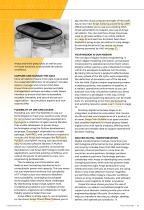
tap into the cloud compute strength of Microsoft Azure. Our new Ansys Gateway powered by AWS offering enables you to use your existing AWS cloud subscription to support your use of Ansys simulation. You can read how Ansys Cloud was used to simulate airflow in an entire stadium on page 34 and see how Emirates Team New Zealand is using Ansys simulation to help design its winning America’s Cup yachts via Ansys Gateway powered by AWS on page 22. Ansys and third-party tools, as well as your in-house solutions, to automate simulation workflows. CAPTURE AND MANAGE THE DATA More simulation means more...
Open the catalog to page 5
MODEL-BASED SYSTEMS ENGINEERING EXPLAINED By Tim Palucka, Managing Editor, Ansys Advantage Model-based systems engineering (MBSE) is a methodology that focuses on creating and exploiting digital system and engineering domain models as the primary means of exchange of information, feedback, and requirements, rather than relying on documents. It involves the entire process of capturing, communicating, and making sure all the digital models we use to represent a system are coordinated and maintained throughout the entire life cycle of the system. Ansys Advantage Ansys Advantage
Open the catalog to page 6
and integrating the simulation into this “Automating allows the team to rapidly identify potential system model issues with changes to mission requirements ... The overall improvement versus the original process was about a 7X speedup in turnaround time. — Phathom Atena Donald, Systems Engineer, Lockheed Martin Space rior to about 2010, a system engineering design was likely to be a bunch of related papers and documents containing drawings, diagrams, mathematical formulas, requirements, and other specifications for how the system would work. But around that time, projects became too large to...
Open the catalog to page 7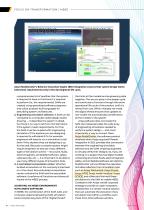
Ansys ModelCenter’s Behavior Execution Engine (BEE) integration ensures that system design meets behavioral requirements early in the development life cycle. comprehensive list of qualities that the system is required to have or functions it is required to perform (i.e., the requirements). SAMs are created using specialized software programs and utilize purpose-built languages for describing system architectures. 2. Engineering simulation software. A SAM can be compared to a computer-aided design (CAD) drawing — it describes the system in detail, but there is no way to tell from the SAM alone...
Open the catalog to page 8
As the design cycle progresses and the product design is refined, engineers can use Ansys MBSE technology to assess whether the as-designed system meets the specified requirements, or whether changes have to be made. When changes are made to the requirements or the SAM, the entire procedure can repeat until results satisfy specifications, verifying that the design will work as intended throughout the product’s lifetime. Only after these requirements have been satisfied will the team build a physical prototype of the design to perform physical tests on it. The value of MBSE is that it enables...
Open the catalog to page 9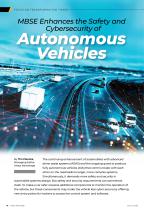
MBSE Enhances the Safety and Cybersecurity of Autonomous Vehicles By Tim Palucka, Managing Editor, Ansys Advantage The continuing enhancement of automobiles with advanced driver assist systems (ADAS) and the ongoing quest to produce fully autonomous vehicles (AVs) that communicate with each other on the road leads to larger, more complex systems. Simultaneously, it demands more safety and security in automobile systems design. But safety and security requirements can sometimes clash. To make a car safer requires additional components to monitor the operation of the vehicle, but these components...
Open the catalog to page 10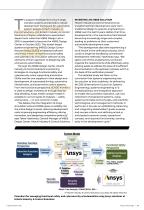
o support development of such large, complex systems and provide a robust development framework for automotive system designs, Hitachi Industry & Control Solutions, Ltd. (Hitachi Industry & Control Solutions) of Japan established a specialized department called the MBSE Design Lab in 2019. It expanded to become the MBSE Design Center in October 2022. This model-based systems engineering (MBSE) Design Center features Ansys SCADE embedded software and Ansys medini analyze functional safety and cybersecurity simulation software as key elements of their approach to designing safe and secure automobiles....
Open the catalog to page 11