
- Catalogs
- Airelectronics
- U-Pilot & U-Pilot OEM Specification


U-Pilot & U-Pilot OEM Specification

1 / 1 PageView full catalog
U-Pilot & U-Pilot OEM Specification
Product catalog summary
Flight Control System Overview
This document outlines the specifications and capabilities of a comprehensive flight control system designed for various aerial platforms, including fixed-wing, helicopter, and multicopter configurations.
This document outlines the specifications and capabilities of a comprehensive flight control system designed for various aerial platforms, including fixed-wing, helicopter, and multicopter configurations.
Control and Navigation
- Flight Control: Fully 3D three-axis control with an attitude estimation and control update rate of 1000Hz.
- Flight Plan: Supports up to 200 waypoints.
- Speed Control: Features auto-throttle for all vehicle types.
- Airfield Operations: Capable of automatic take-off and landing.
Mechanical Specifications
- Standard Dimensions: 89x35x155 mm, weight 280 g.
- OEM Dimensions: 58x21x138 mm, weight 77 g.
- Connectors: Various connectors including Glenair GMR7590-51P Micro-D, SMA, and MMCX.
Electrical Specifications
- Supply Voltage: 6V – 28V, with potential to reach 36V.
- Power Consumption: 4 W.
- Temperature Range: Maximum -30°C to +85°C, recommended +10°C to +60°C.
GPS and Sensor Suite
- GPS Channels: 12 channels with global coverage and optional differential navigation.
- Sensors: Includes a 3-axis accelerometer, 3-axis gyroscope, and optional triple sensor suite.
Interface and Telemetry
- Outputs: 31 PWM/GPIO outputs with configurable rates.
- RS-232 Ports: 4 compliant ports with rates from 9600 to 115200 bps.
- Telemetry Frequency: Options include 370MHz, 900MHz, 1.4GHz, and 2.4GHz, with a range up to 100 km.
Air Data System
- Dynamic Pressure Sensor Range: 0 – 200 km/h, with other ranges available.
- Static Pressure Options: Low altitude (0-2000 m) and high altitude (0-4000 m).
Hardware Architecture
- Technology: Based on Altera® FPGA technology with dedicated hardware access to peripherals.
- CPUs: Two NIOS II soft-cores at 75MHz, handling flight computer, state estimation, control loops, mission control, payload, and communication.
See more
Catalog excerpts
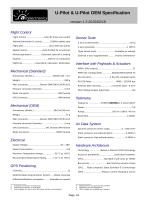
Sensor Suite Mechanical (Standard) Hardware Architecure Excluding connectors in front panel. Excluding connectors in front panel. Input voltage can reach up to 36V under certain circumstances. Magnetometer occupies one RS-232 Port. Depending on local legislation Other ranges are available upon reques
Open the catalog to page 1All Airelectronics catalogs and technical brochures
 superskywalker_brochure
5 Pages
 Skywalker Kit
5 Pages
 Octocopter
3 Pages
 Shepherd
5 Pages
 Benzine with U-Camera
3 Pages
 Benzine
3 Pages
 Skywalker Observation
5 Pages
 Skywalker Remote Sensing
5 Pages
 Skywalker
5 Pages
 Super Skywalke
5 Pages
 U-Station Specification
1 Page
 U-Camera
3 Pages

Related Searches
*Prices are pre-tax. They exclude delivery charges and customs duties and do not include additional charges for installation or activation options. Prices are indicative only and may vary by country, with changes to the cost of raw materials and exchange rates.
About AeroExpo
AeroExpo is a marketplace that offers B2B players a complete experience, from product sourcing to purchase. AeroExpo is an entity of VirtualExpo Group.
Are you a buyer?
Are you a supplier?