
- Catalogs
- Aeroplanes DAR
- DAR-Solo series


DAR-Solo series

DAR-Solo series
This manual is for pilots and maintenance personnel of the DAR-Solo series aircraft, equipped with either a Hirth F-33 BS or Polini Thor 250 DS engine. It includes aerodynamic characteristics and operational guidelines.
Limitations and Safety Information
The DAR Solo is categorized under LTF-UL and is suitable for normal flying maneuvers, stalls (excluding whip stalls), and certain turns with a bank angle not exceeding 60 degrees. Key speed limitations include VS1 = 55 km/h, VNE = 150 km/h, and VA = 109 km/h. The maximum takeoff weight (MTOW) is 260 kg, with a load limitation of +4/-2. Safety precautions emphasize preflight inspections and avoiding flight under the influence of substances.
Ignition and Engine Warm-Up
Before ignition, ensure wheel chocks are in place and a fire extinguisher is available. The engine should be warmed up to 4500-5000 RPM until the cylinder head temperature (CHT) reaches 180°C. Smoothly increase RPM to 7500, ensuring CHT stays below 280°C.
Taxiing
Begin taxiing with neutral pedals, increasing engine RPM to 5000. Maintain a taxi speed of 5-7 km/h, controlling speed with engine RPM and brakes. Avoid sharp turns.
Flight Procedures
Take Off: Align on the runway centerline, set flaps to 11°, and smoothly increase throttle to maximum. Lift off at 55-60 km/h and climb at 2-2.5 m/s.
Horizontal Flight: Maintain 6800 RPM and a cruise speed of 90-100 km/h. Turns should not exceed a 30° bank.
Landing Approach: Reduce speed to 70 km/h at 150 m height, lower flaps to 11°, and maintain a vertical speed of 1.0-1.5 m/s.
Landing: Level the aircraft at 0.5-1 m above the runway, touching down at 55 km/h.
Common Mistakes
During takeoff, abort if direction is lost beyond 15° or if speed is insufficient. During landing, ensure stable speed and angle, and avoid adjusting height by moving the stick excessively.
Probable Special Cases
In case of engine failure during takeoff or flight, follow specific procedures to land safely, avoiding sharp turns and maintaining control.
Exploitation Limits
Details on stall speeds, vertical speeds, and minimal/maximal speeds in various configurations are provided. The practical ceiling is 3200 m with a standard configuration.
Notes
Additional operational notes and reminders are included to ensure safe and efficient use of the DAR-Solo aircraft.
Catalog excerpts

Aeroplanes DAR ltd. Brief Flight Manual DAR – Solo BRIEF FLIGHT MANUAL DAR-Solo series
Open the catalog to page 1
Aeroplanes DAR ltd. Brief Flight Manual DAR – Solo TABLE OF CONTENTS Introduction Limitations and Safety Information General View of DAR-Solo series Horizontal flight Landing Approach Common Mistakes Probable Special Cases Random increase in Propeller RPM Exploitation Limits
Open the catalog to page 2
Aeroplanes DAR ltd. Brief Flight Manual DAR – Solo Introduction This Manual is intended for everyone who flies and maintains the DAR-Solo series airplane with one of the offered engines: Hirth F-33 BS (28 HP) - single cylinder, two-stroke engine, aircooled or Polini Thor 250 DS (36HP) - single cylinder, two-stroke engine, water cooled The Manual contains graphics aerodynamic characteristics of the DAR – Solo airplane with described standard engines.
Open the catalog to page 3
Aeroplanes DAR ltd. Brief Flight Manual DAR – Solo LIMITATIONS AND SAFETY INFORMATION Limitations DAR Solo is an aircraft that falls in the LTF-UL Category. It is designed to be used for any maneuvers as: Normal flying maneuvers; Stalls (except whip stalls); and Lazy eights, chandelles, and steep turns, in which the angle of bank is not more than 60 degrees. The following limitations are imposed on the speeds and loading of the airplane: VS1 = 55 km/h VSF = 51 km/h VNE = 150 km/h VA=109 km/h VF = 92 km/h VFE=83 km/h Max Wind Limits = 5 m/s Engine Limitation = no negative loads more 3 sec...
Open the catalog to page 4
Aeroplanes DAR ltd. Brief Flight Manual DAR – Solo Empty CG = 44,5% MTOW CG = 33% DO NOT FLY WITHOUT INSTALLED WING CENTRAL SECTION FAIRING! Do not overload the Airplane. The Max Gross Weight should not exceed 260 kg. Safety For your safety read this manual thoroughly and make sure you understand the capabilities and limitations of the airplane. If you have any additional questions contact the manufacturer before operating the machine. Never fly when you don’t feel prepared for the conditions of the flight! Never fly under influence of alcohol or drugs! Never fly if you have not performed...
Open the catalog to page 5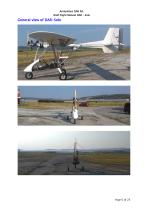
Aeroplanes DAR ltd. Brief Flight Manual DAR – Solo General view of DAR-Solo
Open the catalog to page 6
Aeroplanes DAR ltd. Brief Flight Manual DAR – Solo IGNITION Before ignition you have to do the following: - put the wheel chocks under the wheels; - check the availability of a fire extinguisher; - in start-up with an electrical starter (autonomous) the procedure must be done at the command “Clear Propeller”. You must not push the START ignition button if you do not receive the “Clear” answer from the start-up supervisor! - put the levers at min (at a temperature less than 10°C – at the support of the installed stop). Open (pull out) the mixture control (suction ducts). - push the START button...
Open the catalog to page 7
Aeroplanes DAR ltd. Brief Flight Manual DAR – Solo ENGINE WARM UP When you reach CHT=180°C of CHT increase revolutions to n=5000 rev/min. The increase of revolutions has to be done smoothly, without interruption. After running at these rpm-s for 10 seconds, the lever have to be drawn backwards smoothly till a support end (lever to min) is reached, the rpm fall has to be monitored until they reach the minimal n operation must be done smoothly but in a slower than that of the lever motion. That is the normal way to do it having in mind the fixed pitch propeller and the two-stroke engine. After...
Open the catalog to page 8
Aeroplanes DAR ltd. Brief Flight Manual DAR – Solo nmax=7500(+/-100) rev/min. CHT must stay below 280°C. In 5 seconds draw in the lever to their minimum. In case of unusual engine run (vibrations, interruptions, etc.), draw the lever in to their minimum and turn off ignition using the main switch. TAXIING You have to start taxiing with pedals in neutral position. Then increase engine revolutions smoothly to 5000 rev/min and ease off the brakes. Taxing must be done at a speed of 5-7 кm/h and engine revolutions of 5500-6000 rev/min. The taxiing speed has to be controlled by changing the revolutions...
Open the catalog to page 9
Aeroplanes DAR ltd. Brief Flight Manual DAR – Solo FLIGHT Take Off Start taxiing to the runway and stop on the center line. Apply the brake. Set the flaps to 11°. Look around the cockpit from left to right. Check the instruments. Smoothly push the throttle to maximum position. Wait untill the engine reaches maximum RPM, be sure it works well and ease off the brakes. In the first part of the take off run keep the heading by using the pedals. CAUTION! Do not use brake during take off! When the speed increases above 20-25 km/h, the airplane starts to “obey” the rudder, too. Motion with pedals has...
Open the catalog to page 10
Aeroplanes DAR ltd. Brief Flight Manual DAR – Solo Upon reaching the speed of V=60-65 km/h smoothly proceed to climbing at a speed of Vy=2-2.5 m/s. At a H=50m decrease vertical speed to 0.5-1.0m/s and retract the flaps. HORIZONTAL FLIGHT Reduce the RPM-s down to 6800 and continue climbing at a speed of V=80-85 km/h and Vy=1.0m/s. Turns along the pattern are done with banks of up to 30°, decreasing the vertical speed to Vy=0.5-1.0 m/s and applying power to increase the RPM by 500 before each turn. In flight the RPM-s keeps 6800. A speed of horizontal flight. The maximal airspeed under turbulent...
Open the catalog to page 11
Aeroplanes DAR ltd. Brief Flight Manual DAR – Solo LANDING APPROACH Upon flying over the traverse in the beginning of the runway mark the time. After 20-25 s decrease the airspeed to V=70 km/h, at a height of H=150 m start the third turn with a maximum bank of 30° and a plan to complete the turn at a height of H=120 m. After leaving the turn set an airspeed of V=65(70) km/h and vertical speed of Vy=1.0-1.5 m/s; lower the flaps to 11°. After 12-15 s (visual, watching closely runway approach) start the fourth turn at a height of Н=80m, a speed of V=65(70) km/h and a bank of up to 30° with a plan...
Open the catalog to page 12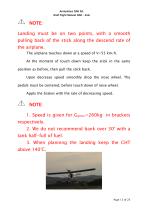
Aeroplanes DAR ltd. Brief Flight Manual DAR – Solo NOTE: Landing must be on two points, with a smooth pulling back of the stick along the descend rate of the airplane. The airplane touches down at a speed of V=55 km/h. At the moment of touch down keep the stick in the same position as before, then pull the stick back. Upon decrease speed smoothly drop the nose wheel. The pedals must be centered, before touch down of nose wheel. Apply the brakes with the rate of decreasing speed. NOTE: 1. Speed is given for Ggross=260kg in brackets respectively. 2. We do not recommend bank over 30° with a tank...
Open the catalog to page 13All Aeroplanes DAR catalogs and technical brochures
 DAR Solo UL
2 Pages
 DAR 23
1 Page