
- Catalogs
- AERODATA AG
- Transponder Pulse Decoder System

Transponder Pulse Decoder System

Transponder Pulse Decoder System
The Transponder Pulse Decoder System (AD-TPDS) is designed for real-time processing of Secondary Surveillance Radar (SSR) interrogation impulses and Mode S information for flight inspection purposes. It enables SSR inspections without ground support by filtering SSR using its Mode S P6 Uplink Format 11 (UF11) identification number. The system comprises a Transponder Pulse Decoder Box (AD-TPDB) and full AD-AFIS software integration, verifying radar interrogations by measuring impulse spacings, widths, and amplitudes, and calculating field strengths and hit rates for all SSR interrogation types.
- Article 6.1: Ensures a sufficient number of valid SSR interrogations with adequate signal energy on the 1030 MHz uplink band. Compliance is checked by measuring field strength and hit-rate parameters, with the system displaying and recording all valid interrogation impulses.
- Article 6.2: Ensures airborne transponders do not excessively reply to ground-based interrogations. Compliance is checked by analyzing reply data sets in relation to interrogation data sets, allowing for deep analysis of false or excessive replies.
- Article 6.3: Detects interferences from ground-based transmitters on the 1030 MHz band. Compliance is checked by identifying "Jam" impulses that do not belong to an interrogation, indicating potential interference.
The AD-TPDB is a rack-mountable unit with components including a 1030 MHz receiver, DPSK demodulator for UF11 filtering, analog digital converter, processing circuitry (FPGA), memory, serial interfaces, and an Ethernet interface for impulse data transmission. The system is fully integrated into AeroFIS® software, allowing for radar inspections using UF11 database entries and providing graphics and data recording for replay analysis.
Every AeroFIS® can be upgraded to include the AD-TPDS option, with the processing hardware available in a compact form factor to fit into available rack space.
The dimensions of the AD-TPDB case are 105 mm x 65 mm x 225 mm, and it weighs 1.3 kg.
Catalog excerpts
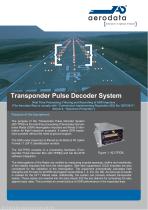
Transponder Pulse Decoder System Real Time Processing, Filtering and Recording of SSR Impulses (The Aerodata Way to comply with “Commission Implementing Regulation (EU) No 1207/2011”, Article 6, “Spectrum Protection”) Purpose of the Equipment: The purpose of the Transponder Pulse Decoder System (AD-TPDS) is the real-time processing of Secondary Surveillance Radar (SSR) interrogation impulses and Mode S information for flight inspection purposes. It makes SSR inspections possible without the need of ground support. The SSR under inspection is filtered by its Mode S P6 Uplink Format 11 (UF11) identification number. The AD-TPDS consists of a processing hardware (Transponder Pulse Decoder Box (AD-TPDB)) and full AD-AFIS software integration. The interrogations of the Radar are verified by measuring impulse spacings, widths and amplitudes of the related impulses that form the interrogation. Side lobe suppression (SLS) impulses are also considered for the validation of the interrogation. The equipment automatically calculates field strengths and hit rates for all SSR interrogation types (Mode 1, 2, 3/A, S4, S6). An extra set of results is created for the UF11 filtered radar. Additionally, the system can process onboard transponder replies. Those replies are inserted into the data stream that the box delivers for comparing hit rates against reply rates. This provides an overall picture of SSR performance in the inspected
Open the catalog to page 1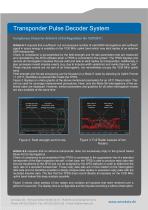
Transponder Pulse Decoder System Compliance Check for Article 6 of EU Regulation No 1207/2011: Article 6.1 requests that a sufficient, but not excessive number of valid SSR interrogations with sufficient signal in space energy is available on the 1030 MHz uplink band which may elicit replies of an airborne SSR transponder. Check of compliance is accomplished by the field-strength and hit-rate parameters that are measured and calculated by the AFIS software when a TPDS is connected to the system. The TPDS displays and records all interrogation impulses that are valid and able to elicit replies...
Open the catalog to page 2
Transponder Pulse Decoder System Article 6.3 requests the possibility to detect interferences of ground-based transmitters on the 1030 MHz band. Check of compliance is accomplished by the fact that the TPDS provides the impulse type "Jam” for all impulses (or other events) that are present on the 1030 MHz band but not belonging to an interrogation. If the display shown in Figure 3 does show excessive Jam impulses in the main lobe of the radar and less valid interrogation impulses then one could interpret this as the presence of interference. Additionally, the hit-rate number would degrade to...
Open the catalog to page 3
Transponder Pulse Decoder System Dimensions and Weight Dimensions of AD-TPDB case (W x H x D) AD-TPDS: “Electrocardiogram for your Radar” We keep you on the best path! Aerodata AG ∙ Hermann-Blenk-Straße 34-36 ∙ 38108 Braunschweig/Germany Phone +49 531/2359-0 ∙ Fax: +49 531/2359-158 ∙ E-Mail: [email protected]
Open the catalog to page 4All AERODATA AG catalogs and technical brochures
 RNAV FI System AD-RNAV
4 Pages
 AeroFIS®
8 Pages
 RNAV FI System AD-RNAV
4 Pages
 PRICE LIST 2017
8 Pages
 VIS Line Scanner
2 Pages


- Inspection machine
- Inspection machine for the aeronautical industry
- Laser scanner
- Aircraft camera
- Aeronautic laser scanner
- Aircraft radar
- Airborne radar
- Flight management system
- Aircraft flight management system
- Optical inspection machine
- Contact laser scanner
- Radio direction finder
- Digital radio direction finder
- Aircraft radio direction finder
- Aircraft engine inspection machine