
- Catalogs
- ADVANCE Thun AG
- LIGHTNESS 3


LIGHTNESS 3

LIGHTNESS 3
Introduction
The manual introduces the LIGHTNESS 3 harness by ADVANCE, highlighting its quality and the importance of reading the manual for safety, care, and maintenance. Users are encouraged to register their product online for updates and support.
About ADVANCE
ADVANCE is a renowned paragliding manufacturer from Switzerland, known for quality products and innovative designs. The company focuses on customer support and continuous improvement through feedback.
LIGHTNESS 3 Overview
The LIGHTNESS 3 harness offers enhanced comfort and protection, with options for a standard or light speedbag and an optional windshield for long-distance flights. It features redesigned suspension for stability and a modular system for flexibility.
Features
The harness includes SAS-TEC back protection, ample storage, and various adjustment options for a customized fit. The LIGHTPACK 3 rucksack complements the harness with ergonomic design and multiple pockets.
Safety Advice
Paragliding requires proper training, equipment checks, and adherence to safety protocols. The harness is not suitable for free fall parachuting, and protectors only reduce impact severity. Pilots must assess weather conditions and ensure equipment readiness before flight.
Handling and Care
The LIGHTNESS 3 is lightweight and requires careful handling to prevent damage. Users should avoid dragging the harness and ensure proper use of zips and storage compartments.
Delivery and Setup
The product package includes the harness, speedbag, protectors, carabiners, and other components. Initial setup involves adjusting the harness for a personalized fit, with adjustments possible both on the ground and in flight.
Technical Data and Service
The manual provides technical specifications, material descriptions, and certification details. ADVANCE offers a service network for customer support and product registration for warranty coverage.
Adjustment Process
Ensure the back pocket is packed correctly for flight, including the reserve. Small adjustments can significantly affect harness fit, so make changes gradually and symmetrically to maintain straight flight.
Speedbag Size Selection
The speedbag material stretches, and most pilots use the size that matches their harness. However, pilots with atypical leg lengths may need a different size. If changing speedbags, use the correct length lines for the new bag. In height overlap areas, try both crossover sizes.
Basic Settings
Start with the harness and speedbag at their basic settings, indicated by grey sewing and black pen marks. Adjust from these standard measurements to find your ideal position.
Speedbag Adjustment
Correct speedbag length is crucial for setting the pilot's center of gravity. Adjust the heel position in small steps and ensure the underside of the speedbag is horizontal in flight.
Upper Body Angle
Adjust the back-recline angle with back straps and shoulder straps for desired support.
Fine Adjustments
Use lower back straps for lumbar support and thigh straps for leg support.
Chest Strap Adjustment
The chest strap affects pilot/glider agility. A wider setting increases agility, while a narrower setting provides a quieter feel. Adjust to personal comfort.
Mini Chest Strap
Holds shoulder straps in place during takeoff and landing.
Final Settings Check
Ensure the speedbag is horizontal and the seat does not press into the knees.
Speed System Setup
The speed system is pre-fitted. Adjust speed loop lengths to ensure full acceleration range without permanent acceleration.
Closing the Speedbag
Use the Closure Remember System for safety, ensuring all buckles and loops are closed before takeoff.
Cockpit and Instrument Panel
The cockpit includes a zip-closed pocket for batteries and a detachable panel for instruments. Secure electronic items with tape loops.
Optional Windshield
Reduces windchill and noise. Clip it to the harness and store it in the COMPRESSBAG after flight.
Additional Stowage
A 6-liter compartment under the seat is available for storage.
Sensible Details
Includes shoulder attachments for devices and a pocket for drink systems.
Relief Tube Routing
Provides a hygienic solution for long flights, with easy access and routing.
Step-in Aid
Facilitates entry into the speedbag after takeoff, especially for the Light speedbag.
Replacing Parts
The LIGHTNESS 3 components can be removed for repair or replacement. Safety considerations are advised against removing protective elements.
Foam Protector and SAS-TEC Back Protection
Instructions for removal and replacement, with caution about cold temperatures affecting SAS-TEC material.
Speedbag Replacement
Detailed steps for removing and fitting a new speedbag, emphasizing the use of original components for safety and functionality.
Carbon Seatboard and Speed Loop
Instructions for fitting and securing the footboard and speed loop, ensuring proper connections to avoid damage.
Installation and Safety Precautions
Ensure that speed and speedbag lines do not cross to avoid cutting. Use only original speed lines and loops to prevent damage to the speedbag and harness.
Installing the Reserve
Familiarize with the reserve/harness system, especially if new components are involved. The LIGHTNESS 3 reserve compartment is aerodynamically positioned near the pilot's center of gravity. Installation should be done by a skilled person, and a compatibility test is essential.
Reserve Specifications
Certified volumes for LIGHTNESS 3 vary by size: S (3-5.5 liters), M (3-6 liters), L (3-6.5 liters). A reserve's volume can expand by up to 30% after repacking, necessitating a new compatibility test.
Steerable Reserves
Can be connected using Maillons Rapide with a safe working load of 2400 daN. Compatibility tests are crucial to ensure proper function.
Inner Container Packing
Fold the reserve to fit the inner container, ensuring 90 cm of reserve line remains outside. Proper closure of the container is critical to prevent jamming.
Connecting the Reserve
Use a suitable quicklink of at least 2400 daN safe load. ADVANCE approves loop-in-loop connections with COMPANION reserves, provided safety measures are observed.
Compatibility Test
Conduct a test release in a flying position to ensure proper installation. The force required should be between 4 daN and 7 daN.
General Use and Adjustments
The LIGHTNESS 3 is designed for a reclining position, with weight distributed evenly for comfort. The EASY CONNECT system aids in safe clipping of the paraglider.
Takeoff and Landing
Check harness, helmet, lines, canopy, wind, and airspace before takeoff. Ensure chest strap is securely closed. For landing, exit the speedbag early and land upright.
Speedbag and Speed Loop Use
The speedbag closes automatically when legs are stretched. Use the speed loop for acceleration, ensuring lines are not too short.
Specifications and Usage
The LIGHTNESS 3 is a lightweight XC harness designed for paragliding. It lacks a separate water ballast compartment and is not suitable for school training, acro flying, or tandem flying. It is compatible with any glider and suitable for winching.
Flying with Ballast
Extra weight should be divided between the back pocket and underfloor stowage. For more weight, hang it from the carabiners.
Water Landings
Wearing a lifejacket is essential during SIV training. In case of water landing, unfasten the harness buckles immediately to avoid drowning.
Packing and Hiking
The LIGHTPACK 3 is designed to carry the paraglider, harness, and additional items. It is most comfortable when full and lightly tensioned. Use rubber tips for hiking poles to protect the backpack fabric.
Care and Maintenance
The harness should be checked annually for wear and damage. Avoid exposure to extreme temperatures, UV light, and saltwater. Clean with fresh water and neutral soap if necessary.
Certification and Repairs
The LIGHTNESS 3 is certified according to DIN EN-Norm 1651. Repairs should only be conducted by the manufacturer or an authorized service center.
Warranty
The ADVANCE warranty covers manufacturing defects for three years from the date of purchase. It does not cover damage from misuse or normal wear and tear.
Service Centers and Online Resources
ADVANCE operates service centers in Switzerland and France. The website offers product registration, warranty information, and additional resources.
Catalog excerpts
Contents Thank you for flying ADVANCE. . . . . . . . . . . . . . . . . . . . . . . . . . . . . . . . . 4 About ADVANCE. . . . . . . . . . . . . . . . . . . . . . . . . . . . . . . . . . . . . . . . . . . 5 LIGHTNESS 3 – Ready to Transit. . . . . . . . . . . . . . . . . . . . . . . . . . . . . . . 6 Features LIGHTNESS 3. . . . . . . . . . . . . . . . . . . . . . . . . . . . . . . . . . . . . . 7 Protectors at a glance . . . . . . . . . . . . . . . . . . . . . . . . . . . . . . . . . . . 9 Features LIGHTPACK 3. . . . . . . . . . . . . . . . . . . . . . . . . . . . . . . . . . . . . 10 Safety Advice....
Open the catalog to page 3
Thank you for flying ADVANCE Congratulations on your choice of an LIGHTNESS 3 – a quality product from ADVANCE. We hope that you will spend many rewarding hours in the air with it. This user manual is an important part of the harness. Here you will find instructions and important information about safety, care and maintenance, and that’s why we recommend that you read this document carefully before your first flight. Register your LIGHTNESS 3 online on www.advance.ch/warranty; you will then receive product updates or safety-related bulletins about the LIGHTNESS 3 direct from us. This information...
Open the catalog to page 4
About ADVANCE ADVANCE, based in Switzerland, is one of the world’s leading paraglider manufacturers. Since it was founded in 1988, the company has consistently pursued its own directions and concepts, both in development and production. The results are quality products with distinctive characteristics. Behind the ADVANCE brand name is a team of specialists who share the passion and trust in the company’s products. At home in the air themselves, they contribute their valuable personal experience and dedication to the working processes. Total control of the production process and supervision of...
Open the catalog to page 5
LIGHTNESS 3 – Ready to Transit The new LIGHTNESS 3 offers comprehensive comfort both in flight and handling, and there’s even more protection. A new choice of standard or light speedbag results in a wider range of uses; there’s also the option of a windshield, which significantly raises flying comfort on long distance flights.. All-embracing comfort Redesigned suspension and chest strap geometry distinguishes the LIGHTNESS 3 by its excellent comfort in flight – especially when accelerated – and high stability. The seat shell fits every pilot’s body perfectly, and protects it where necessary....
Open the catalog to page 6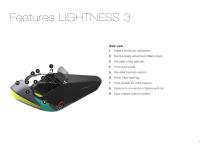
Features LIGHTNESS 3 Side view 1 Edelrid ALIAS alu carabiners 2 Recline angle adjustment (Back strap) 3 Shoulder strap adjuster 4 Drink tube guide 5 Shoulder harness velcros 6 Drink Tube opening 7 Inner pocket for drink system 8 Reserve V-connection channel with zip 9 Easy-release reserve system
Open the catalog to page 7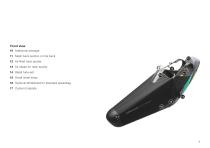
Front view 10 Additional stowage 11 Mesh back section on the back 12 Air-filled neck spoiler 13 Air intake for neck spoiler 14 Relief tube exit 15 Small chest strap 16 Optional Windshield for standard speedbag 17 Carbon footplate
Open the catalog to page 8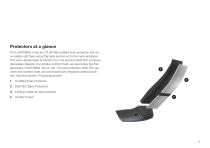
Protectors at a glance The LIGHTNESS 3 has an LTF (91/09) certified foam protector and visco-elastic soft foam along the back section up to the neck vertebrae. This visco-elastic back protection from the German SAS-TEC company attenuates impacts. Our familiar comfort foam, as used since the first generation LIGHTNESS, lies on top. The main protector, SAS-TEC element and comfort foam can be removed and replaced without problem. See also section “Exchanging parts” 1 Certified Foam Protector 2 SAS-TEC Back Protection 3 Folding crease for easy packing 4 Comfort Foam
Open the catalog to page 9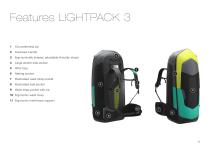
Features LIGHTPACK 3 1 Circumferential zip 2 Rucksack handle 3 Ergonomically shaped, adjustable shoulder straps 4 Large stretch side pocket 5 Wrist loop 6 Netting pocket 7 Elasticated waist strap pocket 8 Elasticated side pocket 9 Waist strap pocket with zip 10 Ergonomic waist strap 11 Ergonomic mesh back support
Open the catalog to page 10
Safety Advice Like all commercially available reserve parachutes, paraglider harnesses are never suitable for free fall parachuting because their design and construction details do not allow such a thing. Neither the reserve parachute nor its attachments to the harness can withstand the loadings involved in an abrupt opening. All harness adjustments should be made before the harness is flown. Correct adjustment of the LIGHTNESS 3 greatly contributes to safety, correct function and comfort in flight. No protector can provide total protection from injury. The EN/LTF certified foam protector only...
Open the catalog to page 11
Handle with Care ADVANCE LIGHTNESS 3 products are extremely lightly built and intended for specialised use. This puts particularly high demands on their handling and care. A committed interest in the products and their characteristics is essential. Because of the choice of materials and construction rucksack and harness are much more vulnerable to wear and tear from improper use than regular ADVANCE products. LIGHTNESS 3 products should never be dragged over the ground. All the zips are for light use only; they should never be closed under heavy loading. Pointed and sharp objects do not belong...
Open the catalog to page 12
Preparing the product Delivery Before delivery every ADVANCE product has to be checked by the dealer for delivery package contents and correct initial settings. A completed warranty form makes sure that deficiencies of the product, attributable to the manufacturer, are covered by the ADVANCE warranty (see under “Warranty” in the section” Service”). We ask you to complete this form on the ADVANCE website under “Warranty”, within 10 days of purchase. Delivery package LIGHTNESS 3 delivery includes § Harness with Standard or Light speedbag, incl. carbon footboard and integrated cockpit § Reserve...
Open the catalog to page 13
Harness adjustment General Individual LIGHTNESS 3 set up is easy, even though there are many adjustment possibilities. As is generally required for reclining harnesses, you should take some time over initial adjustments, and repeat and refine after flight – as necessary. Follow the following step-by-step instructions for a bespoke-fitting harness. They take into account all the important criteria such as upper body support, pressure distribution, speedbag length and the most efficient speedbag angle in flight. All the buckles can be adjusted in flight. All other (non-buckle) settings can only...
Open the catalog to page 14All ADVANCE Thun AG catalogs and technical brochures
 PIBI
PIBI4 Pages
 ADVANCE BIBETA 6
19 Pages
Archived catalogs
 IMPRESS 4
25 Pages
 PROGRESS 3
18 Pages
 PI 3
PI 315 Pages
 ALPHA 7
22 Pages
 ADVANCE SIGMA 10
17 Pages
 EPSILON 9
19 Pages
 PI3
PI319 Pages
 PROGRESS3
12 Pages
 XI
XI14 Pages
 SUCCESS 5
36 Pages
 AXESS 4
39 Pages
 EASINESS 3
43 Pages
 STRAPLESS 2
10 Pages
 BIPRO 3
37 Pages
 BIPAX
BIPAX2 Pages
 EPSILON 8
20 Pages
 ALPHA 6
18 Pages
- Sport paraglider
- Single place paraglider
- Performance paraglider
- Single place free flight harness
- Paragliding free flight harness
- Seated position free flight harness
- Free flight bag
- Mountain paraglider
- Paragliding free flight bag
- Intermediate paraglider
- Two place paraglider
- Light free flight bag
- Reversible harness bag
- Cocoon free flight harness